


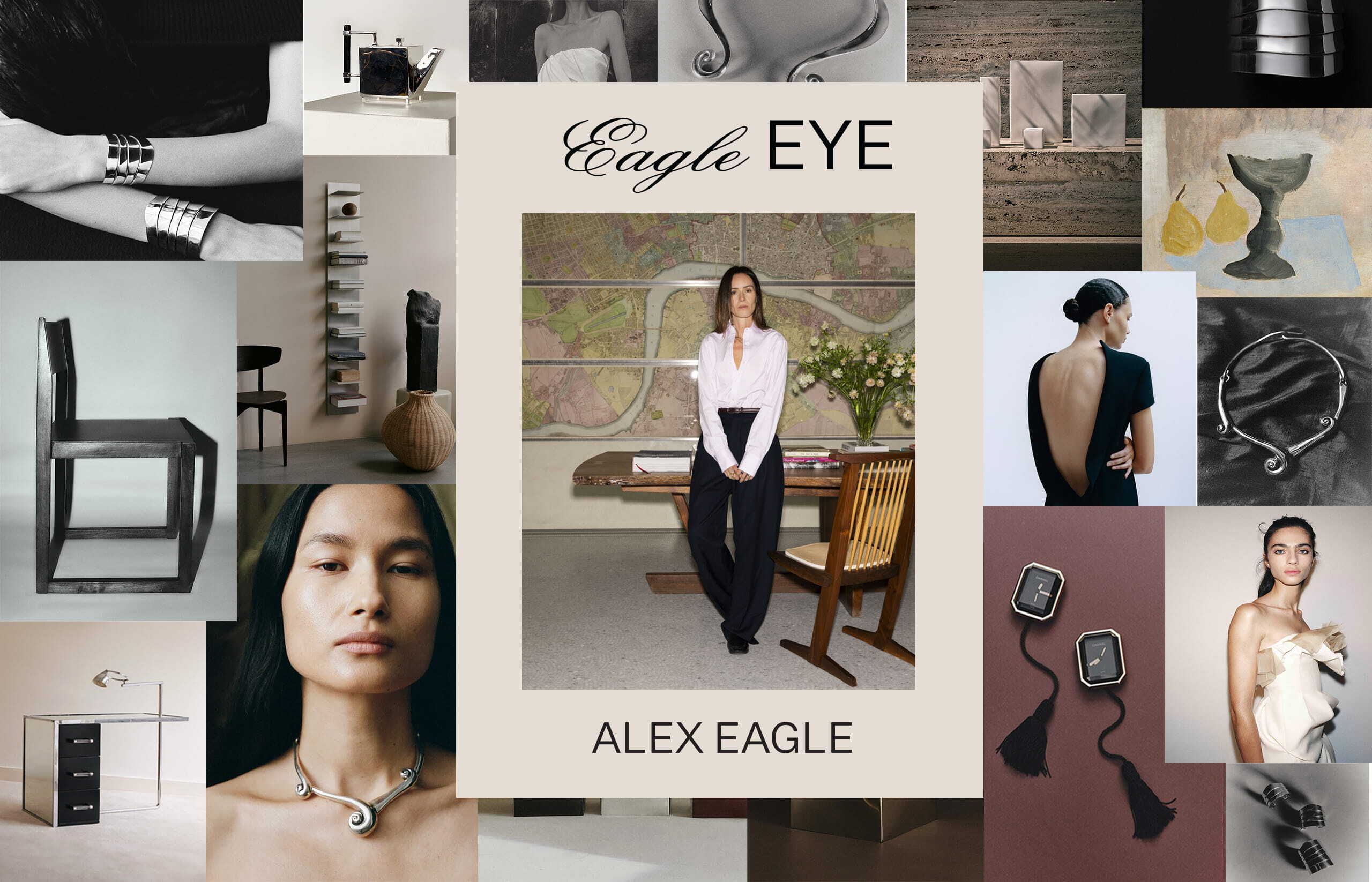
Eagle Eye exists to explain the gaps—between how we dress and how we live; between the spaces you’re drawn to and the coat you keep reaching for. Each month, London-based designer and creative director Alex Eagle will tap her roster of friends and experts to explore the “why” behind a certain theme—why we’re drawn to certain things, and how those instincts quietly form over years without us really noticing. It’s a column rooted in interior design, with many branches (and, of course, a curated edit of shoppable products to boot).
Style, for me, has never been just about clothes. It’s informed by everything else: the exhibitions we return to, the books left face-down on a table, the objects we choose to live with. A perfectly cut jacket can feel as considered as a piece of sculpture. A well-edited room can have the same clarity as a wardrobe that actually works. Once you start seeing those parallels, you can’t stop… which is either a gift or a mild affliction, depending on who’s asking. This column is a place for me to gather those references. Not in an academic way—rather, in a way you’d talk about them at dinner: slightly obsessively, to someone who gets it.
I chose modernism as a starting point because it has always felt less like a movement, and more of a foundation that has restructured the perspective of culture. It feels particularly poignant right now: We’re living in a world that is constantly moving—one that is loud and saturated. Modernism rejects that thinking. At its core, it’s about editing and removing everything until what’s left feels inevitable—not sparse, not cold, just right. The principles of modernism—honesty in materials, integrity in construction, a quiet focus on longevity—feel almost radical now, in a world of more, more, more, and then a bit more on top.
Alessi
Il Conico water kettle
It helps that the original modernists were genuinely, objectively chic: Le Corbusier with his austere clarity and disciplined way of living; Eileen Gray designing her own house and filling it with pieces she had made herself; Charlotte Perriand in her apartment, surrounded by her own furniture; Barbara Hepworth in her studio in St. Ives. Plenty of contemporary labels like The Row, Rier, and Auralee Tokyo also live by similar modernist principles.
Sophie Buhai
Spiral collar
At Salone del Mobile this year, there was a noticeable return to restraint, with a focus on material integrity: chrome, glass, and steel all appear in furniture, interiors, and increasingly, fashion—often left exposed to focus on the raw quality. Right now, I’m looking at designers like Christopher Dresser and his abstract work with the teapot. On an even smaller scale, Joseff Hoffmann’s cutlery is a great way to integrate modernism into your everyday, while architectural silver jewelry—like Sophie Buhai’s designs—revive 20th century modernism through wearable sculpture.
Christopher Dresser
teapot
Josef Hoffmann
135 silver-plated dessert cutlery
The beautiful thing about anchoring your taste to an art movement is that it reframes everything. You’re not a shopaholic. You’re a collector. You’re not swapping one white shirt for another one; you’re making a considered commitment to reduction and quality. Modernism is particularly useful for this because restraint is literally the whole point. (My therapist might see it differently. Then again, she is one of the chicest people I know.)
For me, modernism is also deeply personal. I have always wanted to build a space that values thoughtful accumulation, rather than sporadic change. Fewer, better things; objects and clothes that hold their own, that can be used, worn, lived with, over time. In fashion it’s the piece that makes no argument for itself and yet wins every time. In interiors, it’s space and light and the object that absolutely justifies being there.
These things are always more interesting as a conversation than a monologue. So I asked a few people whose eyes I trust—and whose answers I knew would be more interesting than my own—to weigh in on this month’s theme. Bettina Korek has run the Serpentine Galleries in London since 2020 with a kind of rigorous openness that I find genuinely rare; she thinks about culture the way the best designers think about space, which is to say that what you leave out matters as much as what you put in. Lily Atherton Hanbury, co-founder of Le Monde Béryl (and an architecture graduate of the University of Pennsylvania), I’ve known for years, and her instincts for beauty are the kind you can’t really teach. And Sophia Roe, stylist and founder of The Garment, brings something I find quietly compelling: A sensibility that is both instinctive and completely considered. I learn something every time I talk to any of them.
Is there one object, space, or piece of work—old or new—that you think perfectly captures the modernist spirit?
Lily Atherton Hanbury: Le Corbusier is the first to come to mind because he turned modernism into a belief system. His practice broke completely from the traditions and rules of the past, formed between a rapidly changing world and the constant, ritualistic experience of daily life. Reduced, sleek forms inspired by movement and the machine age were transmuted through a reconnection to nature and the human body. He believed design could elevate the experience of living. And if I had to choose one example that reflects this, it would be Chandigarh because it was so comprehensive, created a new vernacular, and still feels incredibly current today.
Sophia Roe: Donald Judd. [His work] matters because it’s considered. I think that’s what makes it enduring… it doesn’t impose itself! And the reduction isn’t really about aesthetics, as we understand aesthetics today: It exists purposefully without any need to be further explained, and that’s quite a standard.
Bettina Korek: For me, it’s the Serpentine Pavilion. Not just one of them, but the whole program. Baudelaire said modernity was the transient, the fleeting, and the contingent; I think that’s exactly what the Pavilion is. Each one is a complete work and a series that never ends, so every year, an architect who’s never built in the U.K. constructs something different on the lawn of Serpentine South. That openness and infinite continuation is the modernist spirit for me. It’s not a style, it’s this ongoing experiment.
Braun
crystal tabletop clock
Alex Eagle
hexagonal flute glass
Where do you find modernism crossing into your own work or life in a way that surprises you?
BK: Modernism is so often told as one’s story; I’ve come to see it as something much more alive and plural. Hans Ulrich Obrist often references Édouard Glissant, writing about how culture is something that happens in contact between people, places, and traditions—not one stream, but many converging, and that’s where modernism lives for me. I really loved that before the Artemis II launch, Reid Weissman was asked about their legacy and he said, I hope we are forgotten because if enough comes after, the beginning stops mattering. Modernism isn’t an arrival, it’s a kind of relay; something you pass forward.
SR: I think for me it shows up through constant editing, removing rather than adding. Even in how I dress or build images, I’ll start with something quite instinctive, and then it becomes about stripping it back until it feels honest. Modernism is about function and honesty, [which is] something Danes do well. I like when there’s room for projection. And strangely, that restraint tends to make things feel more intimate, because it leaves space for interpretation!
LAH: It doesn’t surprise me, exactly, that our design process relates to modernist principles, but perhaps it has underscored the fact that the throughline in our collections is the belief that design can shape the way you live. The central philosophy of Le Monde Béryl circulates around the idea of beauty in movement: shoes that literally support the human body as it moves through the world. The first shoe we created was based on a Venetian gondolier slipper, with the idea that this piece would elevate daily living through functionality.
Alex Eagle
The James fitted shirt
E.B.Meyrowitz
The Aldwych glasses
If someone wanted to bring a bit of modernism into their life, where do you recommend they start?
SR: Modernism needs to be able to breath. I think people tend to approach modernism as an aesthetic, but it’s really a mindset. And it really comes down to the edit; letting each individual object be useful, with endurance and purpose. It’s very accurately aligned with how minimalism functions in fashion. A well-cut fabric with the perfect weight and finish brings ease. Modernism is similarly grounding and assuring.
LAH: Look at architecture, buildings, and the way spaces are used in daily life. Though I studied architecture, I don’t work with it day to day—and yet it informs so much of how we think about our collections. For instance, we recently developed a curved heel (on our Mica Mule) inspired by stationary buildings that are designed to feel as if in movement; when ideating, I was really looking at Adam Richard’s Nithurst Farm.
BK: You could find something made by a living maker. I think that’s new, and represents someone’s idea of how an everyday thing could be different.
Zara
