


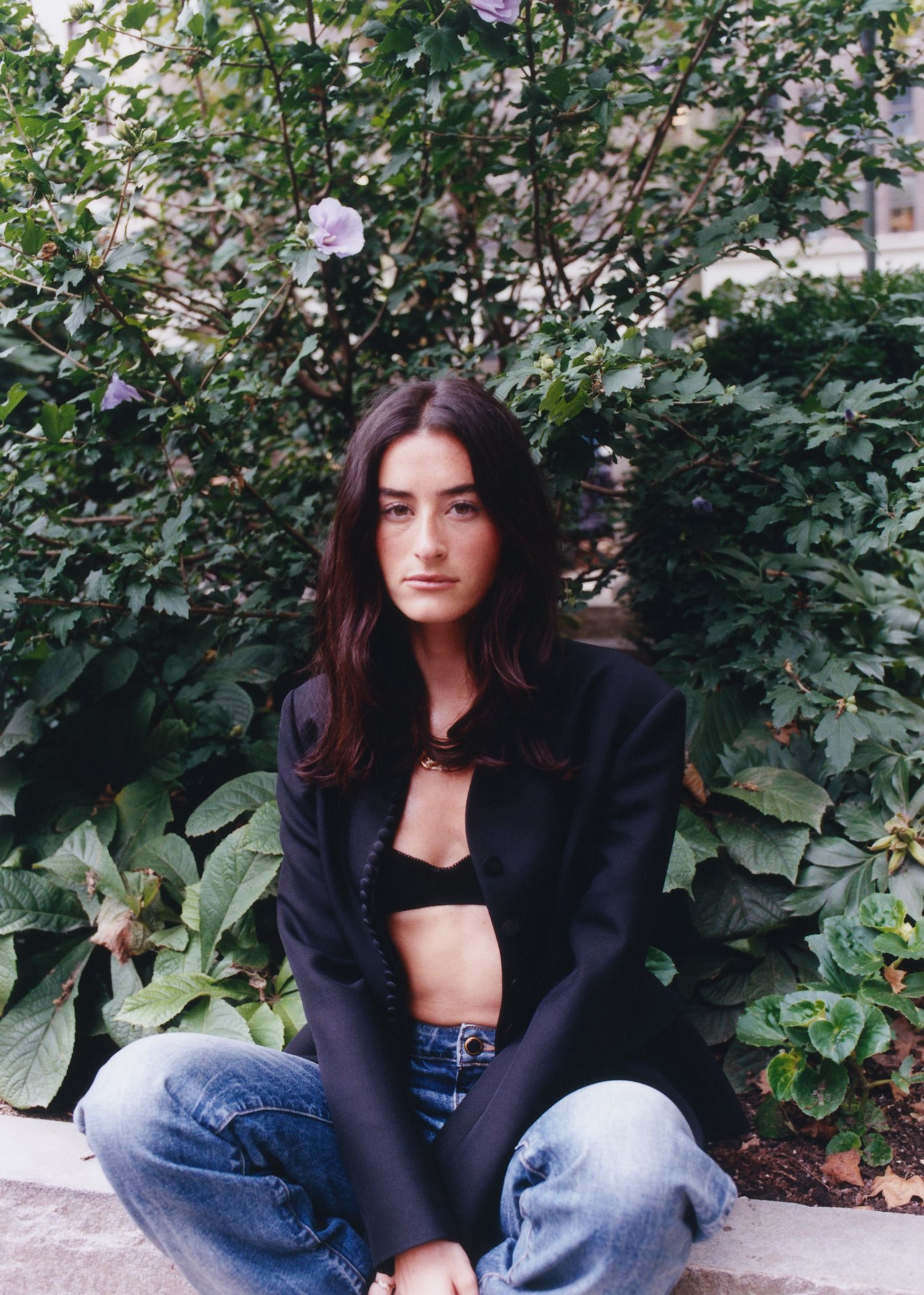
For 24-year-old singer-songwriter Stella Lefty, performing in front of thousands at Lollapalooza was nerve-wracking. Even more harrowing was what she did the next day: get an IUD.
A visit to the gynecologist isn’t how anyone would choose to celebrate their first major music festival appearance, but it’s been a busy summer. Lefty—born Stella Lefkofsky—only had one free day in her hometown of Chicago, and she much prefers her doctor there to the one she sees in Los Angeles, where she lives.
Lefty is still recovering from the IUD insertion when we meet at a coffee shop near New York’s Bryant Park a week later. She got the Mirena, she tells me. And it hurt like hell.
But even some cramps couldn’t dampen Lefty’s good cheer. Her single “Boston” is entering its 20th week on the Billboard charts since its release in late March. When she speaks to Vanity Fair, it’s at No. 3. Prior to Lollapalooza, she was traversing Europe for her first show dates outside the country. On Tuesday, August 18, she was nominated for two MTV Video Music Awards, including best new artist, and the Grammy buzz has already begun. Her debut album, Long Way Home, is out today, August 21.
“I’m glad that we’re even doing this now,” she says mid-interview. “I feel like people are just like, Who is this girl?”
It’s true. “Boston” is a runaway hit, and a real song-of-the-summer contender for anyone who’s young and in love—and anyone who wishes they were either of those things. A spiritual successor to the reigning No. 1 song in the country, Ella Langley’s “Choosin’ Texas,” the track has become difficult to escape. On a recent episode of Therapuss, all Jake Shane needed to say was the word Boston and the episode’s guest, singer Role Model, began to croon Lefty’s infectious chorus. The rapper Boosie Badazz belted the song on a boat with his young daughters. New York Times critic Jon Caramanica, who originally said he thought “Boston” would “curdle” over time, recorded a correction video admitting that, upon further listening, it has become “the first song that has run through [his] mind” when he wakes up in the morning.
But while many Americans could likely sing along to “Boston” at this point, few of them know much about Lefty. This is partially because, for the brief duration of her success, she has been ensnared in a debate over her authenticity.
“The only thing they know is about my dad,” Lefty says.
Her father, Eric Lefkofsky, is the cofounder of Groupon and current CEO of the biotech company Tempus AI. Lefkofsky’s estimated $5 billion net worth comes up early and often wherever Lefty goes—in comment sections and media features, and among fans, poolside, when her music comes on.
Critics have jumped to call Lefty a “nepo baby” (though according to VF’s own definition, the term doesn’t technically apply). On a reposted version of the original “Boston” TikTok, a user named @kylewins22 urges Lefty to “go ahead and slide those 2 weeks [notice] in to wherever you work.” A legion of sleuths inform Kyle that Lefty does not, in fact, work anywhere.
Responding to the song’s key lyric, “On a train back to Boston / and we’re jumping the gun,” others wonder if Lefty has ever actually been on a train before. (“I guess ‘private jet back to Boston’ isn’t as catchy,” a user named @mango_chunk commented.)
She’s also been accused of being an equally despised “industry plant”—a charge not helped by the fact that she is a country singer, twang and all, with no claim to the South other than a Georgia-born boyfriend and a degree from Tulane. (Compare Lefty’s “Boston” to Alabama-born Langley’s “Choosin’ Texas,” and the joke writes itself.)
Speculation abounds about whether, and how much, Lefty’s rise has been accelerated, or even bought, by her personal funds and the attendant privileges that come with them.
But the true story of Lefty’s success is, perhaps disappointingly, normal. Like anyone trying to make it in music today, she has to submit to the tyranny of the algorithm—the rigamarole of daily front-facing posts, the spamming and focus-grouping of every draft of every couplet—to have a shot at making it. She also has to write good music.

Lefty’s debut album, Long Way Home, is out today, August 21.Jack Balaban
Lefty grew up in Glencoe alongside her two brothers (both of whom also use the moniker “Lefty”) and attended nearby New Trier High School, a high-performing public school with such notable alumni as Rahm Emanuel and Bobbi Brown. According to Lefty, it was her father—also a born-and-raised Midwesterner—who first introduced her to country music. He had discovered the stylings of Tim McGraw and Brad Paisley as a young adult. “The music I grew up listening to was country music,” Lefty says. “That was the vibe in my house.”
Her career began on Tik Tok, where she’s been posting videos of herself singing since her freshman year at Tulane in 2021. She maintains that she had no plan to pursue music professionally, and even once she decided to take a crack at it, she saw herself mostly as a songwriter. Midway through college, Pulse Music Group offered her a publishing deal writing for other artists. When the deal fell through, she decided maybe she wanted to be a singer after all.
A second chance came quickly. She connected with her now manager, Adam Alpert, whose past successes included The Chainsmokers and Jessie Murph. Then she got an Instagram DM from Jacob Kasher, a writer and producer who co-owns the publishing venture Livelihood Music Company. Kasher, who goes by “JKash” professionally, is the mastermind behind a litany of 2010s hits—among them Jason Derulo’s “Talk Dirty,” and Fifth Harmon’s “Bo$$.” Kasher’s assistant had been at Tulane at the same time as Lefty and showed him her content. “A couple years later, she randomly popped up on my TikTok,” Kasher wrote in an email to Vanity Fair. “I remembered her and fell in love with her voice.”
Kasher reached out to Lefty, asking, “Got any music?” He then invited her to write with him in Nashville. At the time, he had only seen her perform covers. “I had no idea she’d be one of the best songwriters I’ve ever worked with,” Kasher says.
Recognizing Kasher’s bona fides, Lefty agreed to meet him. “We spent 24 hours together, and then we were inseparable. That was bestie,” Lefty says. He convinced her to move to LA instead of Nashville after graduation and introduced her to a fellow fledgling songwriter, Grace Enger, who had a room to fill in the apartment she shared with several other aspiring musicians. The introduction led to a kind of acoustic hype house in Enger’s apartment. She and Lefty gelled right away, and now do most of their writing together, along with another songwriter, Joe Reeves, who they later met through Kasher.
Reeves and Enger are collaborators on most of Lefty’s songs. Kasher lets them do their thing, waiting until they’re most of the way done to add his hitmaking touch. “I’m just old at this point,” he says.
Lefty’s West Coast relocation did not lead to instant success. “I got really lost in the scene,” she says, adding: “I was being pulled in so many different directions. I was under the impression that in order to be successful, you have to have a very distinct brand in the way that Sabrina has a very distinct brand, and Chapel…you know, what you would dress up as for Halloween.”
Rather than sharpening her “brand,” Lefty initially followed the generic pop-star mold. On her 2025 EP, Tragic, Really, she applies her Miley Cyrus–esque vocals to swelling power ballads and shimmery, washed-out love songs, all of them pure pop. “There were so many people telling me that I had to really stay away from country as a genre…which is why all of the Tragic, Really songs sound so different,” Lefty says.
Lefty teased the songs from the EP on TikTok, but her pop experiments were not successful. The proof was in the like count. “I was getting very low views on songs that I felt like I was pouring so much of myself into,” she says.
Lefty, Kasher, and Enger all swear they don’t think about the algorithm when they’re writing. “The thing we’re thinking about is, How do we make the catchiest and most fun song in the moment?” Enger tells Vanity Fair. Several years prior, Enger had dropped out of college on the back of Sadie Jean’s “WYD Now?” a hit she’d cowritten. She understands intimately how a viral sizzle can come out of nowhere, then subside.
Even so, Lefty’s whole team readily accepts that analytics are a salient form of live feedback. “Nobody has the answer anymore for how to make something work. TikTok decides,” Lefty says.
What “worked” for Lefty was Nashville—both the city and the musical tradition. In December of 2025, she decided to go all in on country music. Her luck changed soon thereafter.
Lefty’s first breakout was “Thinking ’Bout You,” a feel-good acoustic track she wrote with Enger at home during an hourlong session. To promote the track, the two filmed themselves singing together in the way best friends might belt a karaoke standard. The video did well. “Me and Grace are just dancing, and we look like nerds,” says Lefty. “People probably just thought that was cute and resonated with it.
“Thinking ’Bout You” also caught the eye of Vincent Mason, her now boyfriend, a young, Nashville-based country singer who has been been releasing music with Lost Highway/Music Soup since dropping out of Ole Miss during the pandemic. “I listened to the song a hundred times,” Mason says. He DM’d Lefty. To his delight, she replied. She was coming to Nashville the following month and wanted to hang out. When the two met, they immediately became inseparable.
Mason has been following Lefty around a lot this summer. She brought him onstage to sing their duet, “Something to Lose,” at Lollapalooza. He also tagged along for the accursed IUD appointment the next day.
“Boston” is about Mason. Lefty wrote it right after they met in Nashville.
“This was the first week of us,” Lefty recalls. “Oh my god.”
“I wrote the chorus to ‘Boston,’ posted it, and didn’t think about it at all,” she remembers. “I woke up the next morning and [the video] had done relatively well.” Fans were into it.
They also pointed out that the record sounded a lot like Noah Kahan’s 2024 single “Stick Season,” another once-viral New England Americana anthem. “When I was writing the song, I wasn’t thinking about Noah Kahan,” Lefty says. “I was literally thinking about nothing at all.” She didn’t register the similarity at all when fans first remarked on it, but eventually Kahan’s reps got in touch. “We think this sounds similar,” Lefty remembers them saying. She and her team decided to give Kahan a writing credit before the song officially came out, preventing any risk of legal action. “I don’t want to step on anybody’s toes, so I’m like, if this sounds like that, whatever, all good.”
“Boston”’s origin story is emblematic of Lefty’s rise. Every step has had the same lurching, horse-before-the-cart speed. She has scrambled to meet demand and fill the shoes of a Top 10 popstar. Long Way Home was originally slated for a September release, but the label decided to drop it sooner, necessitating a mad dash to finish it. Lefty’s Lollapalooza set, originally scheduled for early afternoon— “the ass crack of dawn,” as she put it—was moved to 7:45 p.m. at the last second, presumably to adjust for her exponential growth in name and song recognition in the weeks leading up to the festival. (Representatives from Lollapalooza did not respond to a request for comment.)
“It’s unfathomable for all of us involved,” Enger says. “It has been an insane rise.”
“There was stuff happening with Stella in the beginning where I was like, Oh yeah, I can relate to this. That’s normal.” Mason says. “I just shrug at her now. I’m like, Good luck. I can’t relate to it. But it’s been really cool to see.”

Speculation abounds about whether Lefty’s rise has been accelerated, or even bought, by her personal funds. But the true story of Lefty’s success is, perhaps disappointingly, normal.Photographer Rafael Martinez
As “Boston” has grown in popularity, the number of people eager to point out Lefty’s silver spoon upbringing has grown too.
“Obviously there’s going to be this conversation around it, which I totally understand,” Lefty says. “Me and my dad have spoken about this a lot since I even started music. He was like, ‘The truth will set you free.’”
But what, precisely, does Lefty have to confess? Can money buy a hit song?
Historically, the answer has been maybe. True rent-a-record-label projects like Rebecca Black’s “Friday” have become the stuff of ubiquitous memedom. Paris Hilton’s 2006 single “Stars Are Blind” peaked at No. 18 on the charts. But Hilton benefited from fame, not just fortune. Being the Groupon heir is not exactly celebrity.
The vicissitudes of TikTok complicate the question. The algorithm’s favor can be easily curried through strategic mass-puppeteering. Companies like the digital marketing agency Chaotic Good have made a killing “astroturfing” new music using fake fan accounts, fabricated interactions, and a deluge of reels that senselessly feature a given song as background noise.
That tool is widely available to all signed artists, not just billionaires, and it’s highly possible that Atlantic Records footed the cost of a guerilla social campaign for “Boston.” But algorithm-optimization is not on its own sufficient for hitmaking. If it were, Lefty points out, “every record label would make every single artist on the label the biggest thing in the world.”
According to Lefty, the greatest upshot of her cushy upbringing is time. “I had the ability to really explore, and I didn’t have a stopwatch. I felt like I had this cushion.” (This answer is strikingly similar to the one offered by Gracie Abrams, the sad-girl popstar daughter of filmmaker J.J. Abrams, in a recent New York Times interview: “I had a safety net and that allowed me the ability to experiment and to concentrate and I had the gift of time.”)
The cushion of billionaire-dom is not nothing. It means freedom to devote oneself not only to writing but to the increasingly mandatory work of self-promoting.
Lefty is a deft user of social media. She smiles when she sings, which some commenters find freakish, but which certainly makes it seem like she’s having fun. She’s willing to sing and post the same snippet over and over again, a humiliation ritual, to be sure, but also the best way to lodge a song in people’s heads. (Someone commented on a May 2026 “Boston” Tik Tok: “This had potential until it was put out a thousand times now it just gets under my skin.”)
The good news for Lefty is that “Boston” is undeniable. For every hate comment there’s an equally adoring one. “I want it in my veins,” one user said. “I have been hearing this on repeat in my head for a solid three days,” another commented. Naturally, the TikTok account of the drugstore cosmetics brand Burt’s Bees chimed in: “this scratches an itch in my brain perfectly.”
It’s wildfire catchy, difficult to resist even if one is predisposed against the ruling class, or suspicious of Lefty’s affected country accent. Some people spend their whole lives trying to write an earworm like “Boston.” Lefty did it in a matter of hours.
“She is such a good pop writer,” Enger says. She adds, “What people don’t see is how many songs she’s writing, how many times she’s posting a day…That’s why it’s working.”
With Long Way Home, Lefty is hoping it can keep working. The stakes are high. One viral hit doesn’t guarantee another one, and there’s no way to know whether lightning will strike twice. The album iterates on the things Lefty is best at—hooky, singable melodies and solid musical storytelling that maximizes her raspy vocal range. She goes to the doldrums on “Forever Guy” and to cloud nine on the album’s first single, “Lean in, Kiss Me.” It’s almost all about romance, and it’s studded with unapologetic country flourishes, like drinkin’ whiskey, dancin’ at the local bar, and leavin’ town brokenhearted.
“I want to get in my car and I want to listen to the songs that I’ve been writing,” she says. “It’s authentic because it’s just what I love the most.”
Credits: Makeup by Taylor Fitzgerald; Hair by Arbana Dollani; Stylist, Gabi Teña. For details go to VF.com/credits.
This article has been updated.
-
From Prince George to Princess Leonor: Where Young Royals Will Attend School This Fall
-
The Pitt’s Patrick Ball on Shipping, Stardom, and Season 3
-
From Cowboys to Clean Girls: The State of American Style, in Pictures
