


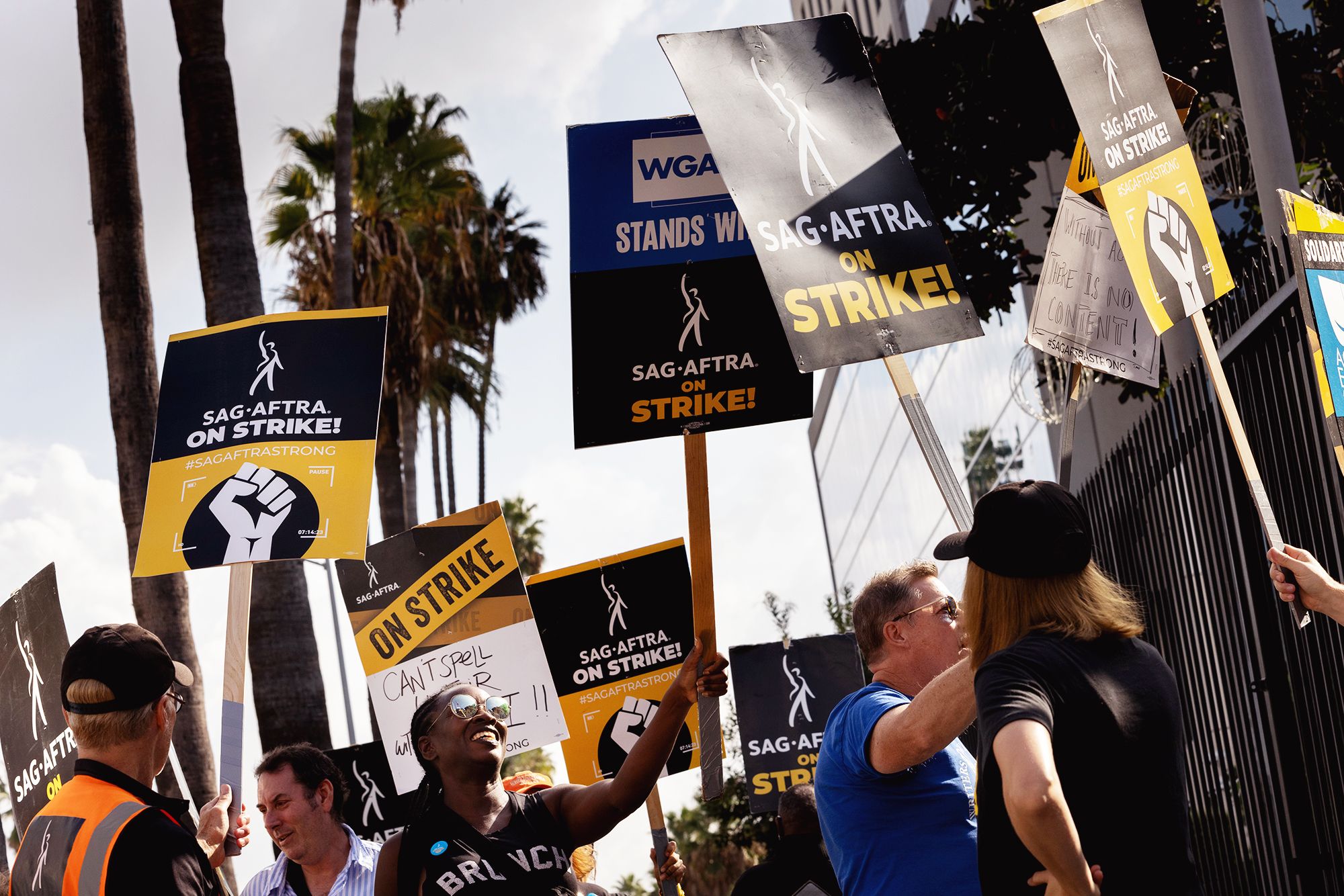
Three years ago Hollywood looked like a stalled assembly line—Detroit with palm trees. Soundstages went dark as writers and actors hit the picket lines and paced in circles like strikers have since the days of Andrew Carnegie—different industry, same ritual. Late-night shows went into reruns. And podcast hosts interviewed actors promoting nothing in particular because they weren’t allowed to talk about the very projects they should’ve been selling.
Now the industry has entered another bargaining cycle, with multiple unions lining up to negotiate with the Alliance of Motion Picture and Television Producers in rapid succession. The Writers Guild of America surprised industry observers by reaching a tentative four-year deal with the studios on Saturday, nearly a month before its contract was set to expire. The Directors Guild of America begins talks on May 11, while SAG-AFTRA—after failing to reach a deal in its first go-around in March—will resume negotiations later this month. Both the actors union and the DGA face contracts expiring on June 30.
The WGA’s deal has created a sense of cautious optimism around town, signaling that the rest of the unions are more likely to land agreements than to reprise the 2023 standoff. The prevailing industry logic—more caricature than consensus—casts writers as the “intellectual rabble-rousers” most willing to strike (think Dalton Trumbo’s and Mary C. McCall Jr.’s labor activism), directors as the least likely given their more traditionally “blue-collar” membership, and actors somewhere in between. Even those repeating it admit it’s an oversimplification, but it’s the frame quietly shaping the vibe around town (though no one who said this to me was willing to do so on the record).
To better understand the landscape heading into negotiation season, Vanity Fair spoke with several industry insiders—including producers at major production companies and members of both the writers and actors unions. Most agreed to speak only on background, citing the sensitivity of ongoing negotiations and a reluctance to publicly criticize studios, unions, or business partners at a moment when contracts hang in the balance.
Running for four years—one year more than the span of the current contract—the new writers union deal covers a longer period than labor would typically prefer. Its duration favors the studios by staving off another renegotiation and potential work stoppage until 2030. The union’s concession on the term of the contract indicates that labor is bargaining from a position weaker than the one it held in 2023, with consolidation and mergers reducing the amount of available work, and AI development making long-term planning impossible.
“Just go back four months and look how much AI has changed things,” says UCLA film historian Jonathan Kuntz. “It’s hard to imagine that we’re going to be able to predict four years out.”
Based on the available information about their new agreement, the writers received wage increases, improvements in residuals, greater contributions to their health care fund, and protections related to the use of scripts as training data in AI systems.
For many WGA members, one fact loomed large over these negotiations: The 2023 writers strike coincided with a sharp contraction in employment, with Writers Guild data showing television writing jobs falling 42% year over year in the 2023–24 season—equating to there being roughly 1,300 fewer positions.
The SAG-AFTRA negotiations are proceeding under a media blackout, so people aren’t saying much. The actors union declined a request for an interview, and the AMPTP did not respond. However, underneath the silence is a shared reluctance to test a strike again because of fears that it might worsen the industry’s ongoing contraction, according to multiple industry sources who spoke to VF.
Kuntz describes the dynamic between the studios and the unions as “two uncertain and weak entities negotiating” in an environment completely different from the one they were in last time. “In 2026 the old world is gone,” Kuntz says.
The previous SAG-AFTRA and WGA strikes revolved around familiar matters—streaming residuals, minimum pay, mini writers rooms, and early concerns about artificial intelligence. The current talks are unfolding in a landscape where those concerns have metastasized into something harder to contain. Even the gains from the last contracts have proved limited for the unions. Changes to streaming residuals helped, but they did not solve the broader, interconnected problems of underemployment and runaway productions.
“AI has advanced so much faster than anybody thought it would,” Kuntz says. “It’s threatening to replace just about everybody.”
Hollywood’s biggest players have struck a bullish tone on AI, though they have been careful not to spook the talent. At Netflix, executives have framed artificial intelligence as a behind-the-scenes upgrade that can make visual effects work more efficient, while stressing that it will “help” creators rather than replace them. Paramount Skydance, facing sharp financial pressure as it prepares to take on a massive debt load in its acquisition of Warner Bros. Discovery, has plans to expand its AI-focused engineering staff tenfold, though CEO David Ellison has said he doesn’t think “AI is a replacement for creativity.”
Behind the scenes, multiple producers who spoke to VF suggest an almost Darwinian view of AI’s impact. If AI ultimately produces a better product than humans do, they argue, the industry won’t be able to justify protecting human-made work because audiences will naturally gravitate toward the most entertaining content regardless of its origin. Additionally, as Dax Shepard argued on his Armchair Expert podcast during the strikes in 2023, trying to preserve human labor could backfire and cede creative ground to other countries that are willing to better embrace the technology. For the studios, the uncomfortable premise is unavoidable: If AI is better and more efficient, the market will reward it and Hollywood will have to adapt or risk obsolescence.
Creatives mostly reject that argument. They say human authorship itself adds value. Additionally, several writers tell VF that if AI replaces them, the industry risks hollowing out the pipeline that produces showrunners and others who can fill creative leadership positions. Some mid-level writers say that the pipeline has already been hollowed out by the overall production contraction. The industry is making fewer shows with smaller episode orders. Take HBO, for example. It produced 16 originals in 2025 compared to 32 the year prior. The cable network once produced 18-episode seasons of original comedies. Meanwhile, The White Lotus has featured an average of seven episodes per season; Euphoria has done eight episodes each season. The mid-level writers add that the WGA’s 2023 contract—while touted as a win for staffing—has done less to protect their ranks than it has for those of more senior writers.
Harvard labor expert Sharon Block says AI proliferation is pushing unions into a fight even more existential than it was in past cycles—forcing them to define the basic terms of employment. In earlier debates, the question was whether someone was a contractor or a full-time employee, but the AI shift has been so disorienting that some entities, like the state of Pennsylvania, are now clarifying that “employees” must be human beings.
The issue is especially fraught in a world with Tilly Norwood and other AI-generated performers. When Norwood surfaced last year, actor Melissa Barrera called for actors to drop any agent who tried to represent her. Emily Blunt called Norwood’s emergence “really, really scary.” Ralph Ineson from Game of Thrones was blunter than Blunt, posting on X, “Fuck off.”
“You’re being impersonated,” Kuntz says. “The best elements of you are being taken away and used to construct something that’s putting you out of work.”
Rather than trying to stop the technology outright, SAG-AFTRA has been strategizing around making its use costly: to mandate compensation and just generally make it more expensive to replace human performers. The group calls it the “Tilly tax.”
Block notes that in earlier negotiations held during the Biden administration, unions hoped that regulators might eventually step in to impose meaningful constraints on artificial intelligence. That expectation has faded in Donald Trump’s second term. She suggests that the negotiations may ultimately hinge on whether labor and management can recognize a shared interest in preserving the industry itself.
With war in Iran and broader geopolitical instability dominating the headlines, both sides concede that a strike involving wealthy studios and famous actors could land with a thud, testing the public’s patience if screens were to go dark.
However, many union votes are driven by members who don’t work consistently, which means there is less immediate downside for them in supporting strikes.
Whether those pressures will lead to compromise or conflict remains unclear. The talks could produce a deal that stabilizes the industry, at least temporarily. The talks could also collapse, sending Hollywood back into another strike just a few years after the last one ended.
