


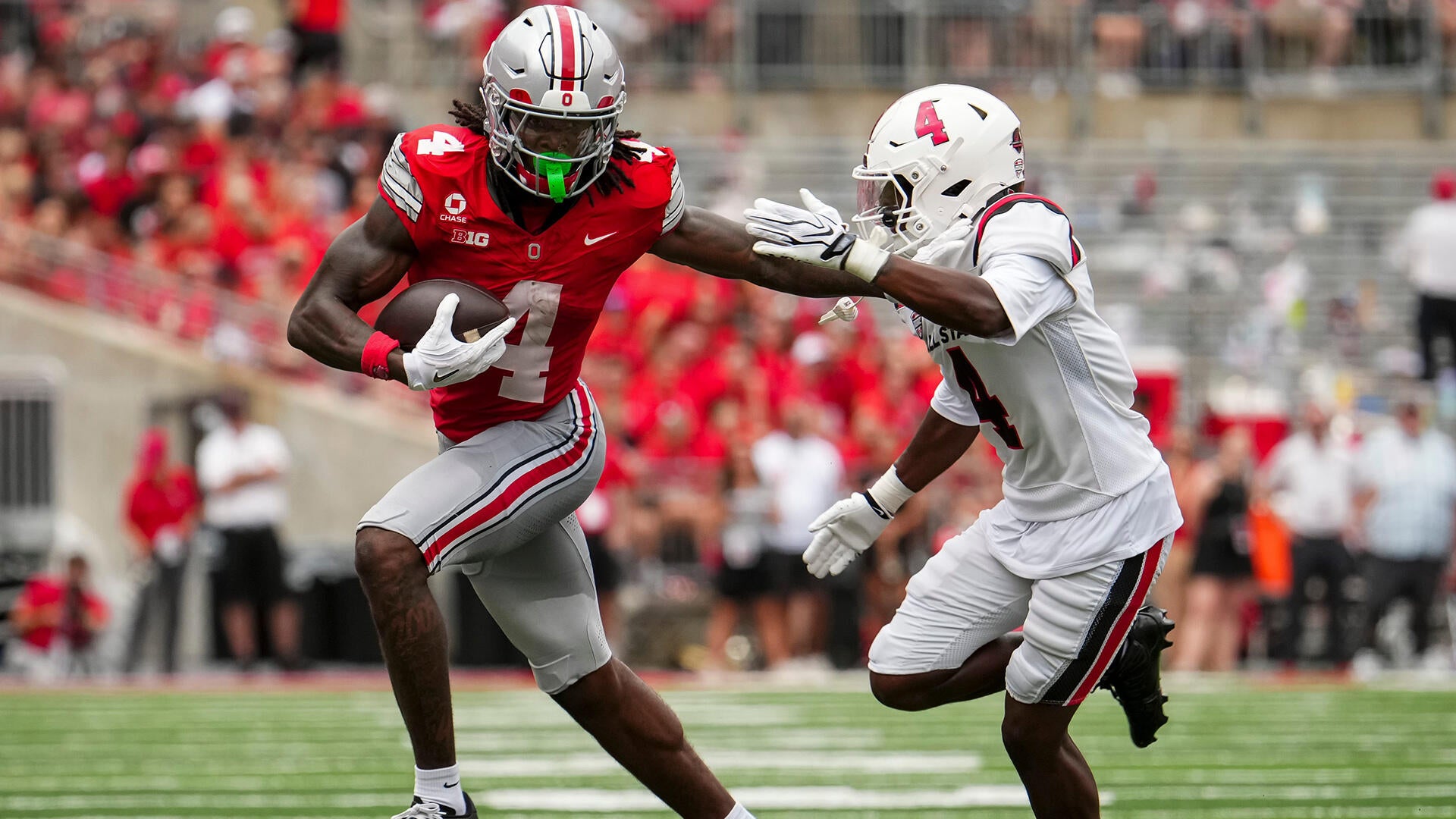
We’ve long known that Jeremiah Smith is often the best player on the field. It’s not a stretch to say he would’ve been a top-five pick — and the first wide receiver taken — in each of the previous two drafts had he been eligible.
Two seasons into his Ohio State career, Smith has 2,558 receiving yards and 27 touchdowns, and he’s been one of the most productive receivers in college football basically from the moment he arrived on campus. He’s probably going to be the first non-quarterback drafted next April (I have him going No. 2 overall in my latest mock draft) and, hell, maybe he becomes the first wide receiver to go No. 1 overall since Keyshawn Johnson in 1996.
But that question is mostly settled. Smith has already shown – consistently – he’s good enough to be drafted that high. The real issue is whether even a receiver this talented can remove any lingering doubts to justify one of the most valuable picks in the draft.
Recent history says the bar has to be higher than simply looking like a top-10 player. The receivers drafted that early are usually dominant, productive and explosive, with little squinting needed to confirm your hunches. Even then, the leap from elite prospect to elite NFL return is hardly automatic.
That’s the line Smith is trying to cross. He’s not just making the case that he belongs near the top of the draft; he’s trying to make the case that the usual reasons for hesitating on a receiver that high matter less with him.
Being good enough for the top 10 isn’t the same as being worth it
The opportunity cost near the top of the draft is enormous. Take a receiver fourth or fifth overall, and you’re passing on edge rushers, offensive tackles, cornerbacks and quarterbacks, depending on the class. The question can’t simply be whether the receiver has first-round talent; everybody under consideration at this point in the conversation cleared that bar a long time ago.
So we went back through the recent history of first-round receivers to see what actually separated the players NFL teams were willing to take in the top 10 from those who lasted until later in Round 1. The first answer was pretty obvious: the premium guys generally weren’t just productive college receivers. They overwhelmed college football.
|
College metric |
Top-10 WRs |
Picks 11-32 |
|
Yards per route run |
3.48 |
2.75 |
|
Receiving grade |
90.0 |
82.2 |
|
Receiving yards/game |
109.5 |
89.6 |
|
Targets/game |
9.45 |
7.68 |
|
TD/game |
1.08 |
0.74 |
|
First downs/route |
14.4% |
11.8% |
|
Positive EPA rate |
55.7% |
48.5% |
There’s no magic YPRR cutoff here, and nobody should decide the fourth pick in the draft based on whether somebody averaged 99 or 101 receiving yards per game. The point is broader: when NFL teams spend that kind of capital on a receiver, there is usually overwhelming evidence that he was already one of the most difficult players in college football to defend. Chase and Harrison Jr. are the obvious recent examples, and Corey Davis fits the same pattern: by the time they were drafted, NFL teams weren’t betting on whether they could dominate college football. They already had.
Adding athletic testing to the historical picture made it even easier to understand why certain receivers were drafted so highly. But it didn’t make it appreciably easier to identify which receivers would become high-level NFL players. That’s the part that should make everyone uncomfortable, because apparently, we’re better at describing the prototype than guaranteeing the result.
And that distinction is the entire top-five WR argument. Drafting a receiver that early isn’t difficult because teams can’t recognize talent. It’s difficult because a clean resume can make the distance between college dominance and NFL dominance feel much shorter than it actually is.
The real question is how much you’re still guessing
Nobody needed a history lesson to know Chase or Harrison Jr. were talented. The same holds for Smith in 2026.
The better question for a receiver you’re considering that high is how many important NFL questions he’s already answered. That eventually led us to six:
-
Was he truly dominant?
-
Was he dominant early and repeatedly?
-
Did he demonstrate multiple NFL ways to win instead of thriving in one narrow college role?
-
Do his athletic strengths fit those ways of winning?
-
Is there context — scheme, QB play, injuries, target competition — significantly distorting what we’re seeing?
-
And, finally, what still has to be projected?
Those six questions make up what we’ll call the Profile Score, with each category worth up to two points for a maximum of 12. It isn’t meant to predict NFL success. It’s simply a way to measure how much a receiver has already shown before draft night — and how much of the evaluation still ends with, “We think he’ll eventually be able to…”
|
WR |
Score |
Pre-draft/profile takeaway |
|
Ja’Marr Chase |
12/12 |
Gold standard; almost nothing meaningful left to project, even after opting out of final year during COVID |
|
Marvin Harrison Jr. |
11/12 |
Premium profile; athletic testing unverified during pre-draft process |
|
Justin Jefferson |
10/12 |
Premium profile; final-year role created unnecessary projection |
|
A.J. Brown |
10/12 |
NFL market undervalued a complete receiving resume because of offense he played in |
|
Jeremiah Smith* |
10/12 |
Already unusually clean before final season/testing |
|
Tee Higgins |
9/12 |
Receiving evidence stronger than timed athleticism |
|
Josh Doctson |
9/12 |
Clean profile that still failed in the NFL |
|
Amon-Ra St. Brown |
8/12 |
NFL ability exceeded the conventional profile |
|
Corey Coleman |
6/12 |
Elite production/explosion; major route-tree projection coming out of Baylor |
|
N’Keal Harry |
6/12 |
Good measurable profile; functional separation remained a question |
|
D.K. Metcalf |
6/12 |
Specialized athletic profile; NFL maximized how he won |
|
Terry McLaurin |
5/12 |
College role hid a much better NFL receiver |
*Smith’s score is provisional because his junior season and pre-draft athletic testing haven’t happened yet.
The Doctson-McLaurin contrast is exactly why the score isn’t meant to be a cheat code. Doctson’s production and ball skills made him look like a first-round prospect, even if his route tree and ability to separate still left questions. McLaurin was almost the opposite: his college production was modest, but the speed, route-running and flashes of NFL ability were there if you looked past his limited role in that loaded Ohio State offense.
So the number isn’t telling us who’s going to be better. It’s telling us how much we knew at the time. And Smith is already at 10.
Smith’s two missing points aren’t really red flags
Smith averaged 3.15 yards per route as a freshman and improved to 3.43 in Year 2, while his receiving grade climbed from 89.8 to 90.7, per PFF. His target share, yardage share and first-down efficiency all increased, too, and he’s done the overwhelming majority of that work aligned outside.
|
Jeremiah Smith |
2024 |
2025 |
|
Yards per route run |
3.15 (98th) |
3.43 (99th) |
|
Receiving grade |
89.8 (99th) |
90.7 (99th) |
|
Target share |
24.3% (90th) |
27.3% (96th) |
|
Yard share |
31.2% (95th) |
33.1% (97th) |
|
TD share |
40.5% (96th) |
36.4% (94th) |
|
First downs/route |
12.7% (97th) |
15.2% (99th) |
|
YAC/reception |
6.5 (83rd) |
4.3 (41st) |
|
Wide alignment |
83.7% |
81.8% |
* Percentiles among FBS wide receivers with at least 100 routes run that season.
And Smith is doing this ahead of schedule. Most of the historical players we’re comparing him to were in their final college seasons, essentially close-to-finished pre-draft versions of themselves. Smith was already matching that level of production and efficiency as a freshman and a sophomore, with another full season to improve.
That’s why Smith’s Profile Score of 10 is a little different from some of the others on the list. He’s already answered the big football questions: He’s been dominant, he did it immediately – and then did it again – he can win in different ways and his production isn’t being propped up in some gimmicky role or unusual set of circumstances.
The two points he doesn’t have are mostly about where we are on the calendar. Smith hasn’t gone through pre-draft testing yet, and he still has another college season to play. That’s different from wondering, for example, whether he can beat press-man coverage.
In other words, those questions are unanswered because it’s September, not because we’ve identified obvious holes — which brings us to the receiver who came closest to checking every box in permanent marker long before draft night.
Ja’Marr Chase wasn’t just great — he made the evaluation easy
Chase’s final season on the field at LSU — his 2019 sophomore year, before he opted out of the 2020 season during COVID — is about as clean as an evaluation gets. He averaged 3.52 yards per route, earned a 91.3 receiving grade and produced 127 receiving yards per game while doing the overwhelming majority of his work from outside. His average target traveled more than 14 yards downfield, and he still averaged more than eight yards after the catch per reception.
Then he tested like an elite athlete, reinforcing what the tape had already shown. Just about everything pointed Cincinnati to the same place. The big debate leading into the draft was whether the Bengals should protect Joe Burrow, who was coming off a serious knee injury, by selecting Penei Sewell or reuniting him with his LSU teammate. They chose Chase, and it’s hard to argue with how that worked out.
Taken all together, it’s why Chase gets a full Profile Score of 12. And that’s also why Smith’s junior season can be about something more than proving he’s worthy of a top-five pick — he’s already done that.
Marvin Harrison Jr. is what keeps this from being easy
Harrison Jr. is an obvious comparison because he played at Ohio State, dominated for much of his college career, and entered the league with a similarly sterling reputation. Arizona took him fourth overall in 2024, and he looked every bit like one of the safest players in the class.
I distinctly remember my former co-host on the “With the First Pick” pod, Rick Spielman, proclaiming that Harrison Jr. was a future Hall of Famer. Even at the 2023 Ohio State pro day – we were there to see C.J. Stroud – you couldn’t take your eyes off Harrison Jr., who was still just a sophomore:
So, yes, his 11/12 Profile Score reflected just how complete the evaluation looked at the time.
But Harrison didn’t take part in the pre-draft process after his 2023 season, mostly because there wasn’t much else an NFL team needed to figure out. The size was there. The ball skills were there. The production was there. Everything, it seemed, was there.
And that’s why his first two NFL seasons matter to this conversation. Harrison had 885 receiving yards as a rookie and 608 in Year 2, while averaging roughly 1.6 yards per route in both seasons — respectable production, but nowhere near what was expected from a receiver taken fourth overall with that kind of college production.
That doesn’t make Harrison Jr. a bust, and it doesn’t mean Arizona was wrong to draft him. It does remind us of the toughest part of this exercise: A college receiver can answer almost every question we can think to ask and that still doesn’t guarantee we’ll see that player at the next level.
Chase answered those questions, and even after taking a season off, he immediately became one of the best receivers in football. Harrison Jr. answered those same questions, though through two NFL seasons, he’s been, well, ordinary. That’s the part Smith can’t control — he’s an easy evaluation, sure, but that doesn’t guarantee what happens next.
Is Smith closer to Chase or Harrison Jr.?
As a prospect, Smith is the closest we’ve seen to a sure thing since Chase declared for the draft in 2021. And this isn’t just about the production; it’s that Smith has been putting up top-five pick numbers since he arrived in Columbus, and doing it while looking like Julio Jones (or Terrell Owens) getting off the bus. (It’s also why Smith was No. 2 on my preseason big board.)
He has been dominant from the beginning, produced at different levels of the field and handled the attention that comes with being the No. 1 player defenses know they have to stop. His per-route production already compares favorably with receivers who were putting the finishing touches on their college careers immediately before entering the NFL. And he picked up right where he left off in Week 1 against Ball State, catching eight passes for 151 yards and two touchdowns and making all of it look almost second nature.
There are still things worth watching this fall. Smith’s YAC per reception dropped from 6.5 as a freshman to 4.3 last season, so it’s worth figuring out whether that came from route usage, defensive attention, sharing targets with 2026 fourth-overall pick Carnell Tate, or something Smith himself can get better at. Just as important, the next step isn’t simply piling up more yards and touchdowns; it’s continuing to show NFL teams more ways he can win.
But none of this is about proving Smith is a top-5 lock. That ship feels like it sailed after his freshman season. What he can do now is convince his next employer to feel about him the same way Cincinnati felt about Chase: this guy is a unicorn and you can’t afford not to take him near the top of the draft.
That’s the standard for a top-five receiver
History is littered with reminders that great college receivers can leave NFL teams with very different problems to solve. Corey Coleman had enormous production and explosive athleticism, but his college route tree left plenty of questions. N’Keal Harry had the size and testing numbers, but those numbers couldn’t answer whether he would consistently separate from NFL defensive backs. D.K. Metcalf had limitations of his own, it’s why he lasted until the end of Round 2, and Seattle succeeded in part because it leaned into the things he did exceptionally well instead of asking him to become something he wasn’t.
The misses in the other direction are worth remembering, too. McLaurin’s limited college production obscured a much better NFL receiver, while Amon-Ra St. Brown became far more impactful than his pre-draft timed speed or eventual Day 3 draft status suggested. Those are different stories for another day, but they reinforce how difficult it is to paint the entire picture of who the player will become at the next level.
That’s why “he’s really good” can’t be the standard for taking a receiver in the top five. There are too many really good players available at other premium positions, and the price of getting those first few picks wrong invariably leads to people losing their jobs.
A receiver taken that high should make passing on him tougher to do than drafting him. The production should be overwhelming, his role should be ready-made for the NFL, and the list of things he’ll need to learn later should be short.
Smith is pretty damn close to that standard because, unlike so many first-round receivers, there just isn’t much left for NFL teams to talk themselves into. Chase met that standard and immediately justified Cincinnati’s decision. Harrison nearly met it as a prospect, then reminded us that even the cleanest evaluation comes with no guarantee.
Smith now has one more college season to make an already compelling case even more airtight. He’s not trying to prove he’s worth a top-five pick; he’s just going to go about his business, and in the process, make the case that he’s the rare receiver for whom the bigger risk might eventually be finding a reason to pass on him.
