


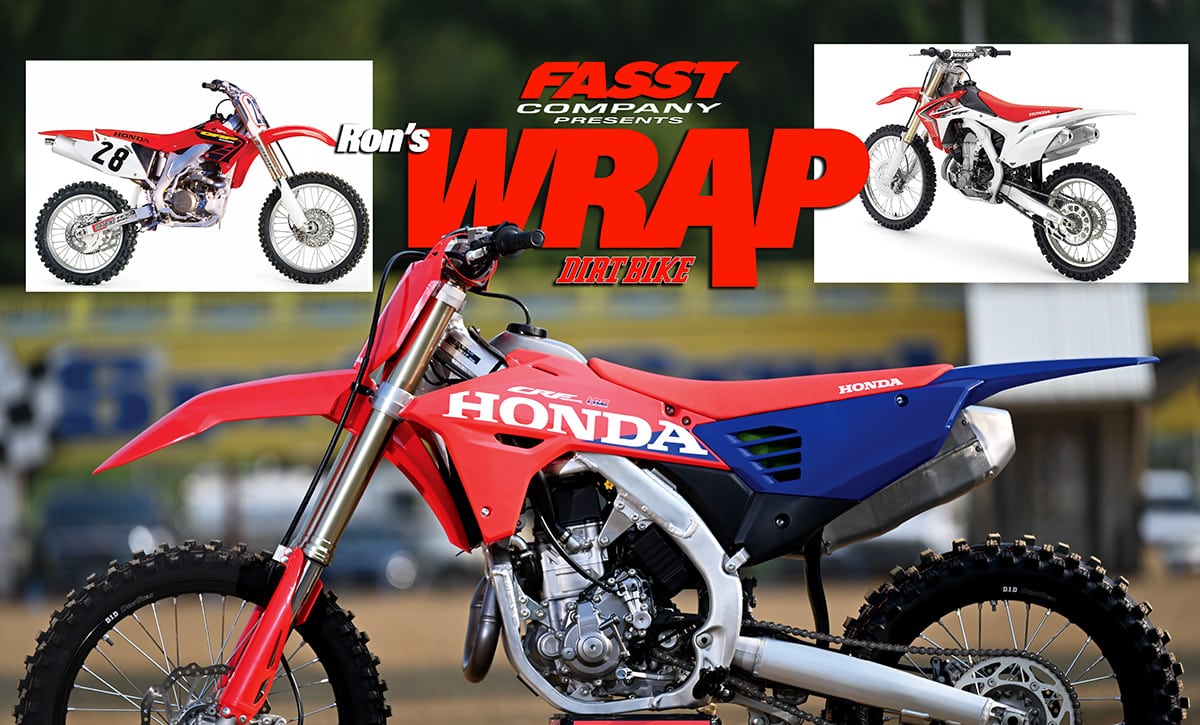
Honda made some big claims for the 2027 CRF450F. They said it would be 10 pounds lighter, with 10 percent more peak horsepower and 4 percent more peak torque. And oh, yes, they said it would be more stable, more nimble and so on. Okay, so now that we’ve ridden the bike, what’s the story? For the most part, it’s all true.

Those claims were relative to the 2026 CRF450R, which was a very good motorcycle, but perhaps not the eighth wonder of the world. It was reasonably light and somewhat torquey, but not especially fast or stable. Honda has a history of making drastic changes on a regular basis, then spending about three years resolving issues and refining the concept.

Here are the bullet points:
• Revised geometry; longer wheelbase and more relaxed steering head angle, Increased frame rigidity.
• 17mm narrower engine cases
• Larger-capacity titanium fuel tank (1.7 versus 1.9 gallons).
• Round versus anchor-shaped crankshaft assembly
• New bore and stroke; from 96.0 x 62.1mm to 97.0 x 60.83mm.
• New airbox, air filter and air funnel.
• Larger titanium valves.
• More aggressive cam profile.
• Steeper valve angle.
• New clutch with slipper characteristics.
• Taller gear ratios.
• Quieter exhaust system.
• Stiffer fork springs; from 5.0N/mm to 5.2N/mm.
• New shock linkage with revised ratio and a new thrust needle bearing.
• Wider rear-wheel hub.
• Dunlop MX34 tires front and rear.
The list goes on and on, making it clear that this is the most comprehensive redesign since 2002.

Honda scheduled our first test of the bike at Spring Creek Raceway in Millville, Minnesota two weeks after the AMA Pro National MX. Then they put our test bike on a truck bound for the west coast, where we could test the bike on our own terms.
Up front, the 2027 CRF450R is a rocket. The low-end power is still there, but now the Honda revs. It still has smooth, sweet power in the basement and makes tons more in the middle and top without the crazy surge anywhere along the way. It is, however, a lot. That’s where the handlebar-mounted map switch comes in handy–just like always there are three maps available. The mild map doesn’t add power anywhere, but it does shave off a little in the middle and on top and can make the bike a little more manageable. The aggressive map returns all the power, plus it gains revs on top. At Millville, we found there was no real disadvantage in running the aggressive map all the time. The power delivery was the same as the standard map down low, you could just stretch each gear farther and get away with fewer shifts.

Honda has taken a fair amount of heat in recent years over a lack of stability. Conversely, recent CRF450Rs have been praised for agility and cornering ability. Is it possible to have both? Maybe. Two years ago, Honda test riders discovered that more frame rigidity helped the stability issue without hurting anything else. Now, they’re doubling down on that philosophy. The new frame is more rigid, plus it has a number of other changes that, on paper, sound like they’re geared for more stability; longer wheelbase, stiffer fork springs, more relaxed head angle. That should change everything, right? Right. Sort of.

The Honda still feels like a Honda. It’s super easy to toss into turns. The fact that it’s so much lighter makes it even more agile. When the track is smooth, it also feels far more stable than any Honda we remember. When it’s rough, some of those old CRF450R memories return. It can hunt around for the line you want, and occasionally decide on a line of its own. Okay, we’ve been here before and we know what to do; we’ll soften the rear end and drop the fork tubes down until they are flush with the top of the triple clamp; standard Honda stuff. It turns out that this bike is so different that we couldn’t use our go-to settings–they were overkill in every way. We returned to stock and used a more subtle approach. We stiffened the fork (slightly), slowed down the shock (slightly) and that made it better. Slightly. Overall, the take-away is that the Honda is improved in every way. But the traits that make it a Honda are still there if you dig deep enough.
We still haven’t done our full regimen of testing on the Honda, but as of right now, we are completely pumped. You can check out the October, 2021 print edition of Dirt Bike for the full test.
HONDA CRF450R BACKSTORY

It wasn’t the first, and it hasn’t always been the best or the fastest, but the Honda CRF450R is the poster child of American motocross. It has been almost from the day it was released in 2002. Prior to that, the world of four-stroke MX had been Yamaha’s private playground, but four-strokes still weren’t mainstream. It was the arrival of the Honda that made us all realize that that motocross would never be quite the same again.
There have been years when we loved the CRF450R and years when we didn’t. We’re not alone in that regard. The Honda has gone through about seven major revisions in its 25-year history, changing its personality somewhat every time. But, throughout those cycles, it has always maintained the same essence and has always been popular with rank-and-file American motocrossers. Here are the highlights, lowlights, problems and fixes in the life of the Honda CRF450R.

FIRST YEAR—2002
We loved the first CRF right out of the gate. It proved that the single-overhead-cam motor design was alive and kicking. It was the lightest four-stroke motocrosser of its day, and it made smooth, sweet power. But, not everyone loved it. There were complaints about steering, mostly from Yamaha YZ426 lovers, and that launched an industry dedicated to almost imperceptible steering geometry changes. A gaggle of aftermarket triple clamps became available with differing offsets. Virtually all of them were a waste of time. A more substantial fix would come from Honda in 2003, when the bike got different linkage that raised the rear end of the bike and steepened the head angle.
There were minor mechanical issues that first year. The chainguide and slider had a short lifespan, and the seal between the air boot and the airbox was poor. That particular problem would be chronic for years. PC Racing offered a kit that was a good remedy. Another ongoing issue from year one was the clutch, which also had a short lifespan.
Today, that first-year Honda still holds its own against modern bikes. There were no life-threatening mechanical issues and no big slipups. Of course, by today’s standards, the performance is predictably weak. The fork in particular was harsh, and the power was about 7 horsepower less than what we have now. But the bike’s weight was 235 pounds without fuel, which was amazing for a four-stroke.
A SLIGHT REVAMP
Usually, Honda’s pattern is to make big changes and then wait a year or two before making any substantial updates; however, the 2003 Honda CRF450R had some surprising new features. The shock was longer and the rear linkage was altered to make the bike turn sharper. The motor got a new cam, a revised ignition map and a new pipe. The airbox was new and had a larger filter, but this only made service more difficult, as the filter didn’t really fit through the hole on top. Oh well. The Honda also had thicker plastic radiator shrouds and better chain rollers.
On the used-bike market, there isn’t much distinction between the first year and the second year. By now, many of these bikes have modified suspension or aftermarket parts. If you find a bike with aftermarket linkage, it rates higher than one with aftermarket fork clamps.
Another milestone: In 2004, the bike finally ditched the steel handlebar for a 7/8-inch aluminum handlebar, just in time for most other brands to go to oversized bars.

A MAJOR REVAMP
By the time 2005 rolled around, it was time for a new bike. Honda redesigned virtually everything around the motor. The frame had different flex characteristics that would make any suspension feel more plush, and on top of that, the suspension components themselves were better. The bike also got a more modern look, with bodywork from the new CRF250R.
What really set the 2005 450R apart, though, was power. It was a sweetheart, and a very fast one at that. The powerband was longer, and it made more on top. This was the start of the Honda’s glory years. In the time between 2005 and the redesign of 2009, Honda was without peer in motocross. In 2006, the engine was tilted forward to bring the crank 5mm lower. The valve-seat material was improved, which dramatically lengthened the time between valve adjustments. It still had some of the same issues with the clutch and airbox, but all that was forgiven by the Honda faithful.
The next big event on the horizon was the coming of the HPSD in 2008—a little steering damper hidden behind the front number plate. The steering geometry was altered to make use of the damper. In fact, it would now rely on the damper to calm down the new front end. The triple-clamp offset was decreased from 24 to 22mm. The fork length was shortened, and the front spring rates were upped. In the motor, the clutch basket was finally strengthened, and the upper rev limit was increased to 11,270 rpm. For most Honda enthusiasts, the 2008 model is the holy grail.

A WHOLE NEW GAME
As the second decade of the 21st century closed in, fuel injection was on the horizon and everyone knew it. To do it properly, virtually everything about the motor would have to be redesigned. Honda took the opportunity to reinvent the CRF450R from scratch. The biggest engineering problem was weight. Fuel injection had already added almost 10 pounds to the 2008 Suzuki, and Honda didn’t want to follow that path. So, the 2009 CRF450R went on a major weight-reduction plan in order to weigh in at the same weight as the 2008 model. Unfortunately, the new bike was a flop. The new bike was received poorly by the Honda faithful who felt the new chassis was nervous. It still had the HPSD system, but it also had steering characteristics that required time to adjust to. On the plus side, the bike felt light and agile, which was a major accomplishment in light of the EFI-driven weight increase in other 450s.

THE TWIN-PIPE CRF
The next version of the Honda was introduced in 2013, and it was a huge hit with amateur racers everywhere. It had twin pipes, a KYB PSF air fork and some significant engine changes. It was a popular 450 at the track and was the lightest in class, for a short period of time. Detractors continued to criticize the Honda’s handling, and sometime in the next few years it fell behind in the horsepower race. But, if you loved it, you loved it. It was a bike that could be anything you wanted, because virtually every aftermarket company in the industry spoke the CRF language.

NEXT GENERATION
In 2017, the Honda got its most extensive remake since the coming of fuel injection in 2009. A sixth-generation aluminum frame arrived with a titanium tank. The coil-spring Showa fork returned, and the Unicam motor was rethought. The shock was lowered so that air could flow into the engine from above. Most important of all to many riders, electric start became a dealer-installed option. On the track, the most striking change of all was the horsepower output. The 2017 Honda CRF450R was a rocket. From this point forward, the CRF450R would always be among the fastest in the class. Unfortunately, electric start was becoming mandatory, and the installation of the Honda’s E-start kit was difficult and time-consuming. In 2017, the bike arrived with the electric starter pre-installed. That pushed the weight up to 240 pounds (without fuel). The KTM of that period was 17 pounds lighter. There were a number of changes in 2018, 2019 and 2020, but nothing compared to the 2021 redesign featured in this issue.

PANDEMIC PANDMONIUM
Honda had big ambitions for the 2021 CRF450R. Unfortunately, COVID cut the testing process short, and the bike was delivered with mystery settings, both for EFI and suspension. There were band-aid fixes, but the bike was difficult to ride and hard to fix. On the plus side, the clutch was redesigned with an additional friction plate and hydraulic actuation.

TREY TIMES
Trey Canard was heavily involved with the CRF450R’s next big change in 2025. He discovered that a stiffer frame made the bike feel more plush. Who would have guessed? In this period, the Honda was a torque king, but not especially fast on top.

HAPPY ANNIVERSARY TO ME
I’m not sure if this is something to brag about or keep secret, but this summer marks 50 years of moto journalism for me. In 1976 I started shooting photos and selling them at DeAnza Cycle Park. In order to gain access, the track owner Doug Hall asked me to write weekly reports in any publication that would accept submissions. So, starting in 1976 I wrote DeAnza and Corona Raceway reports for Scott Hindbrink at MX West, Dale Brown at Cycle News, Brad Zimmerman at Cycle Times, Tom Corley at The So Cal Motocross and other weekly newspapers. In the same period I also made submissions to Dirt Bike and Modern Cycle. I was even an intern for the Norton Globetrotter, which was the newspaper for Norton Air Force Base. Most of that ended when I joined Cycle Guide on staff in 1981. It turns out that 50 years is a long time.
See you next time!