


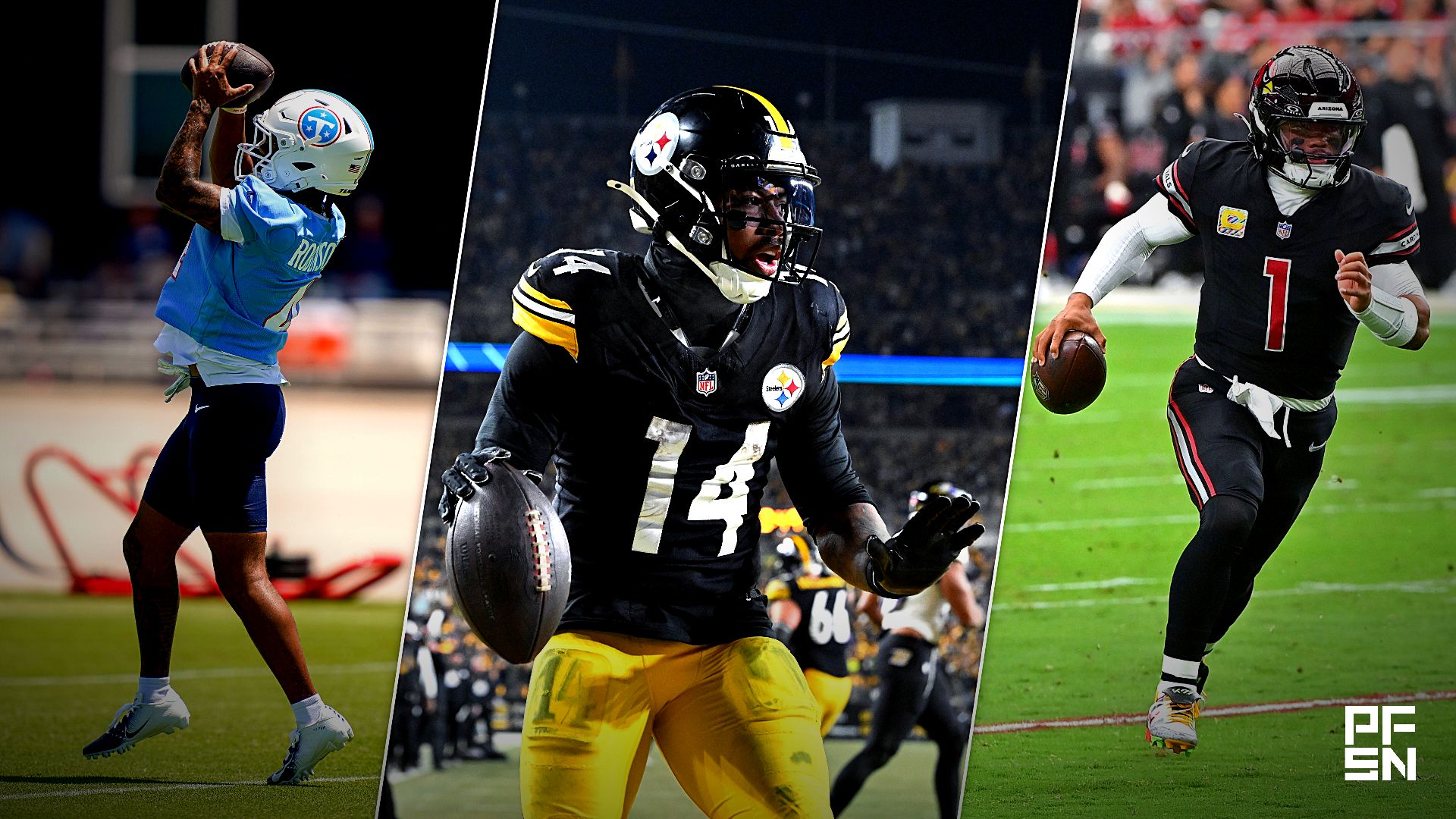
Everyone knows to draft Jahmyr Gibbs and Ja’Marr Chase in the first round of fantasy football drafts. Leagues are won by finding those under-the-radar guys who significantly outperform their cost. It’s still early with training camp yet to begin, but that doesn’t mean we can’t identify some sleepers based on current average draft position (ADP).
QB Sleepers Kyler Murray, Minnesota Vikings
ADP: QB17
The idea that Kyler Murray is washed has taken hold, and I don’t understand it. Sure, the Arizona Cardinals’ moving on made sense for both sides after seven years and a single playoff appearance, but there’s a canyon between failing to live up to a No. 1 overall pick and being unworthy of an NFL starting job. Murray is comfortably one of the 32 best quarterbacks on the planet, and I expect him to win the Minnesota Vikings’ job over JJ McCarthy and start all 17 games, health permitting.
Here’s the part fantasy managers are ignoring. When Murray plays, he produces. Last season was a five-game disaster at 15.6 PPG, torpedoed by injury and a Cardinals team that had quietly checked out on him. In each of the six years prior, though, he finished as a QB1, with a floor of 17.5 PPG in 2024 and peaks of 23.7 and 21.5 in 2020 and 2021.
Now he lands in Kevin O’Connell’s quarterback-friendly system with Justin Jefferson, Jordan Addison, and Jauan Jennings to throw to. Add in the 36.7 rushing yards per game he brings to the table and a handful of rushing scores, and the rushing floor alone keeps him afloat on weeks the arm doesn’t cooperate. Murray carries a QB17 ADP, which sits below a mark he has never actually finished at when healthy. Wait on the position and circle his name.
Tyler Shough, New Orleans Saints
ADP: QB20
Quarterbacks who are 26 as rookies aren’t supposed to matter. Tyler Shough spent the back half of his rookie year proving he could, and the box score everyone will glance at sells him short. Shough’s 14.4 PPG average is dragged down by early cameos and a couple of training-wheels starts before Kellen Moore turned him loose.
Look at the stretch that counts. From Weeks 10 through 18, Shough averaged 18.0 PPG, and from Week 13 on he cleared 17 fantasy points in every single game. That is bona fide QB1 production over half a season. He isn’t a runner by trade, but he chipped in 5.1 PPG on the ground from Weeks 12 to 18, so the mobility is functional rather than nonexistent.
START PREPARING: PFN’s Fantasy Mock Draft Simulator
The situation only sweetens the pot. Moore inherited a barren offense last year and still has it trending up. The New Orleans Saints reinforced it this offseason by adding Travis Etienne and Jordyn Tyson alongside Chris Olave and Juwan Johnson.
Moore’s offenses have finished top seven in scoring four times as a coordinator. At a QB20 ADP, I’m not asking Shough to be elite. A 17-to-19 PPG season is well within reach, and that kind of return at that kind of cost is exactly what waiting on quarterback is supposed to look like.
RB Sleepers: Kenny Gainwell, Tampa Bay Buccaneers
ADP: RB37
If Kenny Gainwell were a wide receiver, he’d be one of the all-time easy fades. Through four seasons to open his career, he never topped 7.7 PPG. Everything changed in 2025, when he stepped into Pittsburgh’s passing-down role and posted a career year on the back of a 16.3% target share that ranked fifth among all running backs.
This wasn’t empty volume, either. Gainwell averaged 1.59 yards per route run (seventh in the league) and 4.32 yards created per touch (fourth). So, the efficiency backed up the workload. We even got a glimpse of his ceiling in a Week 11 spot start for an injured Jaylen Warren. In that contest, Gainwell handled 64% of the snaps and dropped 29.5 fantasy points.
Gainwell now heads to the Tampa Bay Buccaneers, and the runway is real. He profiles a lot like the departed Rachaad White, except he’s better at basically everything White did.
Sean Tucker figures to keep the goal-line work, which caps the ceiling, but a dreadful 2025 from Bucky Irving leaves early-down snaps up for grabs, in addition to him likely having a monopoly on passing down work
Gainwell’s RB37 ADP opened closer to RB40 and has been climbing all summer for a reason. He’s one of the best RB3s you can draft so long as the price doesn’t creep too high.
Rachaad White, Washington Commanders
ADP: RB38
There is nothing fun about the way Rachaad White scores fantasy points, and that’s sort of the point. He’s death by a thousand cuts. A 60-yard house call isn’t in his game, but he’ll grind out a steady stream of touches and catches, and the Washington Commanders may give him more of them than people think.
White is one of the best pure receiving backs in the league, and Washington doesn’t have an obvious second option in the passing game behind Terry McLaurin. He already has a 64-catch season on his ledger, and a 50-plus reception campaign is very much on the table. That alone justifies an RB38 price tag.
DIVE IN: PFN’s Fantasy Football HQ
Then there’s the upside. Jacory Croskey-Merritt couldn’t seize the lead job last season even when it was handed to him, to the point that Chris Rodriguez briefly took it from him. If Croskey-Merritt stumbles again, White is the far more trusted veteran and could push toward 15-plus opportunities per game. I have him circled as a plug-and-play RB3 with a real path to standalone RB2 value, and I’m targeting him aggressively while the cost stays this low.
Dylan Sampson, Cleveland Browns
ADP: RB53
Once you’ve exhausted the obvious starters, the smart money goes to talented backups with a path to volume. Dylan Sampson checks every box. The 2025 fourth-round rookie managed just 5.8 PPG a year ago, but the underlying numbers scream that a bigger role is coming.
Sampson was quietly one of the most efficient backs in football last season. He led all running backs with 2.02 yards per route run and paced the league at 4.87 yards created per touch. Those aren’t the marks of a rotational piece; they’re the marks of a legitimately talented player being underused.
This year, Sampson steps in as the clear No. 2 back for the Cleveland Browns behind Quinshon Judkins, and his profile as a pass catcher is the separator. Cleveland projects to trail in a lot of games, which pushes more passing-down work his way, and his 8.7% target share from a year ago should climb. Standalone RB3 value is realistic at an RB53 ADP, and if anything happens to Judkins, Sampson carries high-end RB2 upside. That’s a dart worth throwing every time.
WR Sleepers: Michael Pittman Jr., Pittsburgh Steelers
ADP: WR47
Michael Pittman Jr. isn’t going to win you a league, and I’m not going to pretend otherwise. What he will do is dramatically outproduce a WR47 ADP that makes no sense given his track record. Last season, playing in a crowded Indianapolis pecking order alongside Alec Pierce, Tyler Warren, and Josh Downs, Pittman still averaged 11.9 PPG and finished as the WR26.
A move to the Pittsburgh Steelers should help more than it hurts. Yes, he now shares a room with DK Metcalf, but Pittman’s game fits Aaron Rodgers far better at this stage of the quarterback’s career.
Rodgers averaged just 6.1 air yards per throw last season, 37th in the league, and attempted only 3.0 deep balls per game. That’s a short, high-volume passing profile tailor-made for a possession receiver.
TRADE NOW: PFN’s Dynasty Trade Calculator
Picture a steady diet of 5-catch, 50-yard afternoons with the occasional touchdown mixed in. That’s not sexy, but it clears the bar of a top-48 receiver with room to spare. Pittsburgh added a receiver who finished as the WR26 last season for pennies, and he’s being drafted more than 20 spots later than where he ended up. Sign me up.
Wan’Dale Robinson, Tennessee Titans
ADP: WR50
Sometimes the best values are guys coming off strong seasons that nobody believes in. Wan’Dale Robinson averaged 13.6 PPG last year and finished as the WR14, and yet he’s being drafted outside the top 48 receivers. The catch is that his production came in an inflated role after Malik Nabers went down, which forced Robinson into a 29.6% target share he won’t sniff again.
Here’s why I don’t care. Robinson reunites with Brian Daboll on the Tennessee Titans, and even in a reduced capacity behind top target Carnell Tate, he profiles as the clear No. 2 working underneath. His target share is coming down, no question. The price, though, has come down even further, to the point of being essentially free.
Robinson is a former second-round pick who posted 1.88 yards per route run last season. Even if he reverts all the way back to the low-aDOT, 7.5-yards-per-reception version we saw in 2024, that’s still a plus return at a WR50 ADP. If this cost holds through the summer, I’ll have him in every league.
Tre Tucker, Las Vegas Raiders
ADP: WR63
Deep in every draft, there’s room for one lottery ticket with real spike-week juice. Tre Tucker is mine this year, with the caveat that his outlook shifts the moment the Las Vegas Raiders add a receiver. As the roster sits, Brock Bowers is the alpha, but Tucker is the clear favorite to lead the wideouts in targets.
The traits are loud. Tucker ran a 4.40 and flashed genuine ceiling last season, including a 40.9-point eruption in Week 3. He only averaged 9.5 PPG on the whole, but the top-end weeks are what make a guy going outside the top 60 WRs worth rostering.
The context is trending up, too. Klint Kubiak is among the most creative offensive minds in the league, and the quarterback play should improve from what Geno Smith provided last season, first with Kirk Cousins and eventually with rookie Fernando Mendoza.
Tucker won’t be a set-it-and-forget-it starter, but as the last receiver on a roster, he offers the kind of upside that can swing a week. That’s exactly what you want out of a final-round flier. And if he doesn’t work out, you can easily drop him.
TE Sleepers: Brenton Strange, Jacksonville Jaguars
ADP: TE19
Tight end is a barbell position. You either pay up for one of the handful of difference-makers, or you punt it entirely and take your swing in the last round. Brenton Strange is the swing I want.
Strange averaged 9.8 PPG and finished as the TE18 last season, which sounds like nothing until you realize that’s basically the going rate for a dozen tight ends every year. What separates him is the peripheral profile. His 1.81 yards per route run ranked eighth at the position, and he landed inside the top 10 in both yards per target and first downs per route run despite being no better than the fourth option in the Jacksonville Jaguars’ passing game.
MORE: Top 5 Fantasy Running Backs for 2026: Bijan Robinson Is the 1.01, and It Isn’t Close
Now think about the touchdowns. Strange is a 6’4″, 250-pound red zone target who somehow found the end zone just three times in 12 games. Trevor Lawrence threw 29 scores for the sixth-best scoring offense in football, and if even two or three more of those find Strange, he’s flirting with 11 PPG and a top-12 finish. Add in that he’s the only pass catcher in Jacksonville with a truly locked-in role, playing north of 80% of the snaps, and a TE19 ADP that means he’s free. Punt the position and grab him.
AJ Barner, Seattle Seahawks
ADP: TE24
Once you’ve committed to punting tight end, the goal is simply to not be worse off than the managers who spent a real pick there. AJ Barner clears that bar comfortably at a TE24 ADP. He jumped from 4.6 PPG as a rookie to 8.7 as a sophomore, finishing as the TE20 while flashing the occasional monster week, headlined by a 24.3-point, overall TE1 showing in Week 5.
The role isn’t glamorous. Barner ran a checkdown-heavy route tree with a 4.4 aDOT and a modest 15% target share, and his 1.3 yards per route run left plenty to be desired. But at 6’6″, 251 pounds, he’s a natural red zone weapon, and six touchdowns on 52 grabs is a repeatable trick given his frame.
Consider the comparison that matters. Dalton Kincaid is going off the board as the TE12, yet Barner produced more usable weeks than him a year ago. Behind Jaxon Smith-Njigba, the Seattle Seahawks lack a clear second target, and if Barner even settles in as the third read, he leapfrogs a bunch of tight ends drafted ahead of him. He’s not someone you need to draft, but he’s the perfect insurance policy that lets you wait out the position entirely.
