


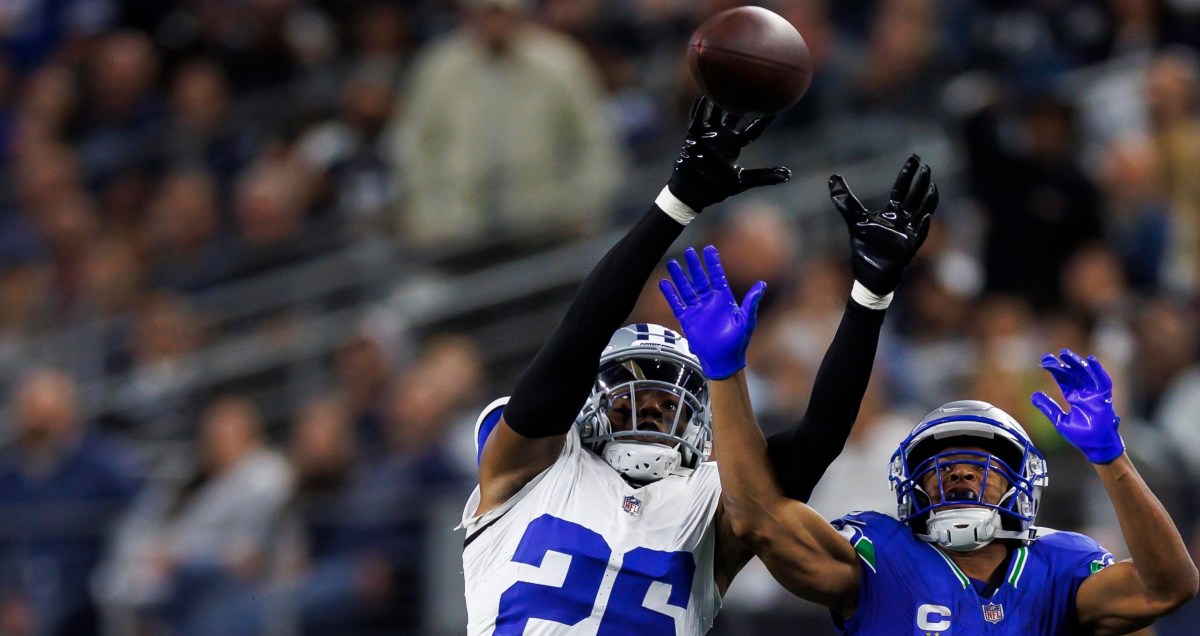
In Tuesday’s press conference, Cowboys head coach Brian Schottenheimer touched on the topic of turnovers when Brad Sham of 105.3 The Fan asked him the following question:
Sham: “When you’re talking ab0ut the turnover margin, are you – don’t say “both” – are you more concerned about improving the way …“
Schottenheimer: “Both!”
Sham: “You cannot say “both”! Are you more concerned with the way you protect the ball or improving the rate at which you took it away.“
Schottenheimer: “Well, if you’re not going to let me say what I want to say …. I’m going to start with: If you don’t give it up, then you’re not going to lose the turnover battle. So if we don’t turn the ball over it’s going to be zero.”
“We proved it last year, Brad, that we could go four straight games [Weeks 4-7] without a turnover. There were too many multiple-turnover games [6] on offense. We were sloppy, we were careless with the ball. Mostly as ball carriers.”
“A couple of them were on third-and-long, like situations where we were checking the ball down, we were probably going to punt, and we ended up losing possession of the ball.”
Earlier in the press conference, Schottenheimer had already addressed what the Cowboys are doing to limit turnovers on offense.
Schottenheimer: “You’ll see a big emphasis on ball security for us. I say it, I think every time I’m up here and because it disgusts me: minus 9 [turnover differential]. It’s awful. We’ve got to protect the ball better on offense, we’ve got to take it away on defense, but that’s an area where we need to make a big jump.”
“Last year we didn’t really spend a lot of time doing ball-security circuits, so are you going to repeat history? No, you’re going to do something about it.”
So Klayton [Adams], Derrick Foster, the offensive staff, LW [Luna Wells], they’ve done a great job of coming up with different ball-security circuits where we’re teaching guys not only how to protect the football […] it’s basic fundamentals […] so there’s things like that where we’re doing a deep dive to get it fixed.“
It’s not exactly a secret that turnover differential is highly correlated with winning in the NFL. It’s great that the Cowboys are aggressively looking at ways in which they can reduce their turnovers on offense, and though Schottenheimer wasn’t allowed to say it, we can assume they are looking for a lot more takeaways from their defense as well.
Because the bigger the turnover differential in your favor, the bigger the chance you’ll win the game. Heck, we even have the numbers to prove it: Last season, teams that won the turnover battle won 79% of the time (164-54-1 record in games in which one team had more turnovers than the other). Here’s a breakdown of winning percentages by turnover differential:
| NFL winning percentage by Turnover Differential, 2025 regular season | ||||
| +1 | +2 | +3 | >3 | |
| Winning %-age | 68% | 86% | 91% | 90% |
| Winning record | 70-32-1 | 56-9 | 29-2 | 9-1 |
Unfortunately, knowing about the importance of turnovers and actually getting turnovers are two very different things, in part because of the inherent randomness of turnovers. In OTAs, and likely later in camp as well, the Cowboys are doing their due diligence by practicing and emphasizing things like ball control, fumble recoveries, ball stripping, and even have their defensive backs catching balls, all in the hopes of improving their turnover differential.
But outside of these specific drills and the ball-security circuits Schottenheimer was talking about, there may be a much bigger factor in determining the number of defensive takeaways, and specifically interceptions: the Cowboys’ offense.
At first glance, this may seem like an odd statement, but it will make a lot more sense when you look at when the majority of interceptions are thrown: Only about a fifth of all 380 interceptions thrown last year in the regular season came when the offense was playing with a lead. Most interceptions happen when you’re playing from behind.
Here’s a detailed breakdown of the interceptions thrown last year, listed by the score differential at the time when those interceptions were thrown.
| Interceptions by score differential, 2025 regular season | |||||
| Behind by 8 or more pts |
Behind by 1-7 pts |
Game tied | Ahead by 1-7 pts |
Ahead by 8 or more pts |
|
| Interceptions thrown | 125 | 101 | 72 | 56 | 26 |
| In % of total INTs | 32.9% | 26.6% | 18.9% | 14.7% | 6.8% |
Last year, like every year before that, teams threw a lot more interceptions when they were playing from behind than they did when playing with a lead. Almost two thirds of all interceptions were thrown when teams were playing from behind.
And when you stop to think about it, the numbers above actually make sense. We’ve seen it time and again, once you’re playing from behind, your ground game goes out the window, and you start taking more risks in your passing game in an effort to catch up. An that’s true for the Cowboys as well: of the 12 interceptions last year (10 by Prescott, 2 by Milton), 11 came when the team was playing from behind, and 10 of the 12 INTs came when the Cowboys were behind by 10 points or more.
And the stats bear this point out as well. The interception rate (interceptions divided by passing attempts) increases the further a team is behind, and the Pass/Run ratio tilts heavily towards the passing game when teams are playing from behind. Conversely, when playing with a lead, especially a big one, teams tend to run more than they pass, and they take fewer risks in the passing game, which in turn leads to fewer mistakes and turnovers.
| Pass/Run ratio and INT% by score differential, 2025 regular season | |||||
| Behind by 8 or more pts |
Behind by 1-7 pts |
Game tied | Ahead by 1-7 pts |
Ahead by 8 or more pts |
|
| INT/Pass Attempts | 2.8% | 2.1% | 2.3% | 1.8% | 1.3% |
| Pass/Run Ratio in % | 65% | 57% | 53% | 50% | 42% |
Scoring more and earlier will put the Cowboys’ opponents in the situation described above, where they have to lean on the pass and take greater risks in order to try catch up. This, in turn, will allow the defense to make more plays. As the opposing offenses are forced to go to the pass, the defense can sit back in its nickel and dime formations and simply wait for the opposing offenses to make mistakes.
Over the last five seasons, the Cowboys’ turnover differential has been all over the place, but there’s a clear difference between years they made the playoffs (*) and years in which they didn’t.
- 2025: -9 (T29th)
- 2024: -6 (T23rd)
- 2023*: +10 (T5th)
- 2022*: +10 (2nd)
- 2021*: +14 (T1st)
If the Cowboys find a way to jump out to an early lead in games more often, we should see a significant improvement in the Cowboys’ turnover differential. And you know what that means?
Playoffs, baby.
