


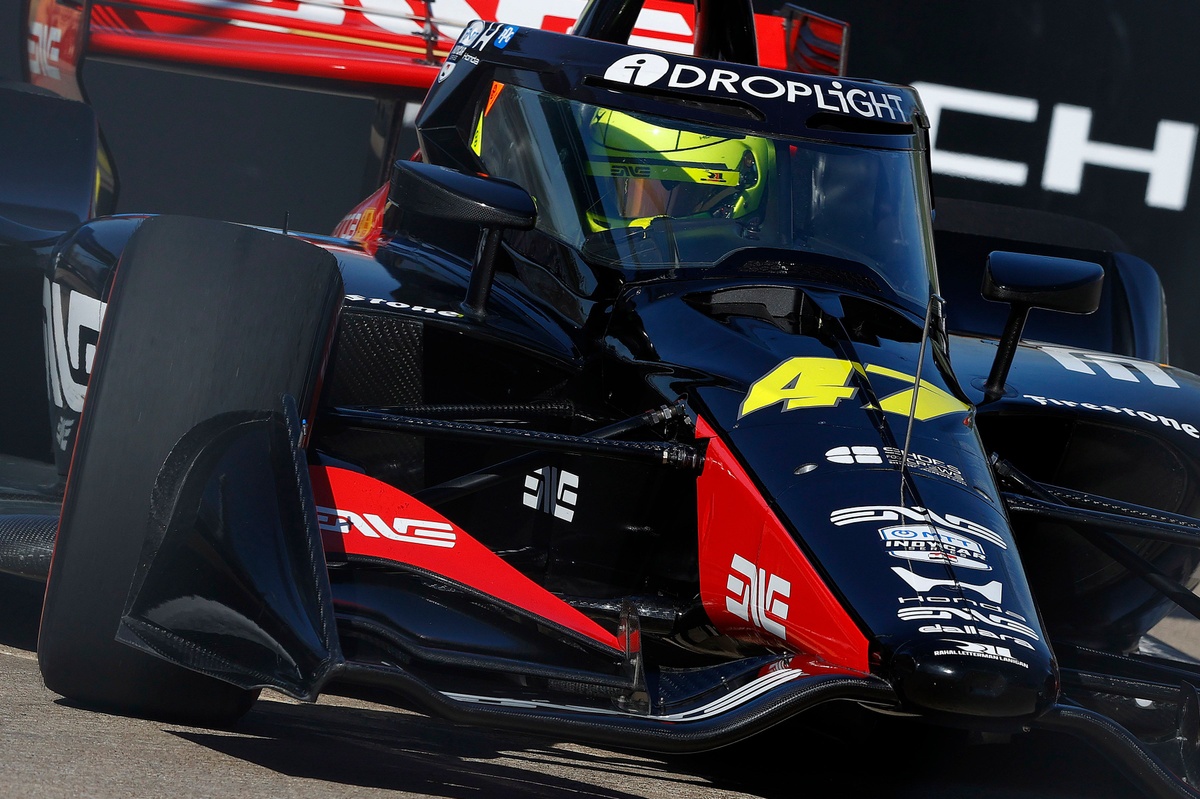
Mick Schumacher has completed the first four races of his rookie season in the IndyCar Series with at least one race weekend on every track type – oval, road course, and street circuit.
But the biggest challenge is still ahead and the official pre-test for the Indianapolis 500 will take place at the end of April. Free practice for the Indy 500 will begin in the second week of May.
In an exclusive interview with Motorsport.com, Mick Schumacher talks about how he has settled into IndyCar as a driver, what the biggest challenge is for him at the race weekends, how the IndyCar series differs from Formula 1, as well as what he hopes and plans he has for the rest of the season.


Question: “What’s it been like being back in equipment where you’re the only driver? Like you’re not having to share a seat with somebody like you had to do in WEC, and what’s it been like to kind of get back into the norm of that?”
Mick Schumacher: “It’s been really good. I really enjoy it. You know, just working away and not having to make any compromises, I think, is the easiest way of explaining that.
“I think, obviously, we’ve had a couple of changes in staff so far, which has been not easy, because you kind of always have to readjust. But having worked with Eddie has been pretty fun at Barber, and I’m pretty excited to go into Long Beach and have a chat with him.”
Question: “I don’t want to stereotype. I don’t want to think anything one way or the other. I kind of just want to leave it to you on this. But for you, what’s been kind of the most important realization with coming to IndyCar so far?”
Schumacher: “You know, I think it’s obviously a bit different in terms of how you structure your weekend than anything that I’ve raced in so far. In terms of Friday, you just do one practice on Friday, and then you’re kind of off and you’re going into the next night, basically. And then Saturday, it’s really shortly packed.
“So, whatever you kind of have after FP1 and decide to go for, usually there’s not much time to change it for qualifying. So, you have to be pretty precise in what kind of setup changes you want to have from Friday to Saturday. And that’s pretty much the same for the Sunday.
“So, that’s where I feel in FP1, you have more time, essentially, to get everything to be perfect, or as close to perfect as it could be, to then stick with it for the weekend. So, that’s, I think, what has been the most realization in a way that I’ve just been trying to really make sure I understand that. The approaches, the changes that we can make, the options that I have, and then really understand the timing of the weekend.
I think that’s been the most difficult part.”
IndyCar vs. Formula 1: Where the differences lie

Mick Schumacher, Rahal Letterman Lanigan Racing, Romain Grosjean, Dale Coyne Racing
Photo by: Penske Entertainment
Question: “I find something kind of interesting, because I’ve had a chance to cover a handful of F1 races, and obviously, I’ve spent most of my time in IndyCar. And there’s such a division between one side of the world and the other in terms of who thinks of what, in terms of, I don’t want to say superiority, but certainly in terms of just what they have to offer in terms of talent. And I’m just kind of curious, do you see more similarities between F1 and IndyCar than maybe a lot of the people genuinely have a chance to see? Or are they so vastly different that it makes sense that there is so much division?
Schumacher: “I mean, you cut out a bit in that question, but overall, I would say there’s been, for sure, similarities here and there. But I think, how do I say this, that they’re very different in terms of, let’s say, driver-to-car relation. So IndyCar, most of the time, they will try and do everything they can to adjust the car as much as they can towards your driving style.
“And in F1, that’s always been something where they’ve had their philosophy, and they would be very much data-driven. So whatever they feel like they see on data to be the fastest, they will most of the time tend towards that. So it’s just a different way of working.
“I feel like it’s a very positive way of working, to be honest, just because it will be the most natural to you. And so that’s been something that has been quite fun to work towards and something to get adjusted to.”
Question: “Because it almost sounds like, in your opinion, I’m paraphrasing here, but it almost sounds like it’s more raw, that you can go at it from a driver philosophy as opposed to having to always cater to an engineer’s philosophy. It’s almost like backwards, where an engineer is kind of catering to your style in that sense. Is that correct?”
Schumacher: “Yes, that is correct. For example, in Europe, I’ve generally been very good at adapting and adjusting to new stuff. So I think that’s probably a bit counterintuitive, but it doesn’t really help me out here, because whatever we change into the car, I’m adjusting to the previous car.
“So it’s always trying to get the feeling and the philosophy right between me and the car, so that I don’t start changing, adjusting or adapting to something that I’ve had earlier, but actually stay more consistent so that we can adjust the car towards what works for me.”
What Schumacher has to struggle with as an IndyCar rookie

Mick Schumacher, Rahal Letterman Lanigan Racing
Photo by: Penske Entertainment
Question: “In Formula 3 and Formula 2, you kind of took two years to get yourself to go from learning the program to getting an opportunity to compete at the front of the pack. And I’m just kind of curious, do you almost see this as a similar time frame? Do you look at this and think, even though you don’t consider yourself a rookie, even though that’s the label that IndyCar wants to give you, but knowing what you have to learn, knowing the championship and the diversity with the track disciplines, do you almost look at this that you need a good two years to properly get from learning everything to competing on a regular basis at the front of the pack like you did in F3 and F2?”
Schumacher: “Yeah, maybe. I think that in F3 and F2, there were obviously different circumstances putting it that way or making it look that way. I think here at IndyCar, I think a lot of it comes down to just not knowing the tracks.
“I have no idea most of the time to the weekends. So essentially, in comparison to some of the other guys, or most of the other guys, I think even everybody, they’ll use their free practice to actually work on the car, to actually work on the things they need to work on, whilst I probably will use 10 to 15 laps just to get acquainted with the track. Those are 15 valuable laps that I don’t really have to spare at the moment, but I still need to just to be able to get acclimated.
“So yeah, maybe it will be a bit longer, but it’s also I guess a question of this field being very niche in some ways, if you want that. I feel like a lot of the guys out here, they’ve been driving this car for so many years, they have just perfectionized the way of driving it. Even though they’ve always kind of adjusted the car a little bit with the hybrid now lately, it’s still a very similar car that has been around for what, 16 years now?
“And that is a long time. In F1 or in any other championship that I’ve driven so far, nothing stays longer than four years. And so, yeah, it is definitely something that might take some time, but I also, I think I just need a good weekend.
“That’s what we need. And the thing is, we’ve had a bit of an unlucky streak going through now these weekends. I mean, I guess the real one, the oval has been great on the qualifying lap, but then obviously that first time driving in an oval and getting thrown into the deep end right at the front was probably not the easiest.
“And then the tire gun failure didn’t really help either to really solidify the results that I think we could have had, because the pace on all the weekends we’ve been so far, honestly, has been at par with the guys that have been running in the top 10. And then Barber has been pretty much as what the top guys were doing once they got everything sorted. So, you know, there are great, great things out there on the horizon. It’s just a matter of time, in my opinion, that we need to put everything into place so that we then can also earn those results that we’re meant to earn.”
Question: “I’m fascinated by something, because talking to Graham [Rahal] and talking to a couple of other people, the way that you carry yourself, you are like a consummate professional in terms of your habits, your studying, the amount of stuff that you put into this, the amount of effort that you put into this. It almost sounds like you put, I don’t want to call it too much pressure, but I’m curious, what is the amount of pressure you put on yourself? And is there any part of that where you almost have to reign it in a little bit and remember to have fun with this?”
Schumacher: “I think there are two aspects to this. European racing is very different. It’s a very tough environment. It’s an environment where you have to learn to survive. And essentially, usually the way I used to survive was by working harder than everybody else. Or at least I tried to. I mean, I can never judge how hard other people work, but I definitely will try and work as hard as I can in any circumstance, in any situation. Now, coming over here, my mentality is to not change that. Because if I do change that and I relax and I have fun and stuff, I feel like I’m just not going to perform as well.
“Because then you’re not putting the pressure on you that you need to, because it is still my job. It is still my place to do all the best that I can. And I really have to work for that.
Because, again, I am somebody who has never seen these tracks, so I need to work double time to be able to be on a position or in a position to be able to fight with the top guys.”
IndyCar has been “super fun” for Schumacher

Mick Schumacher Oval Test at Homestead-Miami Speedway – Wednesday_ February 4_ 2026_Ref Image Without Watermark_m145039
Photo by: Penske Entertainment
Question: “How much fun is it to drive the IndyCar compared to other things that you’ve driven now that you’ve had…You’ve raced on every track discipline now. You’ve tested it a couple of times. I’m fascinated to know what your takeaway is from driving an IndyCar compared to other things that you’ve driven.”
Schumacher: “Well, you know, I love racing. And that’s what makes it fun. So even though I said what I said earlier, it doesn’t mean that I’m not enjoying myself. Because it is the thing that I love the most. And racing an IndyCar has been super fun. And it’s usually the one place where I have the most competition and it’s mostly the places where I feel the most, let’s say, satisfaction when it does go well.
“So I’m super stoked on this season and I’m so excited for the rest of it. And we’ve got so many beautiful racetracks that we’re still going to. And yeah, there’s still a bit of a culture shock sometimes when I get to places like, I don’t know, Arlington.
“And it’s just bumpy as hell. It’s so different. But nonetheless, it’s still something that is part of IndyCar and it’s something that is part of the fun and the flair. Obviously, I think in the future, is there a potential to improve that? Of course. But it’s still something that I get to enjoy and work at.
“And yeah, I do kind of see myself in a position of maybe being helpful in safety and what can we do to improve everything. Because I have all the experiences from the European racing. You know, if it was a single seater, but also sports car. And to see what was good there and what was bad there. So that, you know, hopefully we can all work together to make it great out here.”
We want your opinion!
What would you like to see on Motorsport.com?
– The Motorsport.com Team
