


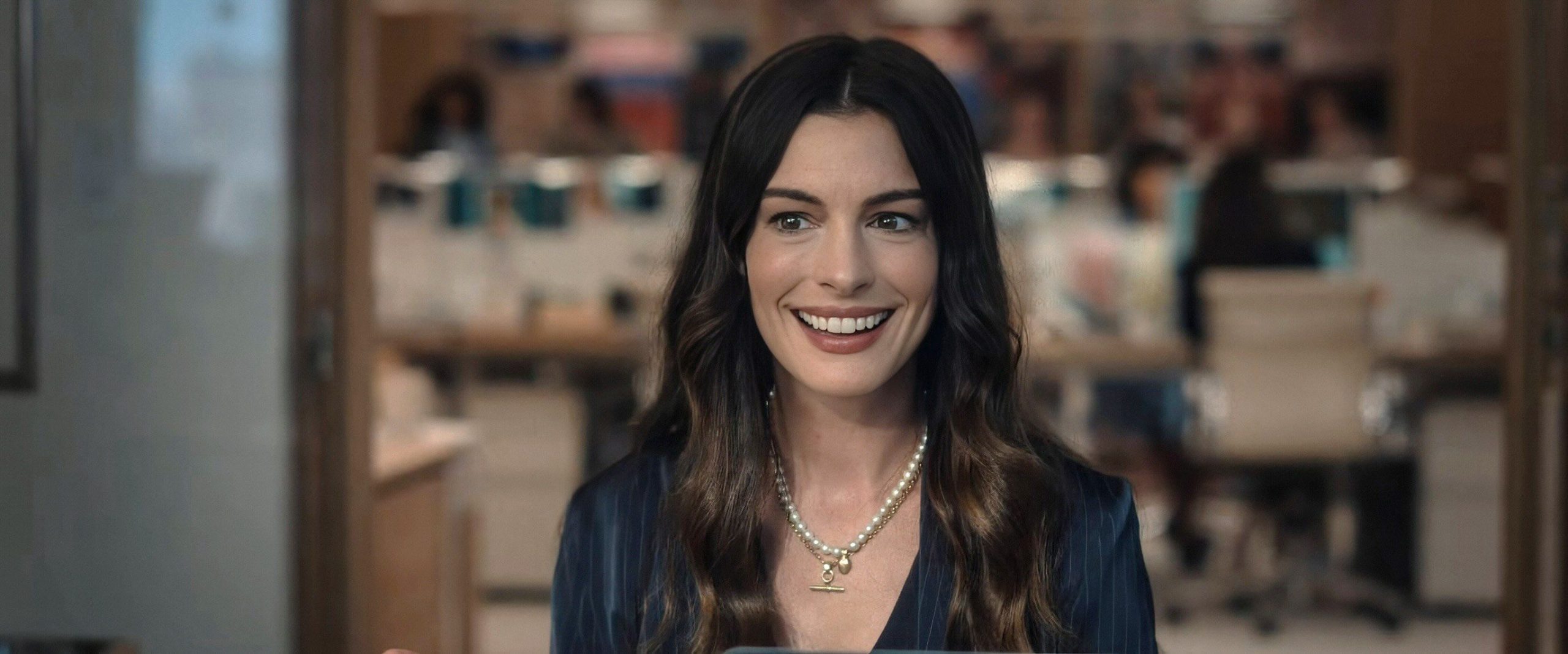
It started a month ago. “Are you going to see the movie?” a mom asked me after morning drop-off. Was she talking about Hoppers? A forthcoming playdate at a Mandalorian & Grogu screening? I looked at her blankly.
And then: “You know, the one about where you work…”
Let’s get the obvious out of the way: The Devil Wears Prada is entertainment. Little of what you will see onscreen in the original (or the sequel) bears any resemblance to reality. Nonetheless, at the end of the screening many members of the Vogue staff attended this week, one colleague turned to me with a slightly ashen look. “Did they bug our offices?” she whispered.
There were, shall we say, a few things that cut a bit close to the bone—not unlike the original book, as outlined in stylist Leslie Fremar’s revealing recent interview for our podcast.
The sequel concerns Andy Sachs’s return to Runway—now as the features editor. After the magazine’s parent company faces a PR crisis, Andy, who has spent the intervening decades toiling away on noble journalistic pursuits like three-part investigations of the Federal Reserve, is hired to burnish the glossy’s reputation with mea culpa blog posts and capital-S serious journalism—or so she hopes.
I have spent most of my time at Vogue telling people that The Devil Wears Prada doesn’t remotely reflect my working life. That argument is aided by the fact that while an awareness of fashion is a prerequisite for working here, my job is firmly outside the fashion trenches. I dart out of the way of the rolling racks whizzing around the floor; I’m not pushing them. I’ve been to about half a dozen shoots in my almost decade working here—enough to convince me my presence wasn’t much appreciated. I have stacks of books on my desk and a single pair of shoes under it.
But the sequel seemed to offer a different proposition—a features editor (the star of the film, no less) stepping in to save the day? A fact-check was called for.
Andy’s Friends
Film: A motley crew of wizened journos—the types who attend awards dinners at Midtown hotels where the tables are round and have no centerpieces. There’s one (Tracie Thoms, reprising her role as Andy’s scold-y friend Lily) who, judging by the real estate she occupies, seems to have made good with her gallery.
Reality: I, too, have friends who own art galleries and have multiple boxes of Maldon salt on their open kitchen shelves. Pantry props may be about where the similarities end. The only people I know with Manhattan lofts like Lily’s have inhabited them since the ’70s. At the start of my career I worked in Washington, D.C., so I keep many wonky types close to my heart. They dress better than these caricatures, but they would really dig a three-part investigation of the Federal Reserve.
Andy’s Apartment
Film: Andy’s promotion allows her to move on up from a charming prewar apartment with a penny-tiled bathroom—Mrs. Meyer’s soap on the sink—dodgy plumbing, and New Yorker totes hanging on the hooks, to a deluxe (soulless) condo in a hollowed-out historic building.
Reality: I don’t think that even the most far-from-fashion of the features editors would happily reside in the cookie-cutter white box that Andy moves into. The dream is living within walking distance of your kids’ school, of course!
Andy’s Clothes
Film: A wardrobe of sensible but stylish blazers paired with jeans and blouses is replaced with outfits my fashion colleagues will have to detail for you—the references are beyond me. When Andy is invited to the Hamptons, she tours the fashion closet with Nigel to pad her roll-y bag with borrowed items.
Reality: Save for a throwaway line or two referencing the fact that she’s obtained some item secondhand, and the fact that she occasionally seems to wear jeans to the office, there was nothing recognizable in the way that Andy approaches clothes. It took me years to work up the courage to even enter the fashion closet. I wouldn’t dream of touching something there, let alone consider it mine for the taking, even for a weekend. Weirdly, I found the film version of the closet a bit more cluttered and less organized than the real one—the rare occasion when reality is more impressive than its fictional depiction.
How It Works in the Office
Film: Andy hovers outside Miranda’s office, she constantly seeks affirmation, she half-heartedly speaks up in meetings with non-sequiturs that are vaguely self-congratulatory. She also promises a story that she hasn’t even begun to lay the groundwork for.
Reality: None of this. You visit any colleague with a concise question. (You learn quickly here that timeliness and efficiency are some of the most important ways in which you demonstrate respect.) You speak up with an idea you’ve considered and believe in; it would take a brave (and foolish) person to pitch a story they had no idea how to begin to deliver. One accuracy: While many people read things on screens, it’s still a common practice to print pieces for the “take home” and have to decipher handwritten notes when they are returned.
How It Works More Broadly
Film: Andy goes with Miranda when she travels, she’s taken along like an accessory to smooth the feathers of ruffled advertisers, she’s invited to Miranda’s house in the Hamptons.
Reality: No, no, and no.
How It Looks in the Office
Film: The office is all blond wood and creamy boucle-upholstered furniture, offices encased in glass like Scandinavian fishbowls, and views over the New York City skyline. Vases filled with single-colored dahlias. Light boxes with rows of image slides.
Reality: Not entirely off—though most of us sit at open-plan desks and you’d be hard-pressed to find any boucle anywhere. But single-color flower arrangements do make not-infrequent appearances on many desks, there are a lot of glass walls and doors, and we have some pretty nice river views. No light boxes, though.
What You’ll Gain Working at Vogue
Film: Your work might eat away at your weekends, but it can also be very, very fun. Even more importantly, you’ll form the kind of friendships that lead to relationships that live beyond your tenure.
Reality: No notes!
