


Known non-biological sources, from meteorites to surface chemistry, fall short of accounting for organic compounds detected by NASA’s Curiosity rover, according to a new study published in the journal Astrobiology.

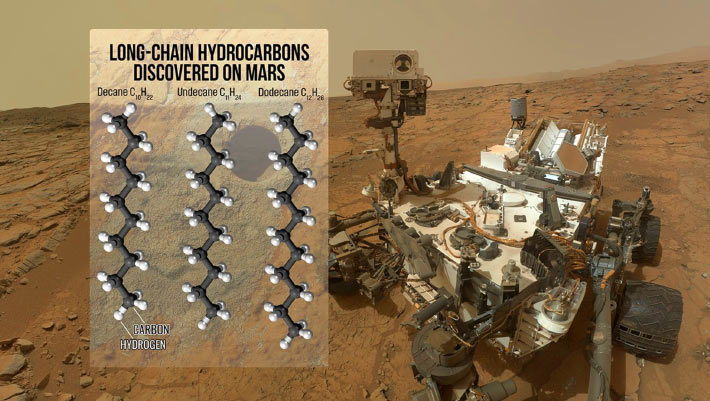
This graphic shows the long-chain organic molecules decane, undecane, and dodecane, and NASA’s Curiosity rover. Image credit: NASA / Dan Gallagher.
In 2025, planetary scientists reported the detection of long-chain alkanes at concentrations of roughly 30 to 50 parts per billion in the ancient Cumberland mudstone in Gale crater, Mars.
They proposed that the alkanes were derived from thermal decarboxylation of fatty acids during analysis by Curiosity’s Sample Analysis at Mars (SAM) instrument.
In a new study, Dr. Alexander Pavlov from NASA’s Goddard Space Flight Center and his colleagues argue that the measured values are merely a lower limit, because most of the original organic material was likely destroyed by radiation over tens of millions of years.
The Cumberland mudstone may originally have contained between 120 and 7,700 parts per million of long-chain alkanes or their fatty-acid precursors before it was exposed at the surface.
“To reach this conclusion, we combined lab radiation experiments, mathematical modeling, and Curiosity data to ‘rewind the clock’ about 80 million years — the length of time the rock would have been exposed on the Martian surface,” the researchers said.
“This allowed us to estimate how much organic material would have been present before being destroyed by long-term exposure to cosmic radiation: far more than typical non-biological processes could produce.”
The scientists also assessed whether known non-biological processes could explain the unusually high inferred abundance of long-chain alkanes.
According to the study, delivery by meteorites and interplanetary dust particles is insufficient by many orders of magnitude, given the estimated sedimentation rates and the inability of dust particles to penetrate lithified rock.
Atmospheric production of organic haze is also unlikely, because early Mars probably lacked the methane-rich conditions required to generate substantial haze deposition.
The authors also examined hydrothermal processes that can produce hydrocarbons under certain conditions.
While lab experiments show that long-chain organic molecules can form hydrothermally, the mineralogy of the Cumberland mudstone indicates it did not experience the high temperatures associated with such reactions.
The findings suggest a more speculative possibility: that some or all of the original organic material could have been produced by a hypothetical ancient Martian biosphere.
“We agree with Carl Sagan’s claim that extraordinary claims require extraordinary evidence and understand that any purported detection of life on Mars will necessarily be met with intense scrutiny,” the researchers said.
“In addition, in practice with established norms in the field of astrobiology, we note that the certainty of a life detection beyond Earth will require multiple lines of evidence.”
“Nevertheless, our approach has led us to estimate that the Cumberland mudstone conservatively contained 120-7,700 parts per million of long-chain alkanes and/or fatty acids before exposure to ionizing radiation.”
“We argue that such high concentrations of long-chain alkanes are inconsistent with a few known abiotic sources of organic molecules on ancient Mars, namely delivery of organics by interplanetary dust particles and meteorites, atmospheric fallout and deposition from photochemical haze, and organic production from serpentinization and Fischer-Tropsch reactions on the Red Planet.”
“In contrast, it is not unreasonable to hypothesize that an ancient Martian biosphere would be capable of producing this level of complex organic enrichment in Martian mudstone deposits, and that allochthonous delivery of hydrothermally synthesized organics could have contributed to the abundance of alkanes found in the Cumberland mudstone.”
_____
Alexander A. Pavlov et al. Does the Measured Abundance Suggest a Biological Origin for the Ancient Alkanes Preserved in a Martian Mudstone? Astrobiology, published online February 4, 2026; doi: 10.1177/15311074261417879
