



Photo courtesy of The Kenyan DAILY POST via Facebook
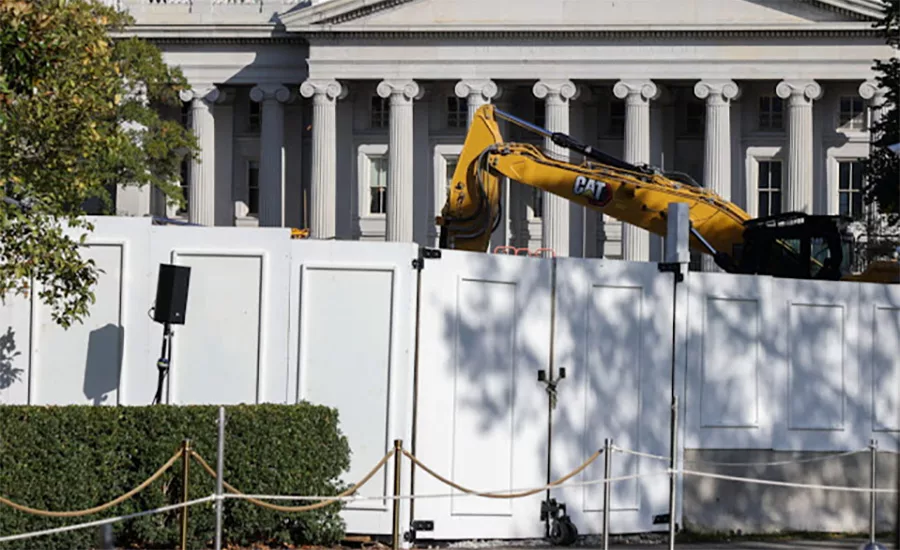
Construction equipment is visible behind temporary fencing at the White House East Wing site as litigation over the planned ballroom project moves forward in federal court.
Updated 3:15 PM EDT, Dec. 17, 2025
Federal court filings reviewed by ENR show the Trump administration is pushing to keep construction of the White House ballroom moving, formally opposing efforts to halt the project while asking a judge to consider sealed national security declarations that would limit public scrutiny.
The Dec. 15 filings, submitted to U.S. District Court for the District of Columbia, mark the first comprehensive government defense of the project since demolition of the East Wing began, including a formal opposition to the National Trust for Historic Preservation’s request for a temporary restraining order and preliminary injunction.
At a Dec. 16 hearing before U.S. District Judge Richard J. Leon, the administration argued that plaintiffs are unlikely to prevail and that pausing construction would cause harm. Leon signaled skepticism toward an immediate halt to the work, questioning whether plaintiffs had demonstrated irreparable harm at this stage and indicating he was inclined to allow construction to continue while the case proceeds.
The administration also asked the court for permission to submit a declaration privately and under seal, seeking to present national security information ex parte and in camera for the court’s review—meaning the judge would review the material privately, outside the public record.
RELATED
Those same filings also provide the clearest public snapshot to date of how work is advancing on site.
National Park Service Liaison John Stanwich testified that the Executive Residence is managing the “White House East Wing Modernization and State Ballroom Project” and coordinating weekly with Clark Construction and project architect, Shalom Baranes Associates.
According to the filing, above-grade demolition of the East Wing and East Colonnade was completed early this month, and below-grade demolition and excavation are proceeding.
Stanwich stated that Clark is expected to begin footing and below-grade structural concrete work in January around the East Colonnade and in February in the East Wing area. He testified that above-grade structural work would not likely begin before next April.
The declaration further notes that architectural design for the above-grade elements “remains in progress,” with below-grade construction proceeding in a manner that will constrain final above-grade design.
The filing also addresses questions raised by both ENR and Sen. Edward J. Markey (D-Mass.) regarding hazardous materials abatement.
Markey, who chairs a Senate Environment and Public Works Subcommittee, publicly questioned whether East Wing demolition contractor ACECO LLC was licensed to perform the work after news of the firm’s 2022 asbestos-abatement license revocation became public. According to Stanwich, Clark Construction—not ACECO—performed hazardous-materials abatement at the site in September and October.
Also revealed was that the Park Service’s Heritage Documentation Programs completed a Historic American Buildings Survey documentation of the East Wing and East Colonnade in late August, including 3D LiDAR scanning and photography, while the Executive Residence and the Office of the White House Curator created a digital twin of the spaces for future preservation and interpretive use.
Stanwich stated that historic facade materials were salvaged and are being stored for reincorporation, including stone columns, doors, windows, fencing, plaques, light fixtures and the I.M. Pei–designed pergola from the East Garden.
While the declaration clarifies how construction is proceeding, the litigation centers on whether the project is advancing without traditional federal design review. What the record does not show is any completed design review by federal planning bodies.
In an opposition declaration, NPS official Tammy Stidham testified that, as of mid-December, the National Capital Planning Commission (NCPC) had not reviewed the project and that NCPC staff had only recently been contacted by the Executive branch. No design submission has been posted publicly.
Vacated Oversight, Rotating Leadership
Under federal planning rules, major construction projects on federal land in the National Capital Region are typically subject to review by the National Capital Planning Commission once the sponsoring entity formally advances a design submission.
Court filings do not show a submission for the ballroom project, and NPS officials state that preliminary discussions have only just started. Review by the U.S. Commission of Fine Arts, which usually provides advisory input on design, is not required but is common for projects of this scale.
However, in October, President Donald Trump dismissed all sitting CFA members, and the commission has not been repopulated. As a result, no independent CFA review of the ballroom design has been conducted to date.
Separate from the litigation, the White House changed project leadership earlier this month, replacing architect James McCrery with Washington, D.C.-based firm Shalom Baranes as the project entered what officials described as “a new phase.” The shake-up followed reported disagreements over the proposed size of the ballroom. The White House has not released revised designs or updated renderings.
The architect replacement came amid continuing unease within the architecture profession about participating in a public project occurring under such extraordinary circumstances.
Financially, the White House has described the ballroom itself as donor-funded. Court filings show that the U.S. Secret Service retains responsibility for security operations and access control during construction, with the National Park Service playing a limited role tied to site operations and temporary facilities.
Plaintiffs argue that the use of federal land, security resources and Park Service involvement brings the project within the scope of federal review requirements. The government counters that donor funding and limited agency roles do not alter the project’s legal standing.
How that distinction affects contractor risk allocation or schedule impacts has not been detailed publicly.
Proceeding with construction despite unresolved legal and design-review questions can create practical risks, including the need to resequence work if oversight requirements change, delays from court-ordered pauses or disputes over responsibility for redesign or rework if final approvals differ from initial assumptions.
Beyond the White House, questions are emerging about whether the project could serve as a model for other federal properties. Bloomberg Law reported that a declaration submitted in the case referenced four additional federal buildings that the administration is considering for demolition or major alteration.
Those details are not included in the public court filings reviewed by ENR, and no executive order or publicly released directive outlining such plans has been identified to date.
For contractors and designers, the convergence of litigation, sealed security filings, shifting design leadership, unresolved design review and ambiguous agency authority raises practical concerns about documentation standards, coordination and liability on sensitive federal sites.

Bryan Gottlieb
is the online editor at
Engineering News-Record (ENR).
Gottlieb is a five-time Society of Professional Journalists Excellence in Journalism award winner with more than a decade of experience covering business, construction and community issues.
He has worked at Adweek, managed a community newsroom in Santa Monica, Calif., and reported on finance, law and real estate for the San Diego Daily Transcript.
He later served as editor-in-chief of the Detroit Metro Times and was managing editor at Roofing Contractor, where he helped shape national industry coverage.
Gottlieb covers breaking news, large-scale infrastructure projects, new products and business trends across the construction sector.
email:
gottliebb@enr.com
|
office:
(248) 786-1591

