


Legend has it that in the wee hours of yet another wild night at Studio 54, a stranger approached Calvin Klein. “How would you like to make a million dollars?” the man asked, having to shout over the ear-splitting music. But Klein “heard him loud and clear,” the designer told Vanity Fair contributor Ingrid Sischy in 2008. “When it’s about the work, and the business, I don’t miss it.”
As it turned out, the man was connected to Puritan Fashions. A year later, in 1978, Klein launched his iconic jeans line in partnership with that company—making him the first American designer to turn denim into a luxury item. Within the first two weeks, they sold 200,000 pairs. Five years later, Calvin Klein Inc. purchased Puritan for $68 million.

David Geffen, Cher, and Calvin Klein attend a party at Studio 54 in New York City, September 20, 1978.
Sonia Moskowitz/Getty Images.
Clearly, a great party can be so much more than a good time. Parties double as social reckonings and scenes for major turning points—places where power shifts, deals are struck, and revolutions are born. And though plenty has changed since the dawn of partying—we’ve moved from gilded goblets to VIP wristbands, from torchlit feasts to paparazzi bulbs—just as much has stayed the same. Parties, after all, are where history happens. And history has a funny way of repeating itself.
In The Parties That Changed the World, VF goes beyond the velvet rope to examine two era-defining celebrations—one modern, one historical—to uncover the unexpected cultural ties between them. First, we look at Paris Hilton’s 21st birthday tour and Marie Antoinette’s soirees at Petit Trianon, which prompted detractors to make both women scapegoats for decadence—convenient femme fatales blamed for their culture’s sins.
The year was 2002, and America was at a crossroads. The world, and its most famous skyline, would never be the same. We’d all seen the towers fall from every possible camera angle; coverage of the war on terror was unrelenting, and not-scary-at-all new phrases like “the axis of evil” and “anthrax threat” suddenly became part of our vocabulary.
The vibe was not chill. We were desperately craving comfort food.
So reality TV and celebrity-tracking tabloids took over our newsstands and airwaves— glossy, low-stakes counterprogramming to the apocalyptic headlines and grim nightly news. Enter Paris Hilton, who embodied what seemed like a brand-new, unofficial sixth stage of grief: pure, unadulterated, unfiltered escapism. The American mindset was slowly shifting to: Well, we might as well enjoy ourselves.… And in the early 2000s, nobody seemed to be enjoying themselves more than Hilton—except, perhaps, her public—as we gleefully clocked her every move, every sparkly outfit, and every night out.
But long before the Von Dutch hats and the mini dogs, the fragrance lines and the catchphrases, the sex tape, the seven-figure DJ gigs, and even The Simple Life, Paris Hilton turned 21. Even then, she was in on the joke. “Partying is an area of expertise for me,” she wrote in her 2023 memoir, Paris. “A marketable skill developed over a lifetime of dedicated practice.” And if every night on the town was a branding opportunity, Hilton sensed that her 21st birthday wouldn’t just be a celebration—it could be a coming-out party for the character she was about to make world famous.
So Hilton went big. Really big. Six balls-out parties in international cities big. The reported cost to Hilton was $75,000—per head. Stars: They’re just like us!

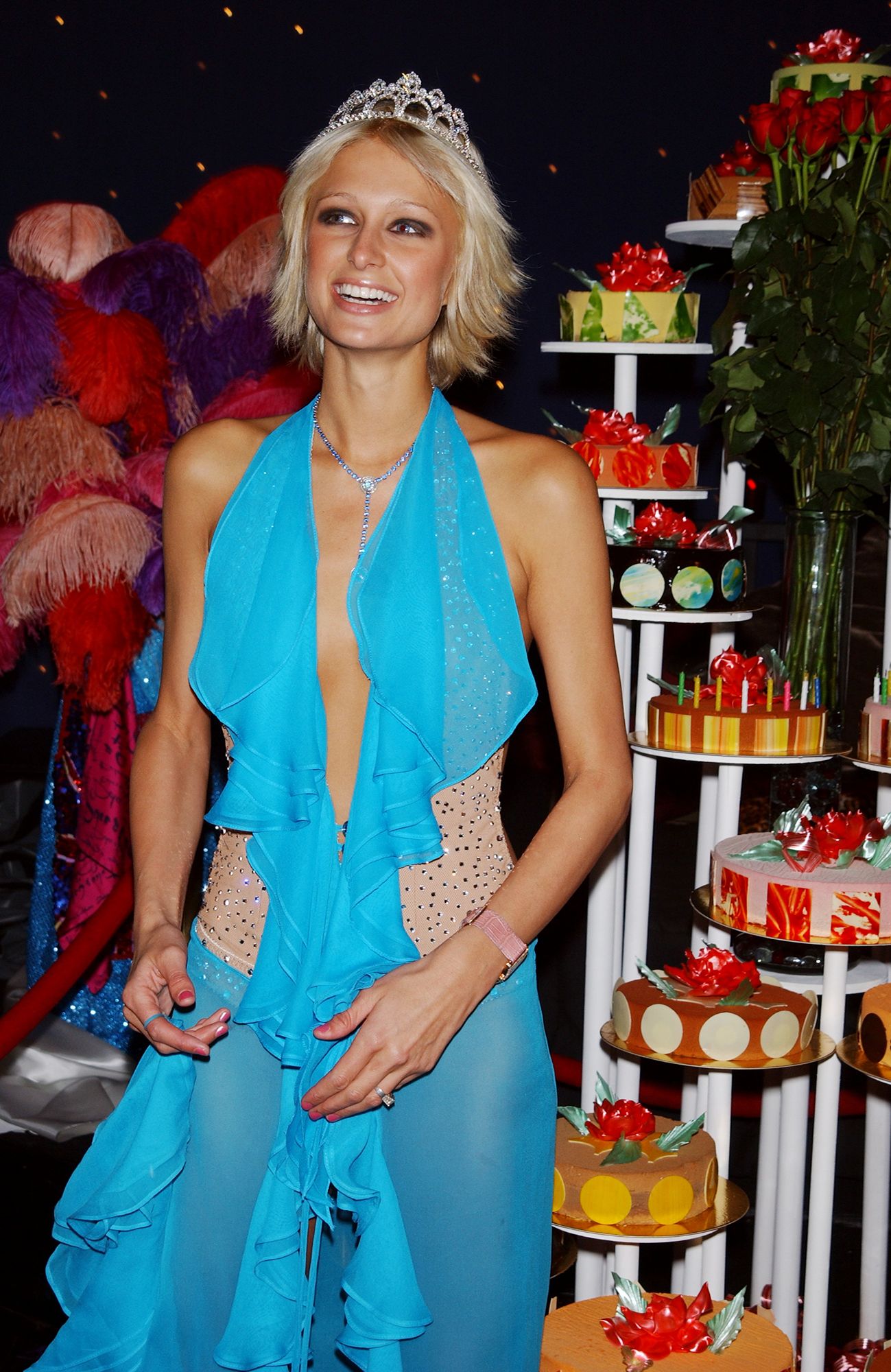
Paris Hilton poses with her cakes at Studio 54.
Arnaldo Magnani/Getty Images.
The first stop in February was the nightclub whose name alone conjures an entire era: Studio 54. Its ’70s heyday was long gone, but the legend of that bacchanal still pulsed through the venue’s walls. The night was well planned; according to event-industry trade platform Biz Bash, professional promoters CS4 Entertainment coordinated, while The Saxton Group handled PR. Among the star-studded guests were future reality star and Hilton’s aunt, Kyle Richards; future media mogul Kris Jenner; and future president Donald Trump. The birthday girl wore a diamond tiara as she posed with a towering 21-tier cake from Le Cirque and danced the night away to DJ Cassidy in the arms of her then-boyfriend, actor-model Jason Shaw.
Next, Hilton obvi had to make a pit stop in the city that gave her its name. By far the series’s most understated, underreported, and elegant fête, Paris in Paris included a glamorous dinner and another nightclub takeover.
Tokyo was for the fans. There, Hilton sponsored a massive blowout for thousands of screaming admirers, “because [I] could never leave [my] little Hiltons behind.” She’d later describe her fans as “family,” their loyalty helping to soften the crushing loneliness that came with extreme fame.
If Paris Hilton is remembered for one thing, it should be that she’s always been ahead of the curve. For the party tour’s Las Vegas leg, Hilton booked emerging DJ AM—whom she later credited, per Billboard, with teaching her his skills. In 2002, DJ AM wasn’t yet the genre-defining superstar he would become. But soon after Hilton’s party at the Bellagio’s Light Nightclub, he secured a first-of-its-kind, million-dollar Las Vegas residency at Pure Nightclub, at Caesar’s Palace.
Her LA affair was a homecoming for the friends and family who knew her best—a celebration of Paris the person, not the headline. It was a “rolling bash” that moved from LAX to her house on King’s Road to the GQ Lounge. As photographer Carlos Lopez recently said in Derek Blasberg’s oral history of early 2000s nightlife, “Paris was having her 21st birthday, and she celebrated it in five different states and countries. I maybe went to three out of the five. It ended in Los Angeles, at a place called Sunset Room.”

Hilton celebrating her 21st birthday in London.
Dave Benett/Getty Images.
But actually, it didn’t. Months later, in May, Hilton hosted a final bash at London’s iconic Stork Rooms, arriving in what became one of the most defining looks of the early 2000s: a backless Julien McDonald chain-mail mini dress and rhinestone choker. This was the night that produced the now-legendary Paris Hilton glitterati shot—the one that would live on in endless best party dresses lists.
Hilton was no longer on the club scene: She was the main event. That’s hot.
In her memoir, Hilton herself calls her party tour “possibly the greatest twenty-first birthday celebration since Marie Antoinette.” She didn’t know it then, but in just a few years—like Marie Antoinette before her—Hilton, too, would go from “It girl” to scapegoat.
Even as a frightened, 14-year-old child bride shipped off from Austria to marry a stranger, Marie Antoinette always had that je ne sais quoi. Though she came from enemy turf, the French court was instantly charmed by her beauty, style, and grace. Beyond Versailles, the public also adored her at first, seeing its future queen as a symbol of renewal, even rebirth, during the messy final years of the reign of Louis XV, best known for his (many) sex scandals, corrupt mistresses, and humiliating military defeats. In her book Marie Antoinette: The Journey—which served as the basis for Sofia Coppola’s 2006 film, Marie Antoinette, starring Kirsten Dunst—Antonia Fraser wrote that children “offered her baskets of flowers, and the daughters of the bourgeoisie, in their best clothes, strewed further flowers in her path.”
As a young dauphine (wife to the heir apparent), nearly every aspect of Marie Antoinette’s palace life was informed by ceremony and performed for an audience. She ate, dressed, prayed, bathed, and later even gave birth in front of a crowd. A memorable scene in Coppola’s Marie Antoinette begins just after the title character has been roused awake by a swarm of ladies-in-waiting. Dunst shivers half-naked, desperate to get dressed, as one lady after another barges in, each ranking higher than the last entitled to present the queen’s garment—grinding the already painstaking Cérémonie du Lever (or rising ceremony) to a halt, all in the name of etiquette. The scene ends with Dunst muttering, “This is ridiculous.” In daily life, too, there were rules for everything—who could stand near the dauphine; who could speak, sit, or even breathe in her presence. Versailles was a cage, and Marie Antoinette was trapped inside.

Marie Antoinette
Heritage Images/Getty Images.
Then, everything changed in 1774. King Louis XV died of smallpox, France was practically giddy, and suddenly, Marie Antoinette was queen—she would be the very last queen of France.
Louis XVI knew his young wife wasn’t about that palace life. So he gave her what every teenager dreams of: the keys to her very own 18,000 square foot party house. Petit Trianon became Marie Antoinette’s sanctuary. There was no formal hierarchy there—she could do, say, and wear whatever she pleased. Her house, her rules.
As Paris Hilton would write more than 200 years later, “curating a crowd is a skill.” So unless you were in Marie Antoinette’s inner circle, scoring a spot on her highly exclusive guest list was nearly impossible. VIPs included Princesse Lamballe of Italy and the Polignacs, a family of French nobles, including her bestie, the Duchesse de Polignac, along with an attractive buffet of artists, musicians, and actors.
Bucking tradition, the rest of the court was iced out. It was as if all the popular kids had been kicked out of their own cafeteria by the foreign exchange student turned prom queen, and forced to eat lunch alone. They struck back by feeding juicy rumors about Marie Antoinette to contemporary pamphleteers, who delightedly ran the stories to show resentment toward Versailles—and especially the queen; the ever-glamorous hostess began to fester. Tales of her decadent and “immoral” Petit Trianon lifestyle spread like wildfire. In her 2008 book, Doomed Queens, Kris Waldherr writes how the queen’s enemies “used the power of the press to point fingers. Marie, a.k.a. Madam Deficit, or Autrichienne (the Austrian bitch), was their favorite object of scorn.”
In reality, the château was relaxed and intimate. Nighttime soirees spilled out of candlelit salons and into the gardens, the string quartet’s timbre floating across manicured lawns as Marie Antoinette’s clique strolled under lantern-lit paths, sipping on fruit liqueur. There were private concerts, card games, and amateur plays. Marie Antoinette, quite the thespian, loved performing for her squad. These soirees were not exactly the lurid, lavish, all-night, anything-goes, Champagne-fueled, lesbian-free-for-all sex parties of lore.
But beyond the gilded palace gates, the country was slipping into a very real crisis, putting the public in a mood to believe anything.
Love for the queen faded slowly. Her original sin was simply not being French, with centuries-old anti-Austrian sentiment lingering just beneath the surface. Then she went eight years without having a child; it took her 11 years to produce an heir. And though it takes two to tango (according to Waldherr—though it’s a matter of debate—Louis suffered from phimosis, a deformed foreskin that made intercourse excruciating for him), only Marie Antoinette took the heat. If the rest of France hadn’t been falling apart, the public might’ve forgiven her and even her party girl image.
But France was falling apart. Helping the US win independence put a massive financial burden on the nation—loans, warships, weapons, uniforms, ammunition, and supplies—sinking the country roughly $1.3 billion livres in the hole. Because of France’s social structure, the bulk of the financial strain fell to its peasants, while the top 1% was virtually exempt from paying taxes. Food prices, especially bread—the literal lifeblood of the French diet—also skyrocketed due to poor harvests. Meanwhile, Marie Antoinette’s parties embodied everything that her haters detested. While the people struggled to put food on the table, the queen was allegedly popping bottles like it was 1769. Her parties fanned the flames of popular hostility that erupted into the French Revolution, changing France and its monarchy forever. Tales of her extravagance were exaggerated—or outright fake news—but it didn’t matter. The people had already turned on her.

Kirsten Dunst surrounded by cakes in Marie Antoinette.
© Sony Pictures/Everett Collection.
Even her most-famous catchphrase, “Let them eat cake” is a myth, one that predates her reign in France by almost a decade. But Marie Antoinette’s reputation as an out-of-touch party girl was sealed nevertheless—in many ways paralleling a 2005 scandal in which Paris Hilton was allegedly photographed on a night out wearing a top that said “Stop Being Poor.” Hilton had the receipts: The image had been photoshopped, the final word on the shirt changed from “Desperate” to “Poor.” But the fake photo went viral anyway; many believed it to be real, and the damage was done.
Only a few years after her 21st birthday extravaganza, Paris Hilton had been overexposed. Her backlash came quicker than Marie Antoinette’s, thanks to The Simple Life in 2003, the leaked sex tape in 2004, and her 2006 DUI. Hilton became a symbol for excessive wealth, celebrity vacuity, and moral decline. Critics complained that the media obsessed over her instead of more meaningful issues, like the Iraq War or widening inequality, but her image sold. The real bad actors were far less photogenic: network execs hungry for cheap reality TV, late-night hosts turning her into a punchline, tabloid honchos cashing in on humiliating young women, and an audience that couldn’t look away.
Marie Antoinette’s get-togethers didn’t actually destroy France’s economy. The country was already buckling under decades of financial mismanagement, an upside-down tax system, obstructionist high courts, and a monarchy unwilling to modernize. Still, on October 16, 1793, Marie Antoinette was carted through the streets of Paris. No women or children offered her flowers or threw them in her path. She remained composed while the crowds jeered. Soon after, she lost her head.
Hilton got another chance. She survived by leaning into her image and turning herself into a brand, proving that scandal—when wielded wisely—can be spun into lasting success. And ultimately, she rewrote the rules of fame: She became the OG modern influencer, someone “famous for being famous” before that was even a thing. In her 2020 documentary, Hilton admits as much: “Everyone says I’m the original influencer. But sometimes I think I helped create a monster.” Her 21st birthday tour is what elevated her from New York socialite to the world’s reigning nightlife queen. Those six celebrations weren’t just parties. They were the launchpad for a new kind of celebrity that Hilton practically invented herself.
What we often forget about those who party hard is why they do it. As she later revealed in her documentary, memoir, and interviews, Hilton was masking the trauma of the horrific abuse she endured at Provo Canyon School. The “dumb blond” persona she embraced wasn’t created because girls just wanna have fun—it was her survival strategy.
Marie Antoinette needed her own escape. Living in a strange land since she was barely a teenager, stripped of her Austrian identity on arrival—her clothes, companions, even her beloved (mini) dog, Mops—she had no family, no allies, and no guidance. Even her husband famously met her warmth with frost. She was desperately lonely. So she retreated into a fantasy.
They both did.
And if there’s one thing humanity loves, it’s putting a woman up on a pedestal—only to knock her down. Especially if she’s tempted by a good time.
-
The New Epstein Files Are Reopening the Pizzagate Box
-
Marty Baron’s Warning on Why Bezos is Shredding The Washington Post
