


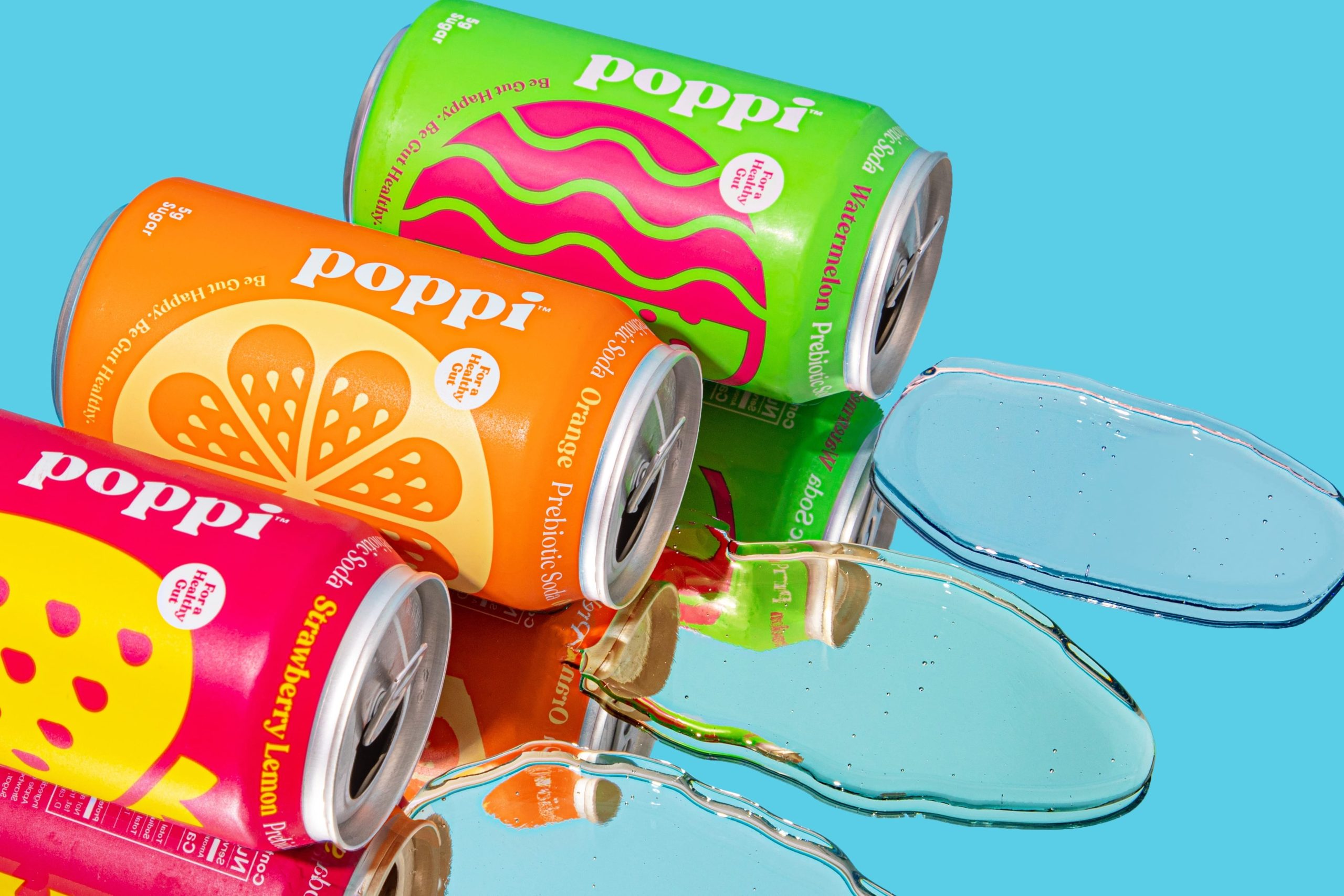
PepsiCo’s reassessment of Poppi’s earnout valuation comes as the prebiotic soda category tops $1.3 billion in sales and brands race to expand beyond gut health with broader offerings.
After PepsiCo paid nearly $2 billion to acquire prebiotic soda brand Poppi in 2025, CPG giant sharply reduced its estimate of the fair value of potential earnout payments tied to the acquisition in the third quarter. The liability fell to $12 million as of Sept. 5, 2026, down from $117 million in June and $278 million at the end of 2025, according to SEC filings
Once a niche segment, prebiotic sodas account for nearly three quarters of modern soda sales and are growing markedly faster than the overall soda category, according to Spate data in the 52 weeks ending Oct. 4, 2026 compared to a year ago.
Although PepsiCo paid a premium for Poppi only to mark down the estimated value of future payouts, the prebiotic soda category continues to post double digits, according to Spate.
Prebiotic soda appears as the main growth driver in modern soda, with the category generating approximately $1.32 billion in sales compared to $1.82 billion for all modern soda products in the same period, according to Spate.
Further, prebiotic soda growth is driven by volume not just pricing. Sales grew 13% year over year while unit sales grew faster at 15.6%, per Spate, indicating that consumers are buying and paying more for these products.
At the same time, some companies like Coca-Cola are doubling down on gut health across several flagship brands. The company announced last month that Coca‑Cola Zero Sugar, Sprite Zero Sugar and Fresca will also include 6 grams of prebiotic fiber in a pilot release across New York, New Jersey and Pennsylvania.
Modern soda grows beyond digestive health
The next phase of growth within modern soda may depend more on broader functionality or standout flavor profiles rather than prebiotics alone.
As competition grows from established brands like Olipop, Poppi, Culture Pop, Health-Ade SunSip and Coca-Cola’s Simply Pop, brands are expanding beyond gut health alone and broadening their portfolios to include energy, mood support and hydration to set themselves apart in the modern soda scene.
For example, Poppi grew beyond digestive health with products like energy drink Poppi Lift containing 70 milligrams of caffeine and Poppi Chill which targets relaxation with ingredients like magnesium and l-theanine.
Meanwhile, functional ingredients are not the only element driving the modern soda set as consumers look for unique and bold flavored sparkling beverages.
The overall modern soda set continues to outperform the broader soda market. Modern soda sales and units increased 14.3% and 15.2%, respectively, while total soda sales rose 4.3% and units declined 0.2%, according to Spate. Diet and zero sugar soda dollar sales posted similar growth to prebiotic soda with dollar sales growing 13.3% and unit sales increasing by 8.4%. At the same time, regular soda sales were essentially flat, declining 0.05% and 4.4% in units.
Indie premium and flavored soda brands like Something & Nothing and Fruga tout natural flavors and no added sugar or artificial sweeteners – aligning with better-for-you soda trends that emphasize a culinary-inspired flavor experience over function.
Conventional soda brands like 7UP, Mountain Dew and Sprite also continue to focus on flavor. Once a lemon-forward flavor, Keurig Dr Pepper’s 7UP reformulated as a lime-led soda to stand out in the $5 billion lemon-lime soda category, according to the company. Meanwhile, Pepsi, Mountain Dew and Sprite have not changed their signature flavors, but the brands continue to maintain relevance by leveraging partnerships with professional sports teams to win fans at home and at the stadium.
