


Ta-Nehisi Coates (Vanity Fair senior staff writer) recently said that if he reads “another scene from a DSA party in Brooklyn where people are drinking beer and doing whatever, I’m going to scream.”
But I can report that there were a lot of ecstatic and tipsy socialists in oversized vintage jackets at the DSA election party on the edge of Skid Row in Los Angeles Tuesday night. And, boy, did these socialists have a lot to celebrate.
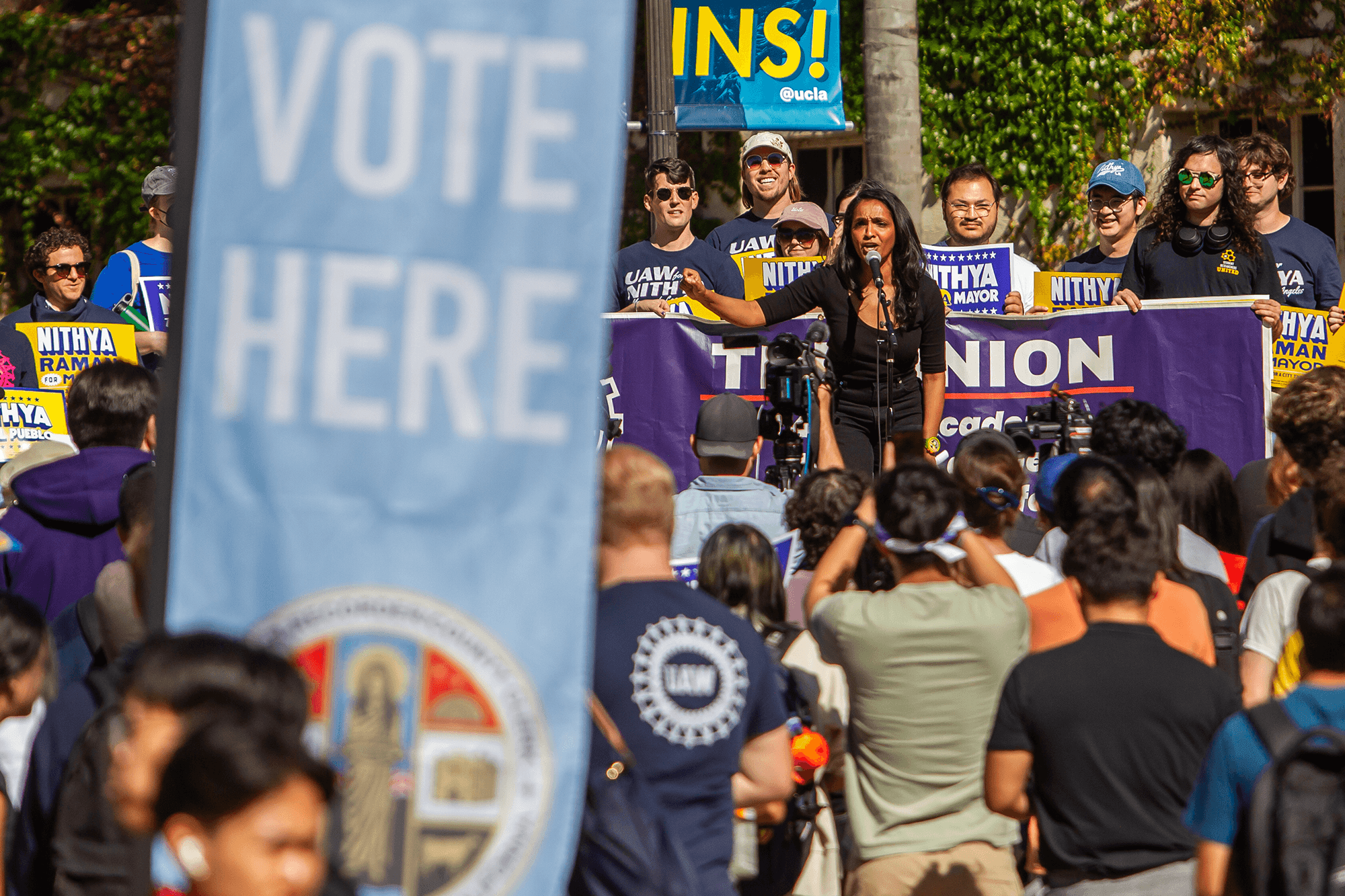
Democrats were trouncing Republicans nationally. Democratic socialists were projected to take at least seven seats in the House, up from two. And in Los Angeles, the DSA’s preferred mayoral candidate, Nithya Raman, appeared poised to unseat Karen Bass. The incumbent Democratic mayor held a less than 1% lead in early returns, but ballots are expected to skew toward the more progressive candidate, Raman.
“Karen Bass said that she would need to be up 10 points on election night to be comfortable,” one DSA-LA leader told the crowd. He gestured at a graphic showing Bass’s narrow lead and said, “I’m not good at math because I’m gay. Is that 10 points? I don’t think so.” (Bass didn’t actually say that, but a pundit on KTLA did say something to that effect.)

Karen Bass during an election night event in Los Angeles, November 3, 2026.
Bloomberg/Getty Images
At the DSA party, people cheered victories elsewhere in the country by socialists and establishment Democrats alike, but they booed when Bass appeared on television, and laughed when a Fox News commentator suggested the economy was doing well. At one point, organizers put on Hasan Piker’s livestream, and at another they played an AI-generated video showing Raman dancing while wearing a traditional Russian fur hat with ear flaps and a red star. When local TV station KTLA suggested Raman would likely win and Mayor Bass’s face appeared onscreen, someone shouted, “Whoa, get fucked, Karen.” It kind of encapsulated the strongest force animating the DSA members I talked to in this mayoral race: their dislike for Mayor Bass. They even called her the C-word onstage: “conservative.”
The DSA and Raman have had something of an on-again, off-again relationship. The organization helped propel her to an upset City Council victory in 2020, only to reprimand her over disagreements about Israel, housing policy, and the city’s mansion tax. The local DSA chapter endorsed her candidacy late in the campaign, but the national organization almost stripped it from her at the eleventh hour. The national DSA voted last week to preserve its Los Angeles chapter’s endorsement of Raman by a single vote, after a dispute over her refusal to embrace the movement to boycott Israel.
“I think people here have varying levels of begrudgingness about supporting Raman, but I think everyone here voted for her,” said one DSA-LA member at the party who worked on the chapter’s video team and declined to give her name.
Still, the DSA members at the party seemed to think this mayoral race offered another encouraging sign for their organization, even if Raman isn’t quite New York mayor Zohran Mamdani. She was attacked consistently by her opponents—mainly Spencer Pratt—as a dangerous extremist, but with the help of the DSA (it said members knocked on more than 110,000 doors this election cycle) she might be the first LA mayoral candidate to defeat an incumbent in over 20 years.
Meanwhile, at the Raman campaign’s official election night party at the Greek Theatre in Los Feliz, there weren’t any signs calling to “Tax the Rich” or to implement “Medicare for All,” as there were at the DSA party, but comedian Guy Branum from Apple TV’s Platonic sounded pretty similar to those socialists. He argued that Raman’s coalition reflected a class divide within Hollywood.
“Nithya has way more of entertainment’s middle class,” Branum said, describing workers worried about their next job. And Raman’s husband, television writer Vali Chandrasekaran, understands the industry’s problems firsthand, he argued.
Branum, who hangs with the couple socially, also wanted voters to appreciate one of her lessdiscussed qualifications. “They lead with the master’s in urban planning, and the Harvard, and the MIT,” he said. “But what you really need to see is that [she can dance]. You really need to see that hair let loose.” (Vanity Fair did not stick around at the party long enough to verify Raman’s dancing skills.)

Raman held her election night party at the Greek Theatre in Los Angeles, November 3, 2026.
Getty Images
Raman’s campaign manager, Ian Manheimer, was pretty psyched when he took the stage outside the Greek. “Holy shit! What is good, Los Angeles?” he shouted. Nearly three quarters of his campaign staff had never worked on a political campaign before, he told the crowd. Regardless, they managed to knock on over 100,000 doors, according to Manheimer.
The campaign’s grassroots operation had apparently become a bit of a competition. Volunteer Leo Blain, 25, told VF he’d knocked on more than 300 doors, putting him near the top of the campaign leaderboard. But the person to beat was Raman’s father, whom volunteers said had knocked on more than 1,000. All of that knocking was crucial, especially since Raman didn’t have a lot of institutional support or name recognition. Many of California’s most prominent Democrats stayed on the sidelines, because most of them would do anything to avoid the choice between an establishment incumbent and a rising DSA-endorsed challenger. But their neutrality didn’t necessarily mean indifference. A high-ranking official in Sacramento told me that plenty of state legislators were privately rooting for Bass, who had served as Speaker of the California Assembly before heading to Congress.
John, a DSA member who volunteered for Raman after having worked on Tom Steyer’s gubernatorial campaign, expected strong support for Raman among the local socialists, arguing that her independent thinking was a positive.
Raman’s party also included some unlikely converts. Kathleen Jensen, a Toluca Lake resident who previously supported Republican Rick Caruso, told me she considered Raman brilliant and wanted a “doer” in City Hall. Although she said some of her Democrat friends remained uneasy about Raman’s DSA association.
By 10:30 p.m., Bass’s election night party at the Loews Hotel in Hollywood had grown considerably quiet as her supporters began to digest the initial results. But the people who remained were still getting down to Snoop Dogg. The demographic differences between the parties were striking. Raman’s crowd skewed whiter, and more Asian, and the music was more alternative and disco. Bass’s crowd was notably more Black, reflecting the mayor’s decades of relationships in the city’s African American community.
Vaval Victor, 28, a member of Alpha Phi Alpha, the historically Black fraternity with which Bass has worked, remained confident that she would pull through. “She started the LA Black Dems Club in her kitchen,” he said, invoking her long history of organizing. “People are thirsty for hope.”
Bass had spent the campaign defending her record on homelessness, city finances, and last year’s catastrophic fires. Caruso, whom she defeated four years earlier, had swooped in at the end to say that he was voting for her, giving some of the city’s more conservative voters permission to support the incumbent. But early election-night returns were not the decisive advantage her campaign hoped for.
For all the divisions this mayoral race exposed, the three parties shared something that had been in short supply among Democrats lately: liberal joy.
-
Penélope Cruz Says She and Husband Javier Bardem are Selective When They Work Together
-
Making the Elizabeth Holmes Doc Fried Nathan Fielder’s and Lance Oppenheim’s Brains
-
“I Hate My Fucking Life Right Now”: How DC Republicans Reacted to the Blue Wave
-
Inside Lane Kiffin’s Trash-Talking, “Joey Freshwater” Era With Nick Saban at Alabama
-
Stacey Abrams Discusses the 2026 Midterms—and Her Future—with Ta-Nehisi Coates
-
From the Archive: Inside Elizabeth Holmes’s Chilling Final Months at Theranos
