


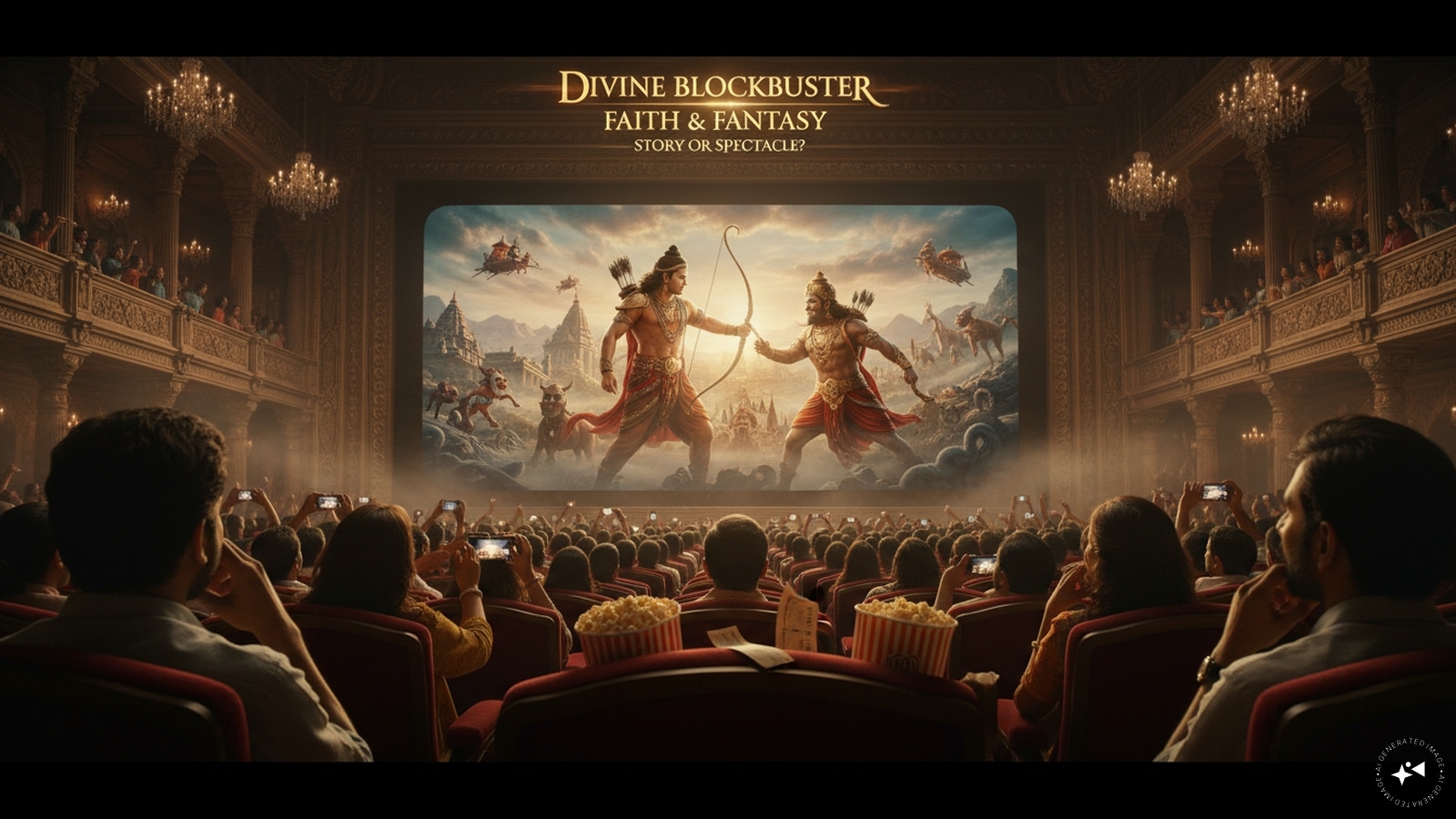
What if Bollywood’s next big box-office draw isn’t a superhero, a spy or a romantic hero, but a god? A film on Neem Karoli Baba has found considerable success, while Nitesh Tiwari’s ambitious Ramayana is generating attention well before its release. The growing interest in faith-led storytelling raises a question: Is spirituality becoming Bollywood’s newest commercial opportunity?
Hollywood built a billion-dollar business around superheroes. India may be discovering that some of its greatest franchise potential lies in mythology. The contest between Hanuman and the Hulk is not merely about extraordinary powers. It is also about cultural familiarity and emotional connection. While Hollywood has spent decades building fictional universes, Indian cinema can draw on characters already embedded in collective memory.
Bollywood has always known how to sell a dream. Its growing appetite for mythological dramas reflects a larger shift in audience sentiment, with filmmakers tapping into faith, cultural identity and spiritual curiosity in the hunt for their next blockbuster.
In an age when audiences are increasingly selective about what they watch in theatres, filmmakers are being asked to promise something bigger than a good story. Spectacle has become part of the selling point. But is the business of cinema beginning to dictate the grammar of art?
The high stakes of faith
Director Suresh Triveni believes renewed interest in spirituality is giving mythological dramas fresh box-office appeal. But faith, he cautions, is no guarantee of success.
“Bollywood has always followed trends, and the current spike in mythological dramas, some of which are performing well at the box office, is likely to inspire more such films. One reason for this trend is a growing spiritual inclination among audiences and a desire to see their culture and traditions represented on screen. When these stories are told well and resonate with viewers, they can find a strong theatrical audience. However, faith alone cannot guarantee box-office success; the film still needs compelling storytelling, strong performances and effective execution,” Triveni says.
With theatrical investments carrying significant financial risks, familiar cultural narratives can offer a relatively safer route to audience engagement. The challenge is to balance commercial caution with creative experimentation.
“We have seen this before with films such as Jai Santoshi Maa, and the industry tends to move in cycles. This phase, in a way, is a welcome one because it allows audiences to reconnect with their cultural heritage through cinema. At the same time, filmmakers are becoming more cautious and less experimental in their approach. A theatrical release involves significant financial risks, and producers are naturally inclined towards subjects they believe will find audience acceptance. There is nothing wrong with a cautious approach, particularly when the stakes are high. The challenge is to balance commercial prudence with creative storytelling,” Triveni says.
Trade expert Komal Nahata sees the shift as part of the industry’s instinct to follow success.
“In a way, faith is becoming the new action formula. There is a herd mentality in the industry, and the success of films such as Hanuman Ansh and Kantara has prompted a shift towards religious, mythological and faith-based cinema. Everybody is chasing success, and when one formula works, others inevitably follow. I see this trend shaping the industry over the next decade,” Nahata says.
Can devotion sell a ticket?
Nitesh Tiwari’s ambitious Ramayana brings that proposition into focus. The commercial question extends beyond the scale of its battles or the pull of its stars. Can reverence become a reason to buy a ticket? Can a story embedded in collective memory draw families across generations and turn a film’s release into a cultural occasion?
Film trade expert Sumit Kadel says devotional cinema has repeatedly demonstrated its box-office potential.
“Devotional films have worked big at the box office on several occasions. Jai Santoshi Maa, which was released alongside Sholay, went on to become a massive blockbuster. Films based on Sai Baba have also found success at the box office. Hanuman Ansh, the Gujarati film Laalo and Mahavatar Narasimha are recent prime examples of the phenomenal success that well-made devotional films can achieve at the box office,” Kadel says.
Beneath the spectacle lies a delicate negotiation. Familiarity brings expectations, and devotion can make audiences emotionally invested. Casting, costumes, dialogue and creative interpretation can all become tests of authenticity. A sacred story may arrive with an audience, but its acceptance cannot be assumed.
Faith may bring a familiar story to the screen, but familiarity alone cannot fill theatres. Nahata says a mythological film must earn its audience through storytelling, performances or spectacle.
“Mythological dramas can work if they are made well. A film like Hanuman Ansh did not need an enormous budget to connect with audiences. Simplicity can be effective; sometimes, a film needs to touch the heart above all else. At other times, the sheer grandeur of its storytelling can make the difference. Whether it is the visual effects, the story or the performances, something must have the power to impress the audience,” Nahata says.
That leaves filmmakers with a delicate commercial calculation. An intimate telling can find emotional resonance, while a lavish production can turn a familiar narrative into a theatrical event. But scale brings its own burden: the more expensive the spectacle, the greater the expectations placed on its box-office returns.
“Faith is not a formula that can be applied to every film. It all depends on how well the film delivers. With Ramayana, the substantial investment naturally brings expectations of an exceptional box-office performance. Streaming and satellite prices are also linked to how a film fares in theatres. Ultimately, a film like Ramayana is made for the big screen,” Nahata says.
The business proposition rests on converting cultural attachment into a compelling reason to buy a ticket. Where Nahata stresses execution and economics, Kadel points to the depth of that attachment and an audience appetite he believes the industry has sometimes underestimated.
“India is a deeply devotional society, with diverse beliefs and faiths even within Hinduism. Several historical and period films based on our national heroes have also performed exceptionally well. On television, Ramayana and Mahabharat have broken numerous records over the years,” Kadel says.
In Kadel’s reading, the current turn towards faith is also a reassessment of whom Hindi cinema imagines as its audience. The urban multiplex became an influential lens through which filmmakers viewed changing tastes. Beyond it, he argues, the emotional pull of devotional stories endured.
“Over the past 10–15 years, with the rise of multiplexes in urban centres, filmmakers have increasingly gravitated towards content inspired by Western cinema, believing that Indian society has changed. Yet, in a country as vast and diverse as India, devotion has always held a special place in people’s hearts. Well-made films rooted in our gods, mythology, faith and culture will continue to draw large audiences across the country, from east to west and north to south,” Kadel says.
The intriguing question is whether Bollywood sees faith as a creative resource or an increasingly attractive commercial strategy. Is religion becoming its new action formula, with devotion supplying the emotional stakes and visual grandeur supplying the event? And can that formula sustain an industry?
Kadel believes films made purely for a quick cash grab may fail, while those made with the right intent, conviction and respect for the subject will find their audience.
When spectacle overshadows the story
With films such as Ramayana promising spectacle on an epic scale, Bollywood’s interest in faith raises another commercial question: Can devotion give a film an advantage beyond familiar star power and visual grandeur?
When cinema begins to sell itself as an experience rather than a story, filmmaking risks becoming an exercise in engineering excitement rather than evoking emotion. Scale, visual effects and technological wizardry become selling points, while character development, narrative ambiguity and the subtleties of human relationships risk becoming expendable.
There is nothing inherently wrong with spectacle. Cinema has always been an art of visual wonder. The problem arises when spectacle ceases to serve the story and begins to replace it.
Mahesh Mathai, director of Real Kashmir Football Club, which was nominated for Best Drama Series at the 54th International Emmy Awards, sees a familiar danger in the trend.
“Both faith and patriotism have been part of Indian cinema, but to make them more important than the story is not going to work for very long,” Mathai says.
His observation speaks to a larger creative dilemma: whether it is spectacle, faith or patriotism, no thematic or visual device can substitute for compelling storytelling. The tragedy would not be that cinema becomes bigger, but that it begins to believe bigger is the only way to matter.
The question of whether devotional appeal can draw audiences across regions and generations, Mathai suggests, comes back to the strength of the writing.
“Great stories are the only things that will work,” he says.
As for whether Bollywood is building a lasting market for stories rooted in India’s spiritual heritage, Mathai’s assessment is blunt: the industry is “chasing a blockbuster trend.” What will allow such films to succeed beyond a handful of major releases, he believes, is good storytelling.
Faith, creative freedom and the risk of controversy
In Bollywood’s mythological universe, creative freedom is welcome. But turning Ram into the villain and Ravan into the hero? That is a plot twist that could cost filmmakers far more than box-office points.
Nahata says religious sensitivities require particular care when filmmakers reinterpret sacred stories.
“Creative interpretation and religious sensitivities, especially in faith-based films, require particular care. You have to be very careful that people’s sensibilities are not hurt, because one wrong move could backfire into a major controversy or calls for a ban,” he says.
The point, he suggests, is not to muzzle creative freedom but to exercise it with an understanding of the faith and its followers.
“But people also understand that there is something called cinematic liberties, and if those liberties are taken keeping the audience’s sensitivities in mind, then there is no harm. But if you have Ravan as the ‘good guy’ and Ram as the ‘bad guy’, then it will not go down well with all viewers,” Nahata adds.
Bollywood turns to religious faith for its next big box-office hit, but will audiences buy the story?
