


Image of the Day for November 26, 2026
New Zealanders have long envisioned the island as a predator-free zone for native birds, but swimming stoats have shown a resolve of their own.
Nov 26, 2026
View more Images of the Day:
In the late 1800s, wildlife conservationists in New Zealand were recognizing how predators such as stoats, brought to the country to control other nonnative animal populations, were becoming a threat to native birds. Naturalists at the time surmised that some of the nation’s islands could serve as sanctuaries where endemic species could persist, free from the voracious newcomers.
Resolution Island, located in the Fiordland region along the rugged southwest edge of New Zealand’s South Island, was one of the first eyed for this purpose. Conservationist Thomas Henry Potts proposed in 1872 that the island could be a place where “wingless species, and birds of feeble powers of flight, might there find a refuge for some of their representatives.”
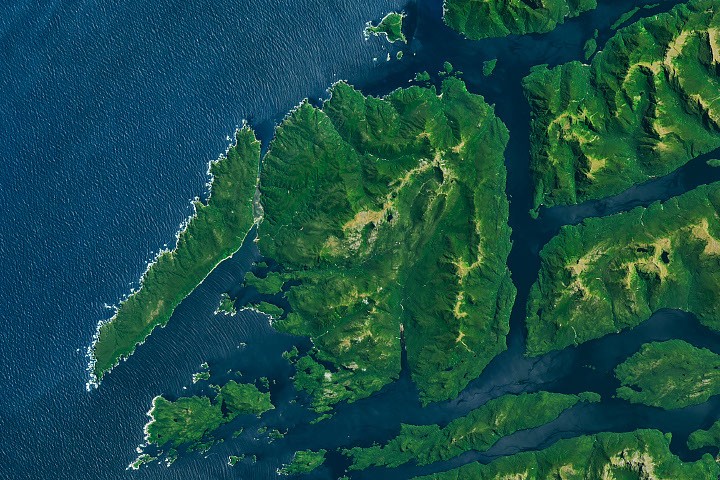
So began an early systematic effort to protect kiwi, kākāpō, and other native birds on Resolution Island, the largest of the approximately 90 islands in Fiordland National Park. This image, acquired with the OLI (Operational Land Imager) on Landsat 9 on December 12, 2025, shows the island’s setting amid a landscape of steep-sided valleys carved by glaciers and now inundated by the ocean.
The uninhabited island rises from sea level to the summit of Mount Clerke at 1,069 meters (3,507 feet). Its diverse habitats and vegetation communities range from bogs and wetlands near the coast to widespread podocarp forests at middle elevations to tussock grasslands in the subalpine and alpine areas. Offshore, the Taumoana (Five Fingers Peninsula) Marine Reserve protects estuarine and wave-exposed rocky reef habitats at the entrance to Dusky Sound, east of Five Fingers Peninsula.
Farther into the sound, Pigeon Island was the onetime home of Richard Henry, who was named caretaker of Resolution Island after it was designated a reserve in 1891. In what some have called a “landmark effort,” Henry spent years transporting more than 700 birds, mostly kiwi and kākāpō, by rowboat to Resolution and other would-be island sanctuaries nearby.
In 1900, however, people began spotting mustelids on Resolution. It turns out the island is within swimming distance for animals such as stoats. Henry was intent on trapping the interlopers but eventually abandoned the project and moved on to caretaking work on another island. The spirit of his efforts lives on, though. A Department of Conservation program started in 2008 aims to control stoat populations and bolster native species on Resolution.
NASA Earth Observatory image by Michala Garrison, using Landsat data from the U.S. Geological Survey. Story by Lindsey Doermann.
Downloads
December 12, 2025
- Australian and Aotearoa New Zealand Environmental History Network (2014, November 14) Review: Island Reserves and Mainland Islands, including a Review of Ecosanctuaries. Accessed November 24, 2026.
- Department of Conservation, Taumoana (Five Fingers Peninsula) Marine Reserve. Accessed November 24, 2026.
- Department of Conservation (2018, August 11) Fiordland Kiwi Diaries: Resolution Island Trapping. Accessed November 24, 2026.
- Department of Conservation (2011, August) Vegetation and flora inventory of Resolution Island. Accessed November 24, 2026.
- Museum of New Zealand (2006) Biography of Richard Henry – bird conservationist (1845–1929). Accessed November 24, 2026.
- New Zealand Geographic (2007) Resolution for Richard Henry. Accessed November 24, 2026.
You may also be interested in:
Stay up-to-date with the latest content from NASA as we explore the universe and discover more about our home planet.
Keep Exploring
