


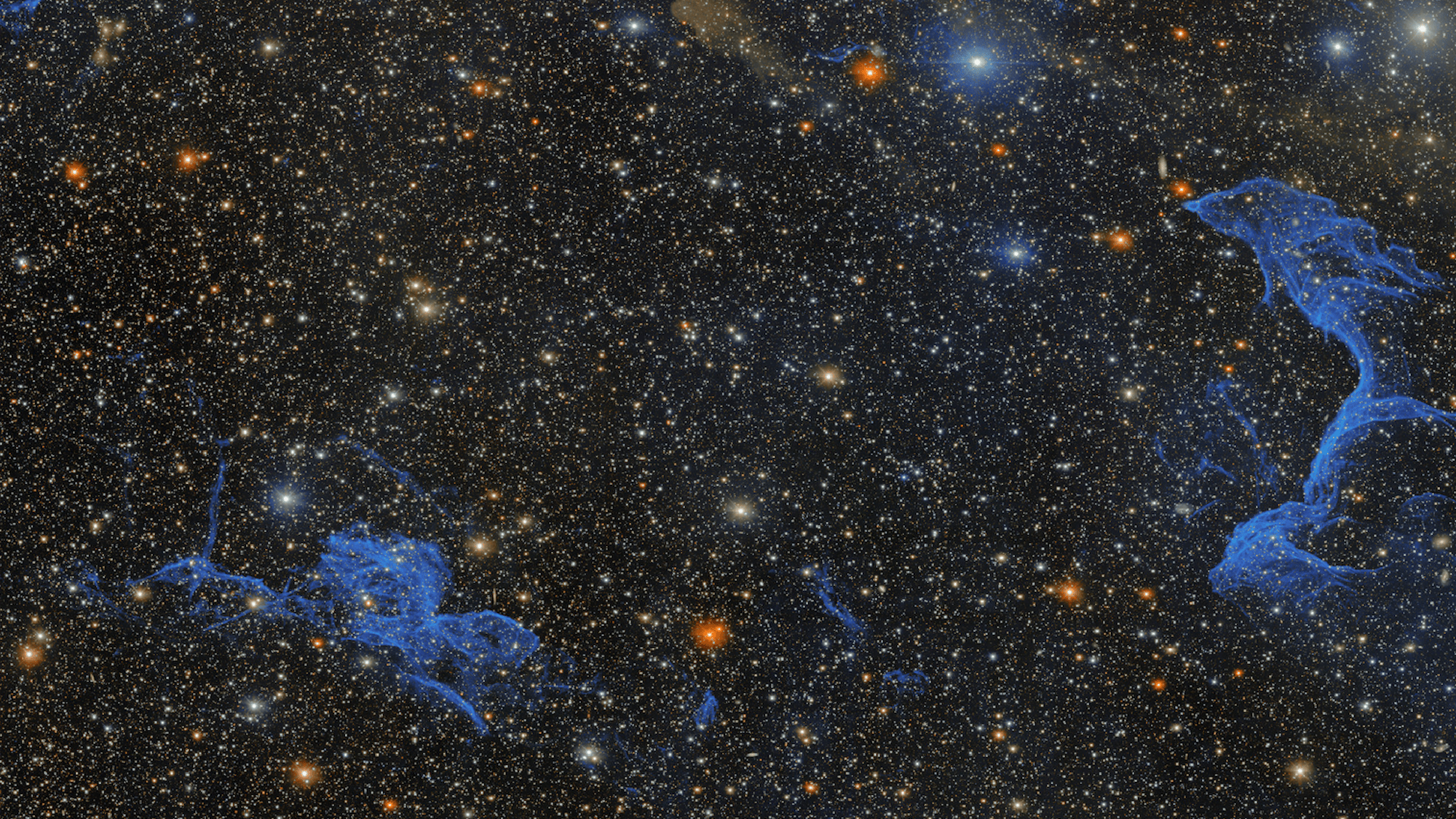
SNR G295.5+09.7 was created between 6,000 and 10,000 years ago from an exploding star.
Credit: NOIRLab
Ghostly blue clouds about 6,800 light-years from Earth are all that remain of an ancient cosmic demise. These and other details are visible in the most recent look at a supernova remnant classified as SNR G295.5+09.7. Depending on how you see it, SNR G295.5+09.7 likely earns at least one of its nicknames: the Betta Fish or Mermaid Nebula.

Zooming into the Betta Fish Nebula
A supernova remnant encompasses vast swirling waves of dust, gas, and stellar material created in the wake of a star’s death. SNR G295.5+09.7 exploded between 7,000 and 10,000 years ago in the Centaurus constellation, ejecting its outer layers of matter to collide with interstellar space’s own gases. The energy from these interactions subsequently caused the region to glow, which is now detectable by highly sensitive instruments. In this case, astronomers imaged the Betta Fish nebula using the 570-megapixel Dark Energy Camera (DECam) located at the Cerro Tololo Inter-American Observatory (CTIO) in Chile.
Although impossible to see with the naked eye, the supernova remnant contains the last vestige of its prior life in the form of a neutron star. The incredibly, miniscule dense object is what’s left from a star that was once multiple times the mass as our sun. Even now, SNR G295.5+09.7’s neutron star is larger than the solar system’s anchor—cramming about 1.4 times the sun’s into a sphere barely 12-miles in diameter. As the National Science Foundation’s National Optical-Infrared Astronomy Research Laboratory noted in its announcement, the stellar object is so small that it could fit inside the city of Tucson, Arizona.
However, the Betta Fish Nebula almost never happened. If the dynamics were slightly different, the massive stellar object’s collapse could have generated a black hole instead of a neutron star. If that were the case, the glowing swirls of cosmic material would likely never escape the black hole’s unfathomable gravitational pull.
2026 Popular Science Home of the Future Awards
39 products that will improve your everyday life.
