


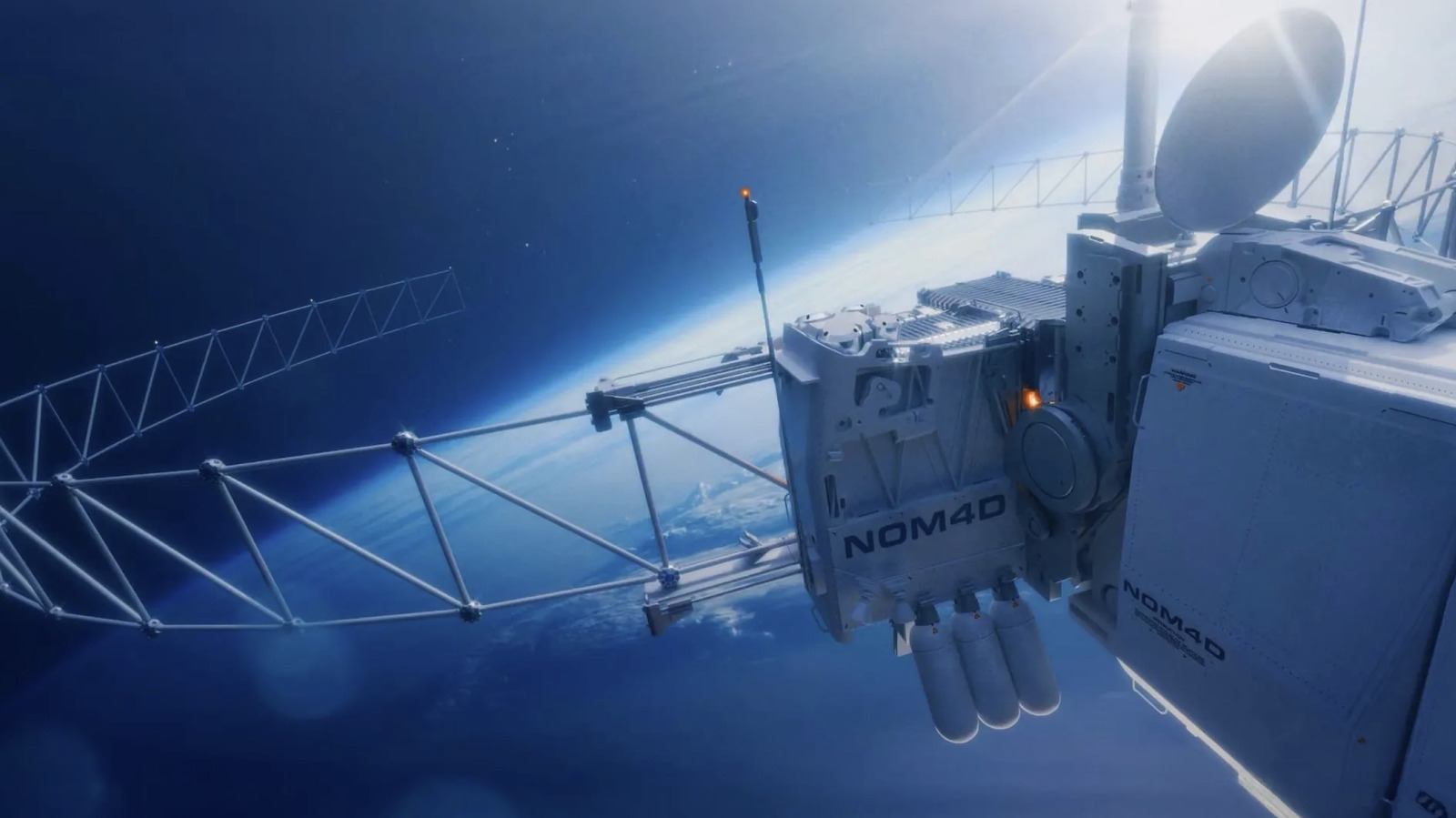
In a landmark experiment, a robotic system has demonstrated the ability to autonomously assemble a structure in space, an achievement that could transform how we build future infrastructure in Earth orbit and beyond. For decades, building structures in space has involved astronauts and robotic systems assembling components transported from Earth. The International Space Station (ISS), for example, was constructed piece by piece in orbit, with astronauts and robotic arms working together to position and join the various parts.
Now, researchers at the California Institute of Technology (Caltech), with support from the U.S. Defense Advanced Research Projects Agency (DARPA), have demonstrated a different approach by creating a robot capable of autonomously assembling structural components in space. The system, known as ASTRA (Autonomous In-Space Tensioned Reflector Assembly), was designed to assemble structures by joining together individual components, instead of just handling large sections that have already been built.
The experiment, which is taking place aboard Momentus’ Vigoride 7 spacecraft over a six-month period following its launch in March 2026, demonstrated that it was possible for a robot to carry out the physical construction process without any assistance from astronauts. It involved assembling an initial section of a planned 4.6-foot reflector antenna. ASTRA’s robotic arm picked up individual fiber tubes and aluminum joints, positioning them and putting them together to form sections of the antenna. It carried out the assembly autonomously while engineers on the ground oversaw the process. The operation had to be repeated a number of times to deal with various issues that cropped up, highlighting the challenges of carrying out construction in space. Although time constraints mean it’s unlikely the structure will be completed, the team said the experiment has proved the viability of robotic assembly in the environment of space, adding that the design now needs enhancing.
Massive space telescopes?
Unlike the construction of the ISS, which involved a great deal of human participation, the success of ASTRA suggests a future in which robots can take on more of the building work. Indeed, the breakthrough ASTRA technology is being developed with the longer-term goal of assembling much larger objects, including enormous reflector antennas and other space infrastructure, potentially bringing fundamental changes to how we build installations in Earth orbit and beyond.
The ASTRA experiment is part of DARPA’s Novel Orbital and Moon Manufacturing, Materials, and Mass-efficient Design (NOM4D) program, established in 2022 to explore manufacturing methods and ways of assembling enormous structures in space. Its ambitions are grand, with the program investigating various technologies that could make it possible to build structures thousands of feet, or even miles, in size, way larger than what today’s rockets can carry into orbit inside their nose cones, even in a folded form that’s designed to unfurl after reaching space. For example, the James Webb Space Telescope‘s sunshield was folded for launch in 2021 before opening up to its full size of 69 feet by 46 feet — impressive by today’s standards, but a size that could be dwarfed by future structures built in space.
Giant space telescopes could give astronomers unprecedented views of deep space, potentially revealing more about the universe than ever before. Enormous communications antennas and even power stations capable of capturing solar energy in orbit could also be possible, while similar robotic construction technologies could eventually play a role in future missions to the moon and Mars. By moving more of the construction work from Earth to space, robotic systems could make projects possible that would otherwise be limited by the size and weight of what you can send as part of a rocket’s payload.
A step beyond Canadarm2
You might be reading this and thinking, “But aren’t there already robotic arms in space, like the Canadarm2 aboard the International Space Station (ISS)?” and you’d be right. Canadarm2 has been performing a range of tasks aboard the ISS since arriving at the orbital outpost in 2001. But there are some notable differences between how this particular robotic arm operates and what Caltech’s ASTRA system is designed to do.
The 56-foot-long Canadarm2 is mainly a remotely operated robotic system designed to move, position, and install equipment and structural components, with astronauts aboard the ISS or controllers back on Earth directing its operations. ASTRA, on the other hand, takes this a step further by automating the process of building a structure from individual components. During its antenna assembly demonstration, rather than simply relocating large, preassembled sections into position, ASTRA was able to autonomously retrieve individual composite-fiber tubes and aluminum joints from onboard dispensers, position them, and then connect them to form structural sections. Although the system is monitored by humans on the ground, its ability to autonomously manipulate separate components is what sets it apart from Canadarm2.
The space station’s Canadarm2, which made headlines when it was struck by space junk, has certainly demonstrated the value of robotics in helping humans to build and maintain structures in space, but ASTRA takes that capability a step further by automating the assembly process itself. Caltech’s efforts are a notable step toward a future in which robots could build much larger and more complex structures in space, and with much less human involvement. For now, ASTRA is a proof of concept rather than a deployable construction system. Caltech says the design needs further refinement, while DARPA hopes the demonstration will encourage further research and investment in space manufacturing.
