


It’s mostly been the subject of Hollywood movies, but one day, an asteroid or comet could collide with Earth and cause serious damage. We don’t have to look all that far back for an example. In 1908, in an incident now known as the “Tunguska Event,” a space rock, likely a few dozen meters wide, exploded over Siberia. Though scientists weren’t able to visit the site for another two decades, the landscape was still scarred from the explosion.
Astronomers predict that in mid-April 2029, the asteroid Apophis will fly by Earth. The 450-meter-wide body will miss us at a distance of only 19,000 miles. That’s about 12 times closer to us than the moon and much closer than many satellites. It will even be visible to the naked eye.
In the past few decades, there’s been enormous progress in making these kinds of predictions. As space probes deepen our knowledge of small bodies in the solar system, astronomers have increasingly reliable and detailed data for finding potentially hazardous asteroids. Our ability to respond to such a threat, however, is another story. This is the missing and extremely important link—planetary defense technology that could allow us to deflect a dangerous object in time.
In a sci-fi flick, such situations are often solved with a nuclear bomb. But in the real world, blowing up a big space rock into tiny bits is not ideal. Instead, it’s better to alter the asteroid’s orbit. Everything in the vacuum of space is in motion. Our own planet travels about 20 miles every second. If the object hurtling towards us can be slowed down and thus reach the meeting point a little later, it will simply miss the Earth.
Four years ago, this was essentially what NASA tested on a pair of celestial bodies known as Didymos and Dimorphos. Astronomers at the Kitt Peak Observatory discovered Didymos, an asteroid measuring 780 meters across, 30 years ago. A few years later, Czech astronomer Petr Pravec observed that this asteroid had a “moonlet” orbiting it about every 12 hours. This smaller body, measuring about 151 meters in diameter, was then named Dimorphos.
The paired objects were a perfect testing ground for the kind of deflection a planetary defense system would involve. Locked in on these targets, NASA launched the Double Asteroid Redirection Test (DART) in late 2021. Nearly a year later, the DART probe crashed into Dimorphos.
Scientists had hoped that the impact of the probe—which was barreling toward the asteroids at over 13,000 miles per hour—could shorten the period of the mini-moon’s orbit by a minute or more. In the end, it was slowed down by 33 minutes. This major deviation was caused by the ejection of debris, leading to a much greater recoil than what was produced by the impact itself. In addition, the orbital speed of both asteroids around the sun also slowed. And in a sense, Dimorphos briefly became a comet—the debris released by the impact creating a long tail behind it.
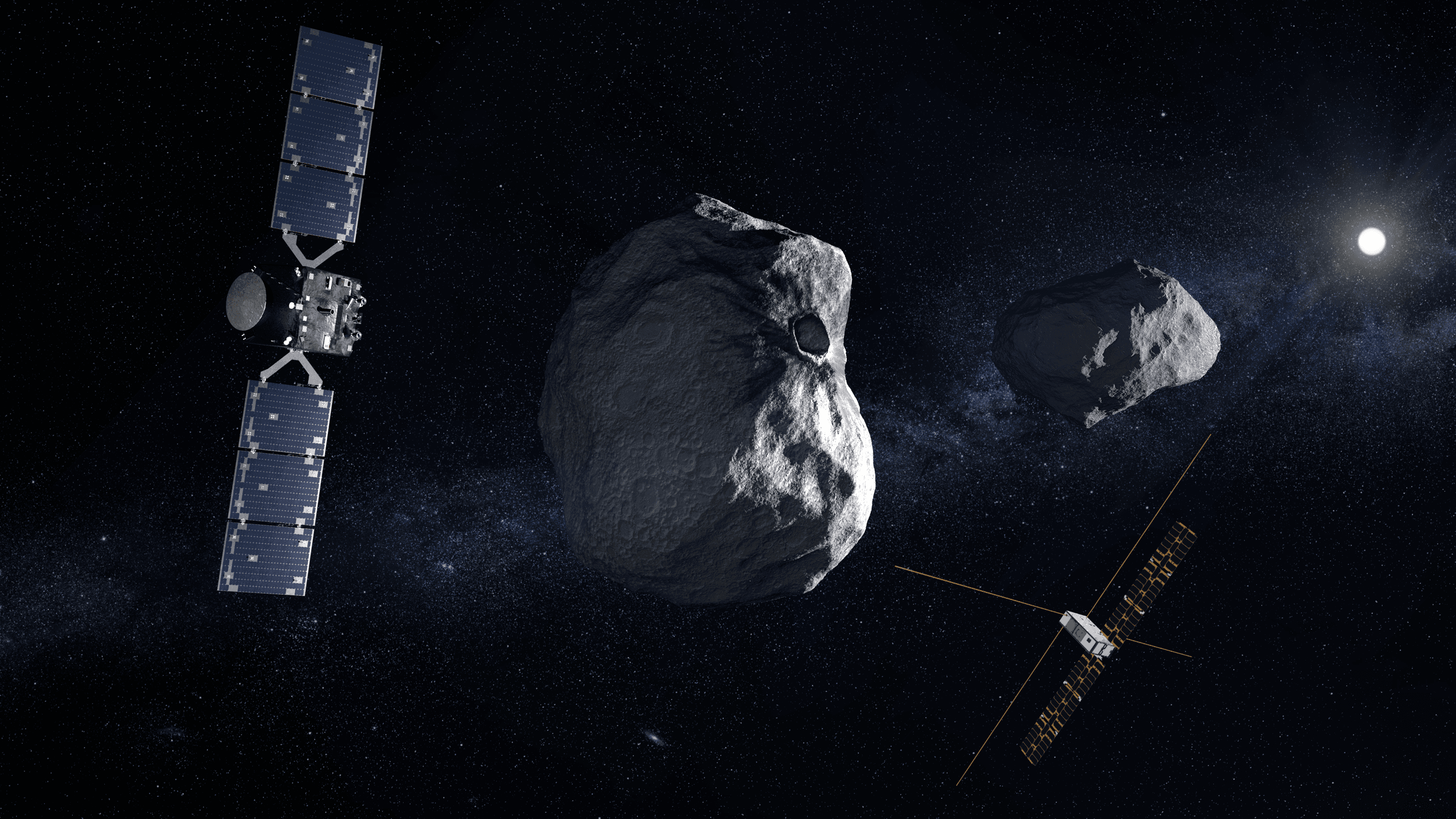
But questions remain about the longer-term impacts of this test. In October 2024, the European Space Agency (ESA) sent off the space probe Hera to rendezvous with both asteroids. After a flyby of Mars, the probe began its arrival phase this past October. It took its first image about 800 miles away, and the first detailed image of Didymos was published in early November.
Now in their vicinity, Hera will study both bodies in depth. Though there’s much we can learn about asteroids by observing them from our planet, nothing can replace close-up exploration, and this will be the first time a binary asteroid system will be explored in detail. One of the mission’s goals is to find out how such asteroid pairs form. Didymos is also interesting for its rapid rotation, turning once every 2.3 hours—placing it on the very edge of stability.
But of course, beyond this traditional astronomy research, which could also take place at another set of binary asteroids, Hera will investigate the consequences of the DART mission. This will include studying the impact site. Because there are so many knowns about the impact itself, scientists can also use this opportunity to understand craters more broadly, answering questions such as whether the strength of the material or gravity plays a more decisive role in crater formation.
Hera will also determine the exact mass of Dimorphos, an important detail in assessing the effectiveness of the DART mission as a test of planetary defense technology. The probe also contains a lidar instrument for mapping the asteroid’s topography and instruments for investigating the chemical composition of the surface. Additionally, we can expect to see detailed images of the asteroids taken with a resolution of 1 meter per pixel.
The probe is also carrying two miniature, cube-shaped satellites, called “CubeSats” for short, which it will deploy in January 2027. In Earth’s orbit, CubeSats are often used for simple experiments, including student projects, and they can even be stacked together to create larger satellites.
Hera’s CubeSats, named Juventas and Milani, will attempt to land on the surface. Using radar capable of probing up to a depth of 100 meters, Juventas will focus on geophysical exploration of the asteroid Dimorphos. Additionally, a gravimeter on board will measure how the gravity on Dimorphos changes during its orbit due to the parent asteroid, Didymos. Meanwhile, Milani will carry out a detailed investigation of the asteroids’ surface composition and will search for traces of dust and the volatile substances contained within many space rocks.
According to current plans, this main phase of the Hera probe’s mission is expected to last until the summer of next year, and findings from this probe will likely only become more relevant, not just as Apophis approaches, but even after it slings back into space. In the year 2000, we knew of only 300 near-Earth asteroids—those that approach Earth or directly cross its orbit. Today, we know of over 43,000.
This story originally appeared on WIRED Czech Republic and Slovakia and has been translated from Czech.
