


In the history of television, Two and a Half Men may be the only sitcom based loosely on the work of Carl Jung. I shit you not. Before Lee Aronsohn and I began writing, I decided it would help with character development if I researched Jungian archetypes. What I came up with was pretty simple. Charlie (played by Charlie Sheen) was a comedic variation on Dionysus, while Alan (Jon Cryer) was the biblical Job. One brother epitomized the god of wine and the pleasures of the flesh. Debauchery, if you will. The other was a decent man constantly being tormented by God in order to test his faith. (I imagined including this sophisticated backstory in my Emmy acceptance speech. Which might explain why I have an imaginary Emmy.)

Jon Cryer, Martin Sheen, Charlie Shee and Angus T. Jones in season 3 of Two and a Half Men.
CBS/Everett Collection
Anyway, for about seven years, things went pretty well. The ratings were through the roof, everybody was making a lot of money. We were happily mining the comedic gold that is alcoholism, divorce, and promiscuity. In order to get around the CBS censor, we’d purposely put crazy R-rated jokes into the scripts, jokes we knew would get flagged, then trade them for the jokes we actually wanted. The negotiations went something like this:
Me: “Tell you what, we’ll cut the ‘brush your teeth after oral sex’ joke, if you give us the three-way S & M joke.”
Censor: “You also have to cut all that bestiality stuff.”
Me: “Okay, I give up. Deal.”
The poor CBS censor was in a constant state of anxiety, trying to keep the show within FCC boundaries while recognizing smutty jokes were part of what made it wildly successful.
At the same time, Charlie, Lee, and I held hands once a week and recited the Serenity Prayer. It was fun. It was bonding. At one point, Charlie negotiated for more money and a four-day workweek—and got both. Sure, there were a lot of late nights filled with screaming and yelling, but that was me fighting with Lee about how best to write and produce the show (lest we forget, I had been warned about him). And somewhere along this seven-year path, I had an epiphany. I realized I could trust my instincts about what worked and what didn’t. I no longer needed to seek consensus. At the same time, I didn’t have to defend my mistakes. If something I believed in failed, I no longer felt it was a reflection on my self-worth. It was just something that had to be fixed. Or cut. Regardless, as epiphanies go, it felt like a little bit of freedom.
Point is, for seven years, Two and a Half Men was a blast to do. We learned a lot. We laughed a lot. My Jungian archetypes kicked ass against that loathsome piece of shit on The Apprentice. Until season eight, when it all began to unravel. Quickly.

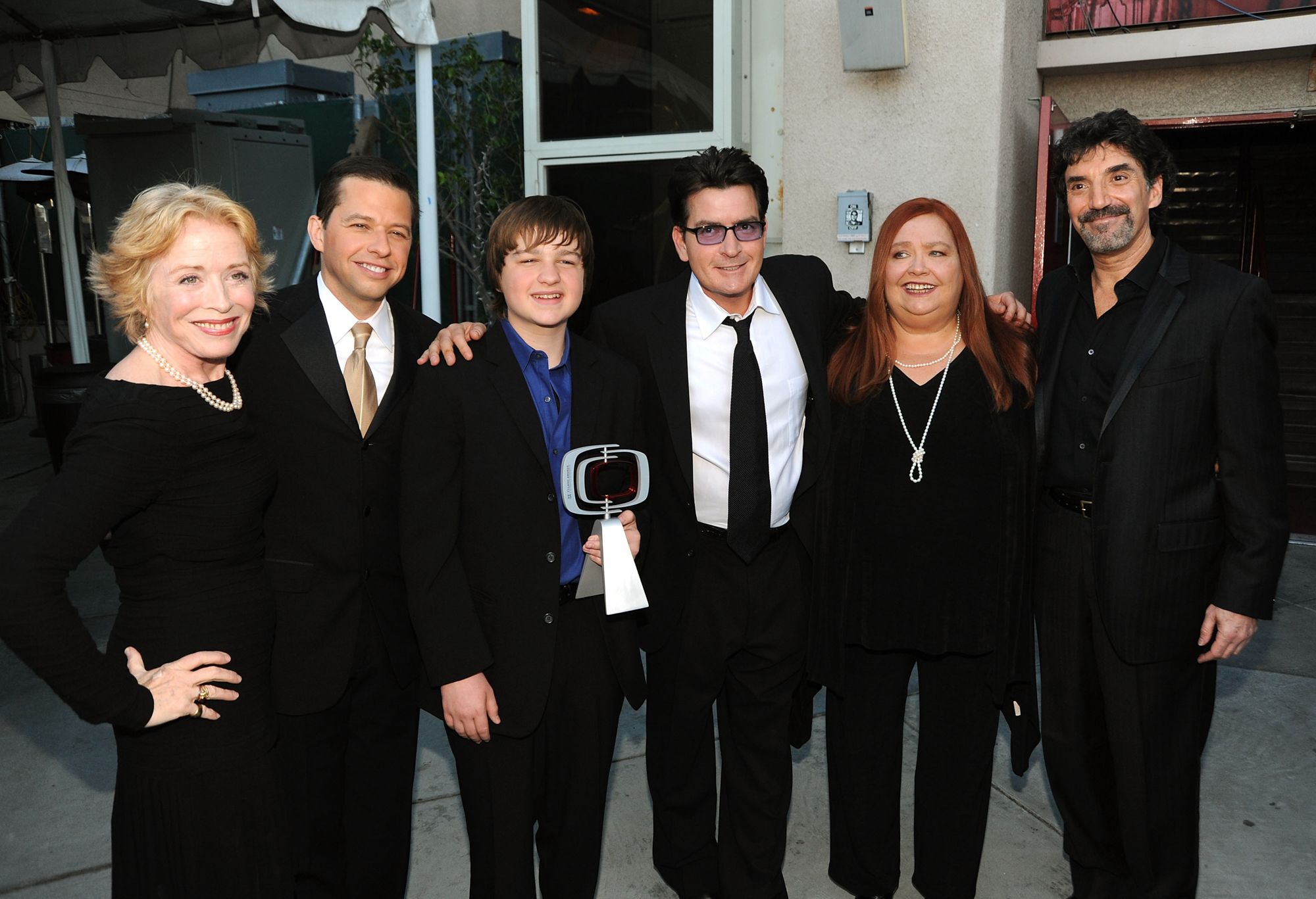
Producer/writer Chuck Lorre and Charlie Sheen at the presentation of Lorre’s star on the Hollywood Walk Of Fame, March 12, 2009.
Getty Images
Charlie started calling in sick all the time. The typical excuse was food poisoning, usually bad clams. There were a lot of emergency dental appointments. Once I was informed he would not be attending rehearsal because his BIC lighter had exploded and burned off his eyelashes. Another time, his manager bragged to me about having to fly across the country, with a bag full of cash, in order to purchase a home video sex tape starring his client. I naively questioned this.
Me: “He’s Charlie Sheen. Sex is kind of his brand. Who cares about a sex tape?”
Manager: “Not this kind of sex.”
Then came the arrest in Aspen.
Charlie was accused of threatening his third wife with a knife. (He would later tell me he wasn’t worried about the arrest, because he’d hired Kobe Bryant’s lawyer.)
I remember thinking to myself that this was spiraling out of control. By continuing to produce the show, I might be enabling criminal behavior. If someone actually got hurt—and I really thought that a possibility—I’d be weirdly complicit. But wife #3 eventually forgave him. So I thought, wrongfully, if she’s cool with everything, who am I to cast clams?
Then came Christmas in NYC.
The Plaza Hotel. A naked porn star was found hiding from Charlie in a closet, afraid for her life, while ex-wife Denise Richards and their two young daughters were across the hall in another room. Incredibly, the NYC police gave Charlie a choice: Stay in New York and be arrested, or leave town. Charlie left.
The next few months, we worked in a constant state of anxiety. We’d shoot the show on Friday nights and wish each other a pleasant weekend, all the while afraid of what might happen to our star between now and Tuesday morning. (Remember? Four-day workweek.) Even worse, every two weeks, the cast got a full week off. That meant ten days where Charlie’s life and the lives of those around him were in jeopardy.
The last scene we shot was with Charlie and Melanie Lynskey. He couldn’t remember any of his lines and had to use the furniture to keep himself upright. Melanie was terrified. It was clear to everyone that this man, whom we’d all grown to love, was in trouble. I had no choice but to shut down the show.
A pivotal phone conversation I had with Charlie might explain a lot of the insanity that followed. Again, might explain. I’m guessing here. After the shutdown, I told him the plan was to shoot two more episodes then call it a season—giving him a chance to get cleaned up. He angrily insisted we shoot four more.* I was emotionally exhausted and held my ground. Two more episodes, then we break for a desperately needed three-month hiatus.

Sheen and Jennifer Taylor in season 7 of the hit sitcom.
CBS/Everett Collection
And now here’s the guess: In my wildest dreams, I never considered that Charlie might have needed the money that two more episodes would’ve paid.
Years later, I put a few things together. I was sitting next to him before a Monday table read, when he told me he’d lost half a million dollars betting on yesterday’s football games. Forgive me for this mental image, but my asshole puckered right up. I was shocked. Amazingly, he wasn’t. He was confident he could get healthy on the Monday night game.
Now, couple that tidbit with the fact that his Mercedes-Maybach limo was stolen from his house—in a gated community—cameras everywhere—and then pushed into a nearby ravine—twice.** Two different Maybachs, two hundred grand apiece, inexplicably trashed, no witnesses, no video evidence.
Was it possible that Charlie wanted the two extra episodes in order to settle a debt with . . . bad people? Was that why he went on that ridiculous tour, selling ‘Tiger Blood’ T-shirts? Was he desperate for the money?
So anyway, that’s my guess.
Here’s what I do know. I called Martin Sheen and asked him to help. He angrily told me that he’d tried to intervene with his son for years. I put the phone down, thinking that The West Wing’s POTUS had just yelled at me. Not gonna lie, it kinda hurt my feelings.
Keep in mind, Charlie was making something like 1.25 million dollars per episode. Maybe more.
I then begged Les Moonves and the president of WB television, Bruce Rosenblum, to go talk to Charlie. They agreed, drove to his house, and offered him the Warner Bros. jet to usher him to the best rehab available. The show would wait for him to get straightened out, only resuming when he was ready. No harm, no foul. He agreed.
Then they make an honest, but fatal mistake. When they asked him to go right now, he said he needed a day or two. They believed him and left. The next day, he announced he would be getting sober at home—what he called Sober Valley Lodge—with his own nurses, doctors, and sober companions. Complete and utter bullshit. He was getting loaded the entire time.
I knew one of his thousand-dollar-a-day “sober companions” and called him to see what was happening. He said he was watching TV in the living room while Charlie was freebasing in the bedroom.
Me: “Why don’t you do something?!”
Sober companion: “What can I do? The door’s locked.”
Then Charlie started to go after me. On TV talk shows, online, everywhere. It was ugly. It was humiliating. There was no way I could continue doing my job, but I didn’t want to put everyone else out of work. So I offered to quit.
WB said it wouldn’t make any difference, they no longer wanted Charlie on the lot. I suggested they move the show to the CBS stages. That didn’t fly either.
And now let’s be clear about something. For years, the media has reported that I had Charlie fired. Ridiculously untrue. Anybody who knows anything about the television business knows that writers don’t have the power to fire the star of a billion-dollar show. We are fungible; stars are not. (Of course, this bullshit story wasn’t helped when Charlie sued me for $100 million for wrongfully firing him.)
So for about two years, I had to eat shit. Not just from Charlie. A lot of people piled on: David Letterman, NBC’s Today show, ABC’s Good Morning America, Alex Jones, Piers Morgan, TMZ, Twitter. Even Roseanne Barr, who always hated that I had a career after leaving her show. Charlie’s testosterone-cream, crack, and vodka meltdown was ratings gold, and everyone eagerly cashed in on it.
For my entire career, I had been happily anonymous. One of many names on the screen. Suddenly, I was a public figure. There were death threats. I needed police protection. Paparazzi were camped in front of my house. They chased me down the street. Photographed me coming out of restaurants. Even followed me into the meetings that I relied on to stay sober.
At a certain point, I became oddly disassociated from my own name. When I saw or read something that was derogatory, which seemed like a daily event, it was almost as if it was happening to a different person.***
Thankfully, I was able to keep from going crazy by working on The Big Bang Theory. Everyone on that show knew what I was going through. There were a lot of gentle pats on the back and “How ya’ doin’s?” Like I had a terminal disease.
And then I got a phone call from Moonves. He wanted to recast the lead role and keep the show going.
Me: “You’re kidding, right? How can we possibly keep going?”
Les: “Chuck, next fall there’s going to be a show on CBS called Two and a Half Men. Figure it out.”
I remember flashing on that image of the little Chinese guy in front of the tank in Tiananmen Square. Except the tank was Moonves.
It was suddenly clear that if I didn’t keep pulling Nielsen ratings out of the golden goose’s ass, someone else would. Fungible, remember?
So I called Lee and said, “Fuck it, let’s try and keep the show going. Worst-case scenario, we fail. So what? We can’t possibly get worse press than we’re getting now.” (In fact, the constant attacks from Charlie would eventually serve me well. These days, it takes a lot to hurt my feelings. Pissy movie stars can’t touch me.)
Somehow Hugh Grant’s name came up. We met with him. Lee and I wrote a couple of test scenes so he could see what kind of character he’d play. (A character very much like Hugh Grant.) He confided that he was terrified of working in front of an audience. No problem. I assured him I could get rid of the audience. (That means canned laughs. Fuck it. Clearly I have no moral compass.)
CBS and WB offered him $750,000 an episode. Four-day workweek.
I was told he had a pen in hand and was about to sign the contract when he abruptly walked out of the room and became “unreachable.” Eventually, his agent, lawyer, manager, or somebody who was not going to be getting a cut of that seven fifty called to tell us Mr. Grant did not want to be in Two and a Half Men.
Okay, now the show was really over. Except for that darn tank.
Les instructed me to meet with Ashton Kutcher. I expressed concern that he was too young for what we had in mind.
Tank: “What do you have in mind?”
Me: “Um . . . He’s too young.”
Tank: “Meet with him.”
So I did. In the Pacific Palisades.
Ashton was charming, funny, ridiculously handsome, and fascinated by all things tech. (Which we would later use in the creation of Walden Schmidt, internet billionaire and brokenhearted romantic.)

Ashton Kutcher, Lorre, and Cryer on-set in season 12.
CBS/Everett Collection
Moonves’s refusal to let the show die would ultimately add four years—eighty-four trauma-free episodes—to Two and a Half Men. It’s also worth mentioning that during that run, Ashton would pocket $63 million, Jon “the Death of Comedy” Cryer would go on to win his second Emmy, and I would enjoy the transcendental catharsis that came from writing Charlie Harper’s funeral episode, as well as the ruthlessly over-the-top, self-indulgent series finale that ended with a piano falling on a body double for Mr. Harper.
“Winning!”
And many years later, I woke up to discover that all the anger and pain was gone. Just . . . poof. Like it happened to another guy. Which, upon reflection, may be the truth.
Many years later, I was asked to meet with stand-up superstar Sebastian Maniscalco. He was clearly a master of his craft and wanted to expand into television with a sitcom. I couldn’t see how to do that and respectfully passed. Then I happened to see him in a small scene in the film The Irishman. He played a psychopathic gangster, Crazy Joe Gallo, opposite Robert De Niro and Joe Pesci. And he was great. I shared this insight with Mom writer Nick Bakay. I confided that I’d always wanted to build a comedy around small-time criminals, but I wasn’t comfortable with combining violence and comedy. He said, “How about a bookie?”**** I said, “Thank you.”
We pitched the idea to Sebastian and he immediately said yes.
It helped that David Zaslav, the newly enthroned president of Warner Bros. Discovery, formerly Warner Bros. AT&T, formerly Time/ Warner Bros., formerly Warner Bros. AOL, was a fan of Sebastian, and he shoved it onto HBO, formerly MAX, formerly HBO Max, formerly HBO GO, formerly indigenous people telling stories around a campfire.
The first episode included a scene with our bookies dealing with a real-life celebrity who owes them money. We kicked around names like Jon Hamm, but left the scene in the script without settling on which famous person we might approach to play themselves. Then, one night, it occurred to me who’d be perfect for the role. I called Nick.
Me: “I know who the degenerate gambler is.”
Nick: “Go ahead.”
Me: “Charlie Sheen.”
Long pause . . .
Nick: “Are you sure about this? Can you really do this?”
Me: “I’m over it. If Charlie’s in a good place, then I would most certainly be good with it.”
So I called Charlie. And he couldn’t have been more gracious and grateful. We didn’t get into the weeds about the whole Two and a Half Men nightmare. It was just over. The morning of the first Bookie table read we hugged. Not a show business hug. A real one. Like when you see an old friend after a long time apart. And then he proceeded to kill at the table. It was a comedy master class. Almost as if he’d been preparing to play a degenerate gambler his whole life.
I got to shoot two seasons of Bookie. I loved the results. I even jammed in some gratuitous nudity for the HBO brand. Sadly, the wise folks at HBO were not fans. Keep in mind that for many years, the DNA of HBO was expressed with the words, “We’re not TV, we’re HBO.” Guess what they saw when they looked at me.
*Keep in mind, Charlie was making something like 1.25 million dollars per episode. Maybe more.
**The Maybach thing was never solved. I once got the chance to ask the LAPD chief of police what the deal was with that. He said he couldn’t comment.
***In order to survive my own grief and rage, I was counseled to pray for Charlie’s well- being. Okay, “just say yes” worked. I’ll try it. In the beginning, I’d hit my knees in the morning and before bed, and say, “Please God give that motherfucker everything he needs and wants to be happy.” I’m pleased to report this actually worked… after about two years.
****It also helped that Nick had once been an ESPN commentator regarding points, odds, spreads, vig, parlays, etc. (This was back when the NFL, MLB, NBA, and NHL frowned on sports gambling. Once they started getting a piece of the action, those frowns turned upside down.)
Excerpted from the book SITCOM: A Memoir by Chuck Lorre. Copyright © 2026 by Chuck Lorre. To be published on October 13, 2026, by Dey Street Books, an imprint of HarperCollins Publishers. Excerpted by permission.
-
Erika Kirk Doesn’t Really Want to Talk Politics. So How’s She Going to Lead Turning Point USA?
-
A Deep Dive Into How Larry Ellison Built His Influence
-
Making the Elizabeth Holmes Doc Fried Nathan Fielder’s and Lance Oppenheim’s Brains
-
“History Will Judge”: Fox News Anchor Bret Baier on Donald Trump and Pete Hegseth’s War With the Press
-
Inside Lane Kiffin’s Trash-Talking, “Joey Freshwater” Era With Nick Saban at Alabama
-
From the Archive: Inside Elizabeth Holmes’s Chilling Final Months at Theranos
