


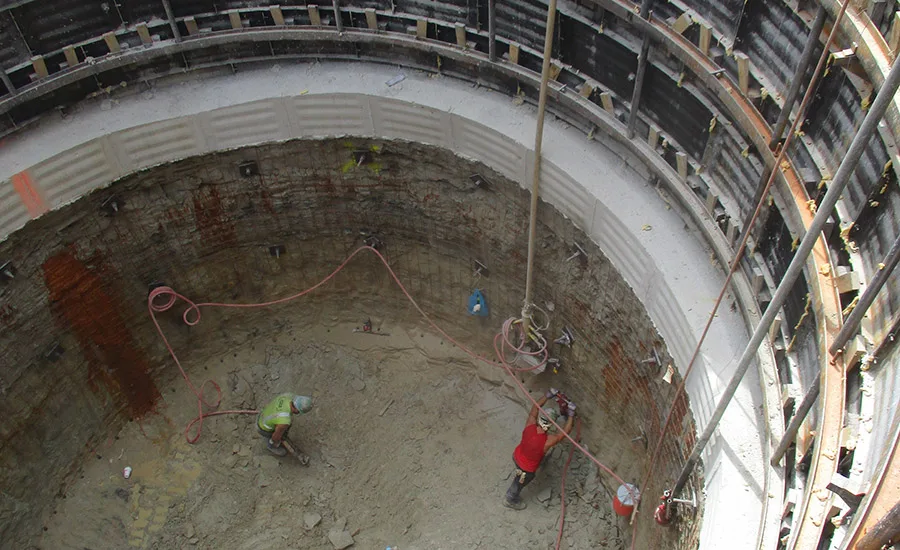

Photo courtesy of Northeast Ohio Regional Sewer District
The Big Creek Tunnel Project is part of a $324.8-million project to prevent combined sewer overflow into Lake Erie.
ENR AT-A-GLANCE 5 Things to Know
EXPAND ↓ COLLAPSE ↑
$324.8 MILLION CONTRACT
A Granite Construction and Super Excavators joint venture will build the Big Creek Tunnel for the Northeast Ohio Regional Sewer District in the Cleveland area.
22,300 FT OF 20-FT-DIA TUNNEL
The project includes 22,300 linear ft of 20-ft-dia tunnel plus 3,115 linear ft of ancillary tunnels, including adits and overflow, connecting and dewatering tunnels.
FINAL PROJECT CLEAN LAKE TUNNEL
Big Creek is the last of seven large-diameter combined sewer overflow storage tunnels planned under NEORSD’s $3-billion, 24-year Project Clean Lake program.
550 MILLION GALLONS A YEAR
Once complete, the tunnel is expected to eliminate about 550 million gallons of combined sewer releases annually and help NEORSD meet federal Clean Water Act requirements.
WINTER 2030 COMPLETION
Construction is scheduled to begin in fall 2026 and finish in winter 2030, with work also including shafts, diversion and screening structures, gate control vaults, consolidation sewers and an overflow box culvert.
A Granite Construction and Super Excavators joint venture has been chosen to build the planned $324.8-million Big Creek Tunnel for the Northeast Ohio Regional Sewer District in the Cleveland area.
The project, announced Oct. 1, is the seventh and final large-diameter storage tunnel in the district’s $3-billion Project Clean Lake program, launched in 2011 to reduce combined sewer overflows and improve regional water quality.
The program, which resulted from federal and state consent decrees addressing overflows into Lake Erie and its tributaries, involves tunnels, treatment plant improvements, collection system projects and green infrastructure.
Read More
Northeast Ohio Regional Sewer District —
Project Clean Lake
Work is expected to include construction of a 22,300-ft-long, 20-ft-diameter main tunnel, plus about 3,115 ft of ancillary tunnels, including adits and overflow, connecting and dewatering tunnels. The project also includes shafts, diversion structures, gates and screening structures, consolidation sewers, and overflow box culvert, utilities, sitework and restoration.
The rock-bored tunnel will capture flows from 11 combined-sewer-overflow outfalls, preventing about 550 million gallons of annual sewer discharges into Big Creek and its tributaries. It will span more than four miles, measure 20 ft in diameter and run 50–100 ft beneath Cleveland, Linndale and Brooklyn, Ohio.

The Big Creek Tunnel includes more than four miles of 20-foot-diameter tunnel, built in rock, 50 to 100 ft beneath Cleveland, Linndale, and Brooklyn, Ohio.
Image courtesy of the Northeast Ohio Regional Sewer District
Major structures planned include multiple shafts, diversion structures, gate and screening structures, gate control vaults, consolidation sewers, and an overflow box culvert, along with associated sitework, restoration, and utilities.
“The scale and complexity of this project align directly with Granite’s strengths in large-diameter tunneling and shaft construction,” Granite Tunnel Division Vice President Jim Nickerson said in a news release. “This is a major wastewater infrastructure project, and it will strengthen system performance and protect local waterways across Northeast Ohio.”
The Granite-Super JV submitted the lowest of four bids. The price was about 8% above the district’s roughly $300-million estimate. Detroit-based Wade Trim is the lead designer, with KS Associates providing surveying services.
Construction, now set to begin, would complete in late 2030, although the district says work could continue into 2031.

Annemarie Mannion is editor of ENR Midwest, which covers 13 states. She joined ENR in 2022 and reports from Chicago.
