


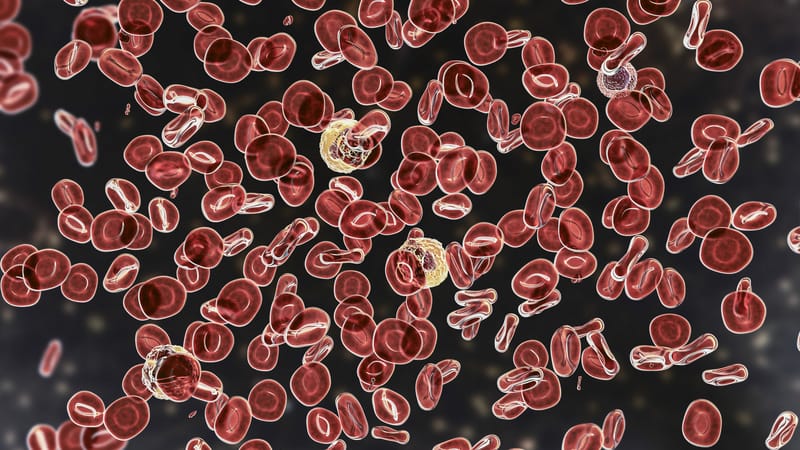
The FDA has approved rusfertide (Mimrylo, Takeda) to treat erythrocytosis in adults with polycythemia vera.
Patients with polycythemia vera overproduce red blood cells, increasing blood viscosity and the risk for life-threatening thrombotic events, including stroke, deep vein thrombosis, and pulmonary embolism. The new medication is for those “whose disease has not been adequately controlled with existing therapies,” according to a press release from the FDA.
Rusfertide, a once-a-week, self-administered subcutaneous injection, is a first-in-class peptide that mimics the hormone hepcidin to regulate iron homeostasis and reduce red blood cell production, according to Takeda.
Approval was based primarily on the phase 3 VERIFY trial, which randomized 293 phlebotomy-dependent patients evenly to rusfertide or placebo on a background of standard-of-care treatment — which could include hydroxyurea, phlebotomy, and interferon and/or ruxolitinib. Placebo patients were allowed to cross over to rusfertide at week 32.
“Efficacy was measured by the proportion of patients who did not meet criteria for phlebotomy between weeks 20 and 32 of the study,” the FDA said. At week 32, overall, 76.9% of patients on rusfertide did not require phlebotomies compared with 32.9% on placebo.
The mean number of phlebotomies was 0.5 per patient in the rusfertide arm vs 1.8 in the placebo group. At week 52, the median time to first phlebotomy had not been reached with rusfertide; it was 16 weeks with placebo. Mean hematocrit was below 43% in patients who continued rusfertide and those who switched over from placebo.
The most common treatment-emergent adverse events with rusfertide at 32 weeks were injection site reactions (55.9% vs 32.9% with placebo), anemia (15.9% vs 4.1%), and fatigue (15.2% vs 15.8%). At 52 weeks, the most common events with rusfertide were injection site reactions (47.4%), anemia (25.6%), and fatigue (19.6%). Overall, two rusfertide patients had thrombotic events.
M. Alexander Otto is a physician assistant and award-winning journalist. He is also an MIT science journalism fellow. Email: aotto@medscape.net