


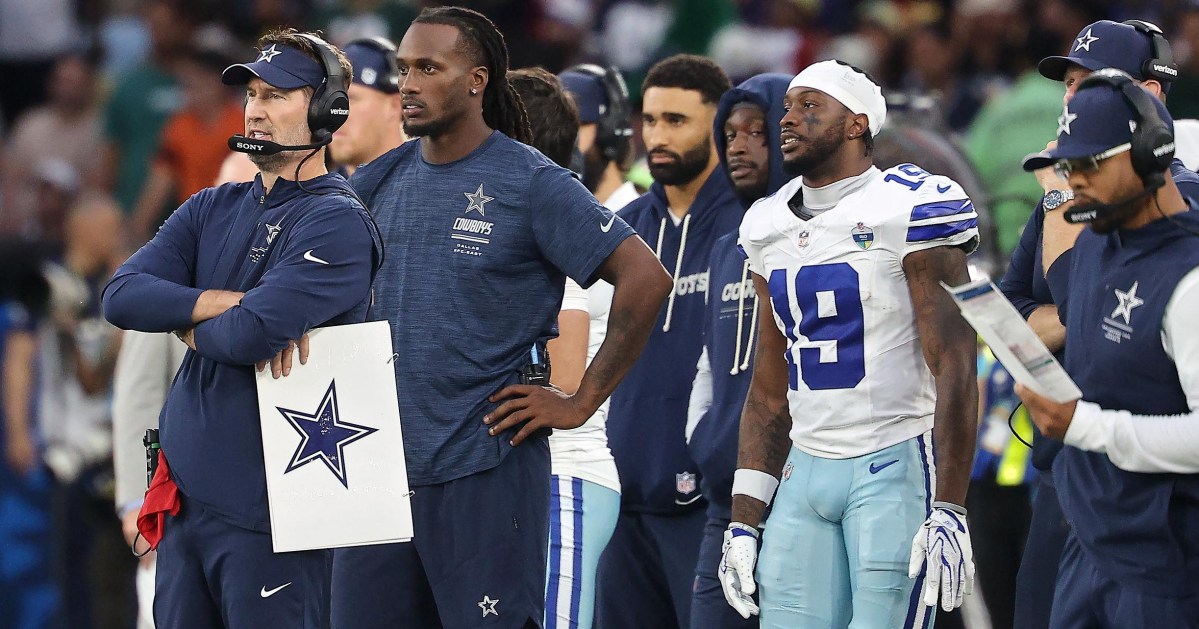
At some point, a bad loss stops being an isolated incident and starts becoming a reflection of the people responsible for preventing it, going all the way up to the front office. Yet, since the Cowboys are structured and operated the way they are that’s a story for another day. For now, the focus should be on the field with the people who are making decisions in real-time.
Thursday night’s 24-16 defeat to the Tampa Bay Buccaneers was another reminder that the problems plaguing this team extend far beyond one player, one position group or one unfortunate bounce of the football. Dallas lost at home to an 0-4 team starting an undrafted rookie quarterback in his second NFL start. Tampa Bay left AT&T Stadium with its first win of the season after outgaining Dallas in yardage, controlling possession for more than 39 minutes and winning the turnover battle 3-0.
The Cowboys once again struggled to stop the run, failed to sustain their offense, surrendered a costly special-teams turnover and watched their final realistic opportunity disappear when Jake Ferguson couldn’t secure a pass that became the game-sealing interception.
Individual mistakes played a role, but they cannot explain away the broader failure. Dallas looked unprepared to handle Tampa’s pressure, unable to stop its rushing attack and incapable of consistently executing in any phase of the game. When those problems appear simultaneously, the scrutiny has to extend beyond the players making mistakes and toward the coaches responsible for preparing them.
Brian Schottenheimer, Christian Parker, Klayton Adams and Nick Sorensen all have different responsibilities, but Thursday exposed shortcomings across their respective units. Five games into the season, the Cowboys have given fans little reason to believe this staff can turn a talented roster into a consistently competitive team.
Brian Schottenheimer keeps coming up short
Schottenheimer’s responsibility extends beyond calling plays. As head coach, he sets the team’s standards, oversees its preparation and ultimately answers for the product Dallas puts on the field. As offensive play-caller, he also has a direct hand in an offense that struggles at inopportune times.
Dallas opened Thursday’s game with a promising touchdown drive, but managed only three additional points before its final touchdown with 5:26 remaining in the fourth quarter. Tampa’s pressure disrupted Dak Prescott, and the Cowboys never found a consistent counter until the game was nearly out of reach.
When Dallas can establish its preferred rhythm, the offense has enough talent to score against anyone. When an opponent disrupts that rhythm, however, the Cowboys too often look as though they are waiting for the original plan to start working again rather than finding a different way to attack.
Every play-caller has bad games, but the better ones recognize when an opponent has taken away the first option and respond before an entire half slips away. Schottenheimer’s offense failed to do that against Tampa, and Dallas finished with three turnovers while leaving too much of the burden on Prescott to manufacture a comeback.
The struggles were not limited to the play calls themselves. TE Jake Ferguson’s blocking has been inconsistent, and his three-catch, 19-yard performance against Tampa ended with a drop that became an interception when Dallas was trying to mount a late comeback.
Not every tipped interception is the receiver’s fault, but Ferguson needed to secure a catchable pass in that situation. Combined with his ongoing difficulties as a blocker, the play highlighted another weakness the offense has not adequately addressed.
Ferguson has shown he can contribute as a receiver, but a tight end who struggles to finish blocks and cannot consistently deliver in critical moments puts his offense in difficult situations. The coaching staff must find a way to improve his execution or reconsider how heavily it relies on him. Continuing to use the same personnel in the same ways without addressing the results is not a meaningful adjustment.
Schottenheimer cannot catch passes or prevent every turnover, but he can put his players in better positions to succeed. His offense needs a more adaptable approach, and his team needs greater discipline in the situations that decide close games. Until those improvements become visible, it is fair to question whether he is the right person to lead this operation.
Christian Parker’s defense has no identity
If Schottenheimer’s offense failed to adjust, Christian Parker’s defense failed to stop the most obvious threat in front of it. Tampa Bay ran for 241 yards, with Bucky Irving accounting for 165 on 21 carries. Irving broke off a 72-yard run to open the second half, setting up a touchdown on the next play, and later added a one-yard scoring run. The Buccaneers finished with 419 total yards while controlling the game through their ground attack.
Meanwhile, quarterback Jalon Daniels completed 19 of 25 passes for 189 yards and a touchdown. He played efficiently without needing to take over the game, largely because Tampa could rely on its running game to move the chains and keep Dallas’ offense on the sideline.
That is an increasingly troubling reflection on Parker’s defense. Dallas entered the season expecting a new identity under a new coordinator, but the unit has struggled to stop the run, generate consistent pressure and create turnovers. Through five games, the Cowboys have yet to record an interception, although Daron Bland just tried his best to secure one.
In fairness, maybe Parker deserves some time to establish his system, and injuries have complicated his personnel decisions. Joey Porter Jr., acquired to strengthen the secondary, was unavailable Thursday because of an illness. Those circumstances deserve consideration, but they do not explain away the fundamental breakdowns against Tampa.
A defense should still be able to maintain gap discipline, tackle effectively and prevent an opponent from repeatedly exploiting the same weakness. The Buccaneers did all the things Dallas needed to prevent, and the Cowboys had no effective answer.
The performance also raised legitimate questions about the team’s preparation and effort, particularly on defense. Effort cannot be measured simply by looking at the final score, and a poor performance does not automatically mean players were unmotivated. But repeated failures to finish tackles, control the line of scrimmage and respond when Tampa seized momentum are difficult to overlook. These are fundamental responsibilities that should not disappear because an opponent has a favorable matchup or the game is being played on a short week.
Parker’s challenge is not simply to install a scheme; it is to establish a dependable standard of execution. The issue is not that he has failed to rebuild the defense in five games, but that his unit has yet to demonstrate a reliable foundation on which that rebuild can succeed.
Nick Sorensen’s special teams are another problem
Special teams should provide a hidden advantage when the offense and defense are struggling. Instead, Sorensen’s unit contributed another costly mistake to a night when Dallas could not afford to give away possessions.
After Tampa scored to take a 21-10 lead early in the third quarter, KaVontae Turpin fumbled the ensuing kickoff return. Tampa recovered at the Dallas 37-yard line and converted the short field into a 41-yard field goal, extending its lead to 24-10.
Turpin is responsible for securing the football, but the coaching staff also has to answer for a unit that failed to execute in a critical situation, again. Remember those blocked field goals in weeks 3 and 4? Sorensen’s job is to prepare the coverage and return units, reinforce fundamentals and limit precisely these kinds of mistakes.
The turnover was particularly damaging because Dallas needed an opportunity to respond after surrendering a quick touchdown. Instead, Tampa received another scoring chance without having to drive the length of the field. That is how a single special-teams error compounds the problems created by the other two phases.
Dallas cannot afford to keep surrendering possessions and field position while asking its offense to overcome defensive breakdowns. Sorensen’s unit has to become more dependable, because the Cowboys have little margin for mistakes when the rest of the team is struggling.
The Cowboys need answers, not more explanations
Five games are not enough to declare an entire season lost, and Dallas still has talent capable of producing better results. Prescott can move the football, the receiving corps has shown it can generate explosive plays, and the comeback against Houston demonstrated what the offense can accomplish when it finds its rhythm.
But the Tampa loss exposed how dependent Dallas is on individual talent to overcome its other weaknesses. When the offense struggled, the defense could not stop the run, and special teams handed away a possession. Ferguson’s late drop compounded the offensive problems, while the defense’s inability to get off the field left Dallas fighting an uphill battle for much of the night. There was no reliable phase of the team capable of compensating for the others.
That is the main problem with this coaching staff. Schottenheimer has not consistently demonstrated that he can adapt the offense or get the entire team to execute, or as he would say “play complementary football.”
Parker’s defense lacks a dependable identity, Adams’ offense needs better answers against pressure, and Sorensen’s unit cannot afford costly mistakes. Each coordinator has a different problem to solve, but the head coach is responsible for making sure those problems do not define the team as a whole.
The short week deserves some consideration, but it cannot serve as a blanket excuse for missed tackles, poor ball security, ineffective blocking and an inability to adjust, and simply put, beat a bad team at home. Dallas’ FO can continue, and will, to insist that it has the talent to compete, and there is evidence to support that claim.
What the Cowboys cannot keep doing is treating each disappointing performance as an isolated setback while the same fundamental issues resurface every week.
At some point, the staff has to demonstrate that it can turn those problems into progress. After Thursday night, Brian Schottenheimer and his coordinators have given Dallas very little reason to believe they are the answer.
