


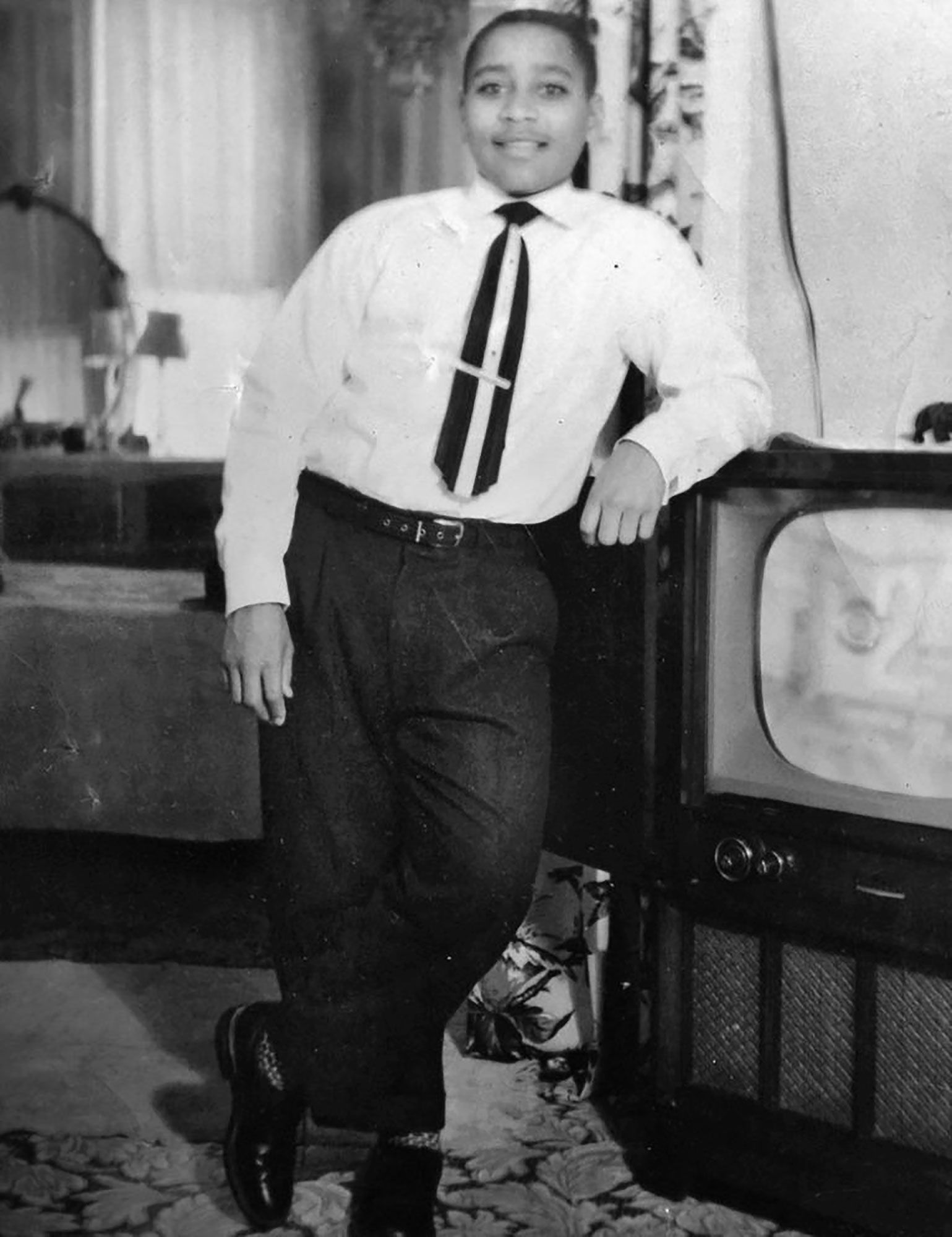
Since his lynching in 1955, Emmett Till has been a symbol of the civil rights movement and a face for the countless Black men slain in racially motivated attacks. But while the 14-year-old’s kidnapping and murder has inspired a number of films and documentaries, Dr. Sarah Elizabeth Lewis—a professor of humanities, African studies, and African American studies at Harvard—wanted to approach Till’s legacy in a new way: not as a case to be investigated, but as an example of the promise the world loses to every act of racist violence.
“We are in an era where we are challenged to see the facts of history, to see what’s in front of us,” Lewis tells Vanity Fair. She does just that in What If Emmett Till Lived?, a multi-artist exhibit at Columbia College Chicago’s Museum of Contemporary Photography (MoCP) that Lewis curated under the guidance of Reverend Wheeler Parker, Jr.—Till’s best friend, cousin, and witness to his abduction.
On August 24, 1955, Chicago native Till was visiting relatives near Money, Mississippi, when he was accused of whistling at a white woman, shopkeeper Carolyn Bryant. Four nights later, on August 28, Emmett Till was kidnapped, tortured, and shot in the head for that alleged transgression. His abductors, Roy Bryant and J. W. Milam—who admitted their crimes but were never convicted for them—threw his body into the Tallahatchie River, weighing it down with a cotton-gin fan.

Drinking Fountains, Mobile, Alabama, 1956.Gordon Parks/The Gordon Parks Foundation
When his body was found, Emmett’s mother, Mamie Till-Mobley, insisted on an open-casket funeral. She hoped that the horrifying image of his grotesquely brutalized head might reach people the way words have not. “A photograph was what would be required to transform witnessing in society,” Lewis said—and indeed, the funeral photos had a tremendous impact at the time when news outlets published them. “For me, there can be no more important question than asking, ‘What does seeing the truth require today?’”
What galvanized her to launch this project was the resistance, even now, to acknowledging the details of Till’s case. One example: a memorial placed at Graball Landing near Glendora, Mississippi, where Till’s body was pulled from the river, has been the site of countless acts of vandalism. A visit to the monument “constructed an urgency in me to do my part to honor Emmett Till’s life,” says Lewis. But she was coming from a place beyond mourning and despair. “He’s become a symbol,” she says, “but we’ve never given ourselves a means to envision his right to life.” So Lewis sought to build one for him, using photos by artists in MoCP’s permanent collection—including ones by Annie Leibovitz, Francesco Scavullo, Bruce Davidson, and about 110 others.
For months on end, Lewis would take a seat, set an intention, and scan through images until she lost focus. She went through 18,000 photographs, choosing images without considering the identity of each individual artist. She also invoked the departed: “I’m not afraid to say I really asked for guidance from Till and from Mamie Till-Mobley. I really asked for a sign of what was meant to represent his unlived life, and really, that’s maybe for another kind of interview. But it shocked me how precise the feedback was.”

Dr. Sarah Elizabeth Lewis and Reverend Wheeler Parker, Jr.Lance Omar Thurman
Once Lewis had winnowed the images down to a manageable number, she met with Parker to make the final picks. “He lives with that survivor’s guilt,” Lewis says of the 87-year-old clergyman, who has dedicated his life to keeping Till’s memory alive. “He is the last living eyewitness. He bears the testimony of the story that’s never been acknowledged by the official record.”
The exhibit’s choices aren’t necessarily what you’d expect from a project related to one of the most notable tragedies in modern American life. It and its companion piece, a photo and essay collection called If Emmett Till Lived: A Creative Monument, express messages of hope and positivity, a rare and almost counterintuitive tactic for a death as horrific as Till’s. We see photos of children playing alongside images of a cup of coffee or a scoop of ice cream; a father playing with a baby is followed by an image of former president Barack Obama. “What I was asking in every turn is, does this represent a pathway, a life option?” Lewis says. “Does this represent opportunity? Does it represent freedom? So you see, in many cases, proxies for Till.”
That so many images are simple, relatable scenes is intentional, Lewis says. “It represents, ultimately, the fact that Emmett Till’s story represents all of ours, and that our lives represent his.”
Peter Cochrane, one of the artists whose work Lewis chose, says he understands her reasoning. “Photographs used in journalism, videos, etc., can strike a chord initially, but then we grow sort of tired of them—I’m thinking of the sort of horrors that have been documented,” he says. “We just become sort of inured.”
“Then, there are images in our sort of artistic and social canon that just stick with us forever, right? You see them once, and you’ll never forget them,” Cochrane continues. “I think that’s a lot of what Sarah Lewis was drawn to in these.”

A Man and a Woman Waiting for the Bus, Syracuse, NY, 1985.Dawoud Bey
Call it guidance from beyond; call it the ghost in the machine. But whatever was guiding Lewis seemed to agree with Cochrane about tragedy’s numbing effect. “There were moments where an image, because these are civil rights photographs, was of explicit violence. I would look at it, and there were many times where something would glitch on the computer, and it would not get in.”
It’s hard to think about Till and not feel despair, especially for someone who’s paying attention to the news. But Lewis hopes the exhibit can counteract despair with the reminder that living in “generation time”—a longer span than just a few years—is important. She cites activist W. E. B. Du Bois, the first Black person to earn a PhD at Harvard. “He needed to be able to maintain his fortitude because of what was going to come. We’re going to have another flourishing, another time.”

Children Playing Behind an American Flag Hanging in Little Village, 2002.Antonio Perez
“Generation time requires keeping an eye on two things at once,” Lewis continues. “You know what’s required for the moment, and what’s required for the era, and the era requires endurance. That’s what I owe to my ancestors. That’s what I owe to the future.”
What if Emmett Till Lived? opened at MoCP on September 10 and will run until December 19, 2026. Its companion publication, If Emmett Till Lived: A Creative Monument, is available now.
-
From Prince George to Princess Leonor: Where Young Royals Will Attend School This Fall
-
The Pitt’s Patrick Ball on Shipping, Stardom, and Season 3
-
From Cowboys to Clean Girls: The State of American Style, in Pictures
