


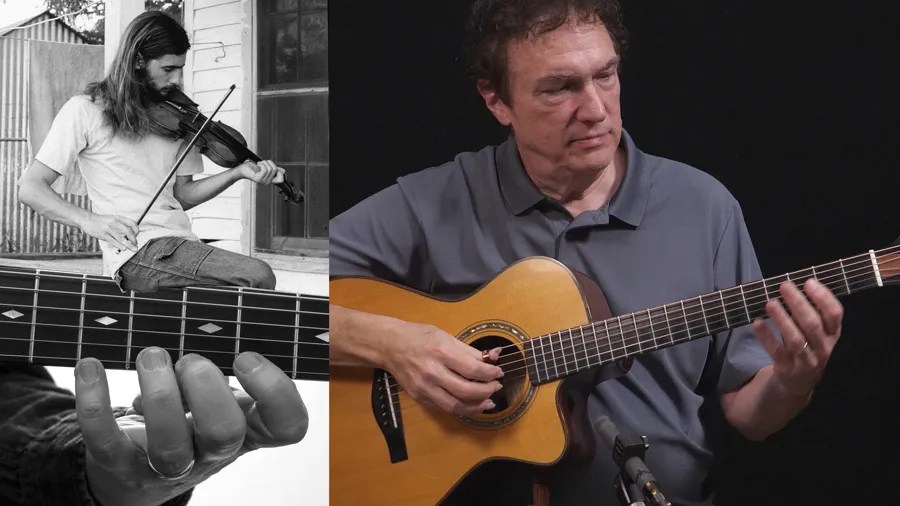
Traditional and fiddle tunes are often framed as flatpicking fodder, but they also offer a deep well of ideas for solo fingerstyle guitar. Their sturdy melodies, built to withstand countless reinterpretations, translate beautifully when you bring them under the fingers—opening the door to arrangements that feel both rooted and personal.
In this lesson, we’ll use “Will the Circle Be Unbroken” as a model for that process. Although the hymn was written in 1907 by Charles H. Gabriel, it’s widely treated as a traditional song and has been reshaped by generations of singers, from the Carter Family to Willie Nelson, Bob Dylan, Joan Baez, and the Nitty Gritty Dirt Band. That long interpretive history is part of the appeal: with a tune this familiar and adaptable, arranging becomes less about replication and more about finding your own voice within the melody.
Getting Started
To create this arrangement, I began by listening to and playing along with a range of vocal recordings to get a sense of how different artists approached the tune, while trying not to mimic any single version. I quickly noticed how differently each singer treated the melody—altering the timing, phrasing, and even the notes. Singers often slide into pitches from above or below and may anticipate, delay, or extend notes. That’s one of the beauties of traditional music: it evolves with each performance, giving us permission to shape our own interpretations as well.
When arranging a tune for solo guitar, it’s important to consider how the melody and harmony sit on the instrument. If the melody is too low, there’s no room for bass lines or chords beneath it; too high, and it can be difficult to reach both melody and supporting bass notes or chords. A helpful rule of thumb is to choose a key that places the melody in first position on the top three strings. After exploring a few options, I settled on the key of D major, where the melody spans from string 3, fret 2, to string 1, fret 5. Dropped-D tuning works well here, giving you a low D on an open string.
Introducing Variety
“Will the Circle Be Unbroken” illustrates a common challenge in arranging folk and traditional songs: the verse and chorus share the same eight-measure melody. When sung, the lyrics sustain the listener’s interest across multiple verses; instrumentally, we have only those eight measures to develop into a full-length arrangement.
One way to expand such a short, repetitive tune is to explore different ways of harmonizing and phrasing the melody. Example 1 shows a straightforward first-position version of the opening phrase, and Example 2 adds hammer-ons and slides for a more vocal-like feel. In Example 3, we move out of first position, allowing for a more dramatic slide between notes. You can also shift the melody into other octaves: Example 4 places it an octave lower on the fourth and fifth strings, while Example 5 moves it an octave higher and adds a new texture using harmonics.

There are many harmonic options as well. Subtle chord substitutions—such as occasionally using Dmaj7 instead of D or D5—can add interest. Example 6 shows a measure of D with a descending bass line, implying a more nuanced harmonic sequence. A partial D major scale (D E F# G A B C#) is played in thirds in Example 7, while Example 8 uses sixths. Harmonizing the melody in these intervals provides contrast and introduces a fresh texture.

Putting It All Together
This full arrangement presents the melody five times, each using a different approach. You can repeat these variations in any order to extend the piece.
In measures 7–14, play the melody in first position over a descending bass line.As the piece moves into measures 15–22, the melody shifts higher up the fretboard, opening up new phrasing possibilities and briefly introducing harmonized thirds.Beginning in measure 23, the melody moves to a lower octave for a deeper texture. There’s little room for harmony below the melody here, so focus on phrasing and expression to let the line stand on its own. I’ve added occasional chord tones above the melody for color—play these lightly so they don’t overshadow the main line.
Measures 31–38 present the melody harmonized in sixths.The final variation, in measures 39–46, relies entirely on natural harmonics, weaving melody and accompaniment into a shimmering, harp-like texture. The harmonics can be challenging—make sure each note rings cleanly, and avoid cutting them off as you move to other strings.
I hope you enjoy playing “Will the Circle Be Unbroken,” exploring these different approaches to its melody and harmony, and discovering your own additional variations—there are many more possibilities to try. You might also apply these techniques to arrangements of other traditional tunes.


