


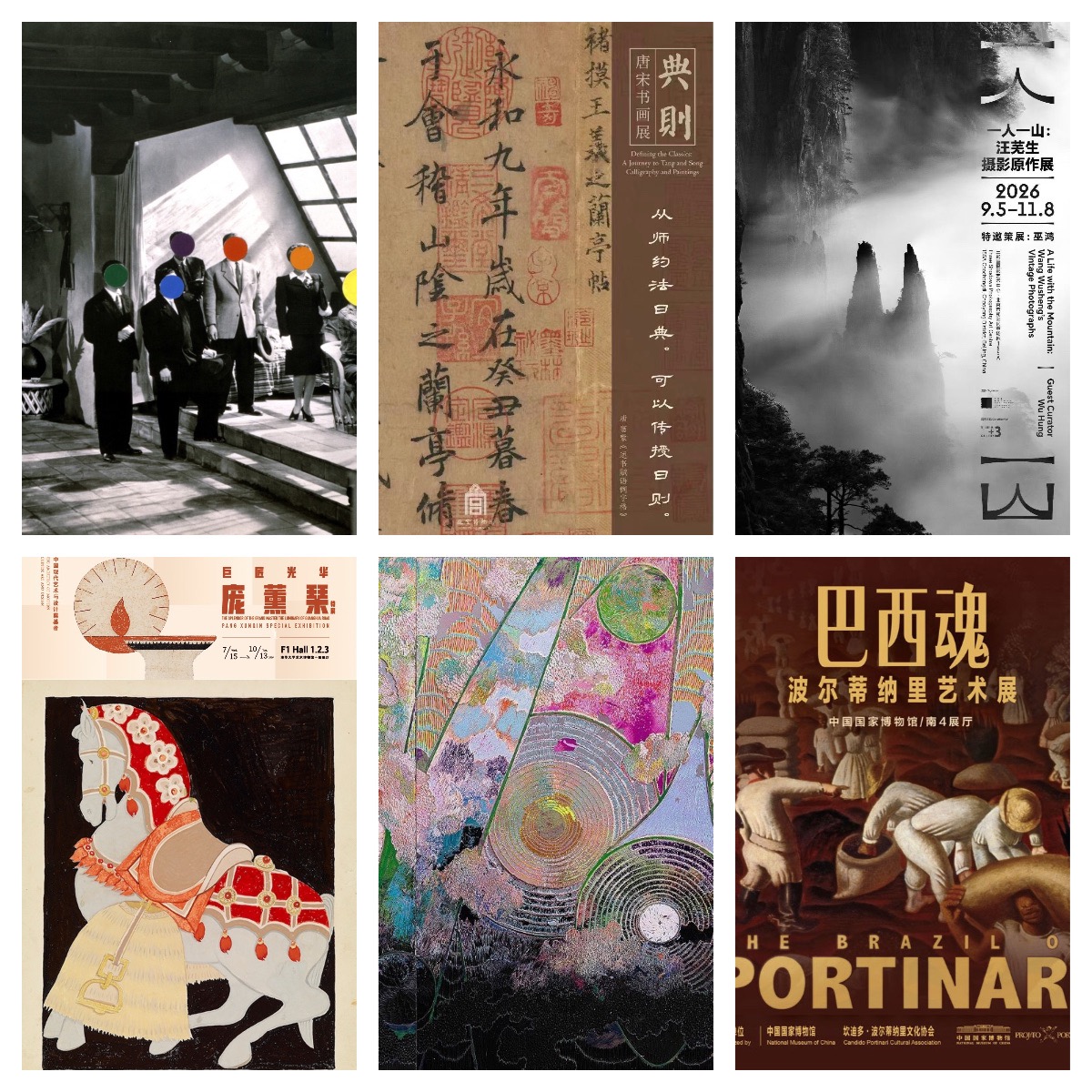
From paintings that helped define Chinese art a thousand years ago to a photographer who returned to the same mountain almost 100 times, September exhibitions in Beijing span an unusually wide range of time and media.
The Palace Museum opens its vaults for Tang and Song masterpieces, Brazilian modernism arrives at the National Museum, and bonsai and viewing stones shrink entire landscapes into miniature worlds.
Photography, Chinese modernism and conceptual art take the story into the 20th century and beyond.
Here are six exhibitions worth making time for.
Defining the Classics:
A Journey to Tang and Song Calligraphy and Paintings

There are exhibitions where the names on the labels tell you immediately that something unusual is happening. Nymph of the Luo River by Gu Kaizhi, Spring Excursion by Zhan Ziqian, Emperor Taizong Receiving the Tibetan Envoy by Yan Liben, and Xiao and Xiang Rivers by Dong Yuan are among 107 works gathered for the Palace Museum’s survey of Tang and Song calligraphy and painting. The exhibition examines how artistic conventions established during these centuries became reference points for generations that followed. It comes in two chapters: Tang and Five Dynasties works first, followed by the Song from September 30. For anyone interested in Chinese art, this is one of Beijing’s essential autumn exhibitions.
September 1–November 1, 2026
First rotation: September 1–27, 2026
Second rotation: September 30–November 1, 2026
Admission: Included with Palace Museum admission; exhibition reservation required
Wenhua Hall, The Palace Museum, 4 Jingshan Front Street, Dongcheng 东城区景山前街4号故宫博物院
A Life with the Mountain: Wang Wusheng’s Vintage Photographs

Wang Wusheng first climbed Huangshan in 1974 and continued returning for more than three decades. Rather than treating the mountain as scenery, he used black-and-white photography to pursue something closer to the expressive spirit of traditional Chinese landscape painting: peaks emerge from darkness, rock dissolves into mist, and familiar Huangshan views become almost abstract. Curated by art historian Wu Hung, this is Wang’s first solo exhibition since his death in 2018. Original gelatin-silver prints from his celebrated Huangshan series reveal not only the years spent on the mountain but also the extensive darkroom experimentation that followed each encounter.
September 5–November 8, 2026
Three Shadows Photography Art Center, 155A Caochangdi, Chaoyang 朝阳区草场地155号A三影堂摄影艺术中心
The Brazil of Portinari

What does Brazil look like through the eyes of one of its defining modern artists? For Candido Portinari, it could be red earth, laborers bent by physical work, childhood memories, religious imagery, popular celebrations, or the enormous social inequalities he witnessed around him. The Brazilian modernist eventually carried those concerns onto the international stage with War and Peace, the monumental murals created for the United Nations headquarters in New York. This exhibition brings together 56 original works, ranging from intimate family scenes to depictions of labor and folklore, as well as studies for larger compositions. Presented during the China-Brazil Year of Culture, it is the first systematic presentation in China of Portinari’s artistic development.
Until October 11, 2026
Gallery S4, National Museum of China, 16 East Chang’an Avenue, Dongcheng 东城区东长安街16号中国国家博物馆
JIANG MIAO: Vortex Evolution

Layers of acrylic are repeatedly applied to wooden and aluminum panels, then cut back with a carving knife to expose colors buried underneath. The process turns painting into something almost archaeological: covering and removing, destroying and revealing, with earlier layers surviving inside the finished work. The vortex has become a recurring form in Jiang’s practice, connecting ideas of life, spirituality, time and the cosmos. For this second solo exhibition at Whitestone Gallery Beijing, early woodcuts and oil paintings appear alongside recent circular, irregular and suspended works, showing how that visual language has evolved, and how the vortex has gradually escaped the picture frame to shape the space around it.
September 5-October 24, 2026
Whitestone Gallery Beijing, Sevenstar Street (E.), 798 Art District, No.4 Jiuxianqiao Road, Chaoyang 朝阳区酒仙桥路4号798艺术区七星东街白石画廊
The Splendor of the Grand Master: Pang Xunqin

Before contemporary Chinese design had much of a name, Pang Xunqin was already asking what it might become. The artist was a founding member of the Storm & Stress Society in 1930s Shanghai, studied in Paris, and moved among modernist painting, decorative art, traditional Chinese patterns, craft research, and design education. That makes him particularly difficult and rewarding to place in a single category. This special exhibition at Tsinghua University Art Museum offers a chance to reconsider Pang not simply as a painter but as a figure who connects Chinese modernism with the development of modern design.
Until October 13, 2026
Tsinghua University Art Museum, Tsinghua University, Haidian
John Baldessari

John Baldessari once had almost all the paintings he had made between 1953 and 1966 cremated. What followed helped change the language of conceptual art. Photographs were paired with apparently unrelated text; coloured dots covered faces; found images were cropped, enlarged and rearranged until their original meanings became unstable. Humor was never far away. Opening at UCCA on September 19, this survey reaches across five decades of the late American artist’s work. Baldessari’s visual strategies have since traveled so widely through contemporary art, advertising, and popular visual culture that some can now appear almost obvious. Seeing the experiments that helped make them possible is precisely what makes this show worth catching.
September 19, 2026–January 3, 2027
UCCA Center for Contemporary Art, 798 Art District, 4 Jiuxianqiao Road, Chaoyang