


 6 min read
Max Cady will kill you with kindness. Or try to, anyway. That’s the M.O. of Javier Bardem’s vengeance-seeking ex-con in the upcoming Cape Fear series, and although the show expands the villainous role in unusual and unexpected ways, this one trait is something he shares with those who’ve played the role before.
Unsettlingly smooth charm is the not-so-secret weapon of Cady in all his iterations, from the original 1957 John D. MacDonald novel The Executioners, to the 1962 film version (renamed Cape Fear) with Robert Mitchum, and the 1991 remake starring Robert De Niro. As the antagonist of this cat-and-mouse thriller, Cady always plays nice-as-pie as he stalks the Bowden family that he blames for his past misfortune. It’s part of his sadistic mind games, winning over the people around them and making them seem like the crazy ones. Then, like any ambush predator, he lashes out.
As part of Esquire’s multi-story package exploring the creation of the new Cape Fear, debuting on Apple TV on June 5, Amy Adams says the point of the villain is not to do direct harm, but to make his targets hurt each other. “He’s just a catalyst, but they’re the ones that are actually going to do the work for him,” she says in our other deep-dive piece.
In the interview below, Bardem explained how he brought this new version of Cady to lurid, vivid life—and even discusses how this madman might measure up to Anton Chighur, the other lethal and relentless figure who won him an Oscar for No Country For Old Men.

“That’s Max Cady,” Bardem tells Esquire. “This animal that’s wild, that is really fascinating to look at, and it’s attractive and charming.”
ESQUIRE: I know he’s no good, so is there something wrong with me that I often liked your Max Cady?
JAVIER BARDEM: [Laughs.] No, we all like Max Cady! It’s this attraction for that kind of figure that breaks boundaries in ways that we fear and are scared of. We are not going to do that, or we prefer not to, but we are very curious and attracted to those who do. And that’s why there’s this fascination.
Other actors have memorably played him in movies, but you have ten episodes of the show as opposed to two hours. How does that change what showrunner Nick Antosca is able to explore in Cape Fear?
We were aiming to create more of a specific backstory around Max Cady, where we understand where he’s coming from and what he has lost. We can relate to his pain, because otherwise he will be just a figure of disruption. It should be more than that. He should be someone that we are not able to frame, even though we know who he is. He becomes the person that we are expecting him to be, but it’s going to come through a personal, emotional journey that we may care for. Hopefully.

Patrick Wilson and Amy Adams play Tom and Anna Bowden, two now-married lawyers whom Max Cady blames for his long incarceration.
We expect menace from him, but he starts out by making everyone around Amy Adams and Patrick Wilson’s characters warm up to him. He could have just shown up and attacked, but he plays the long game. Why is that?
It’s about a man who has the whole time in the world and he doesn’t want to rush anything. He wants to enjoy it. When you have ten episodes, you have the time to go deep into aspects of him. In both Mitchum and De Niro’s iconic, amazing performances, he was more somebody that was always bringing a physical threat to the comfort of their Bowden’s lives. He is here as well, but there is something [else] that we cannot really put our finger on until a later point in the story. That’s what differentiates those two movies from this show. You cannot bet on what he’s looking for. In many cases, you will be wrong. That’s what creates this sense of insecurity for the Bowdens. And for the audience.
Max Cady always has a sense of humor. He’s always laughing and making jokes. Is that a camouflage? Tell me about making this character both scary and funny.
The humor is a must for the character. This is a person who has survived decades in prison. Before that, he was running a restaurant. So he has social skills, and that’s a way to survive. One of the most important things for him was humor, not giving himself too much importance, even though he feels very deeply the pain and the depth of the curse that is on him, the curse that he feels the Bowden’s have put on him.

“He’s just a catalyst, but they’re the ones that are actually going to do the work for him,” Amy Adams says.
You mentioned Mitchum and De Niro. You’re obviously doing your own thing with the character, but was there anything about what they did that you thought was useful or inspiring?
Absolutely. In both cases, I felt that they were a very attractive, uncomfortable presence. That has to do with the way they were moving, their physicality, their way to be perceived by others. How aware he is of that, and how much he wants to play with it for his own will, for his own needs—but without breaking it, or tensing the chord too much. There is a game of giving and taking, giving and taking, in both performances. I thought, that’s the thing. You cannot rely on him, but at the same time, you want to be near him because you want to understand him. That’s his gift.
Is there anything you can share about the look of your Max Cady?
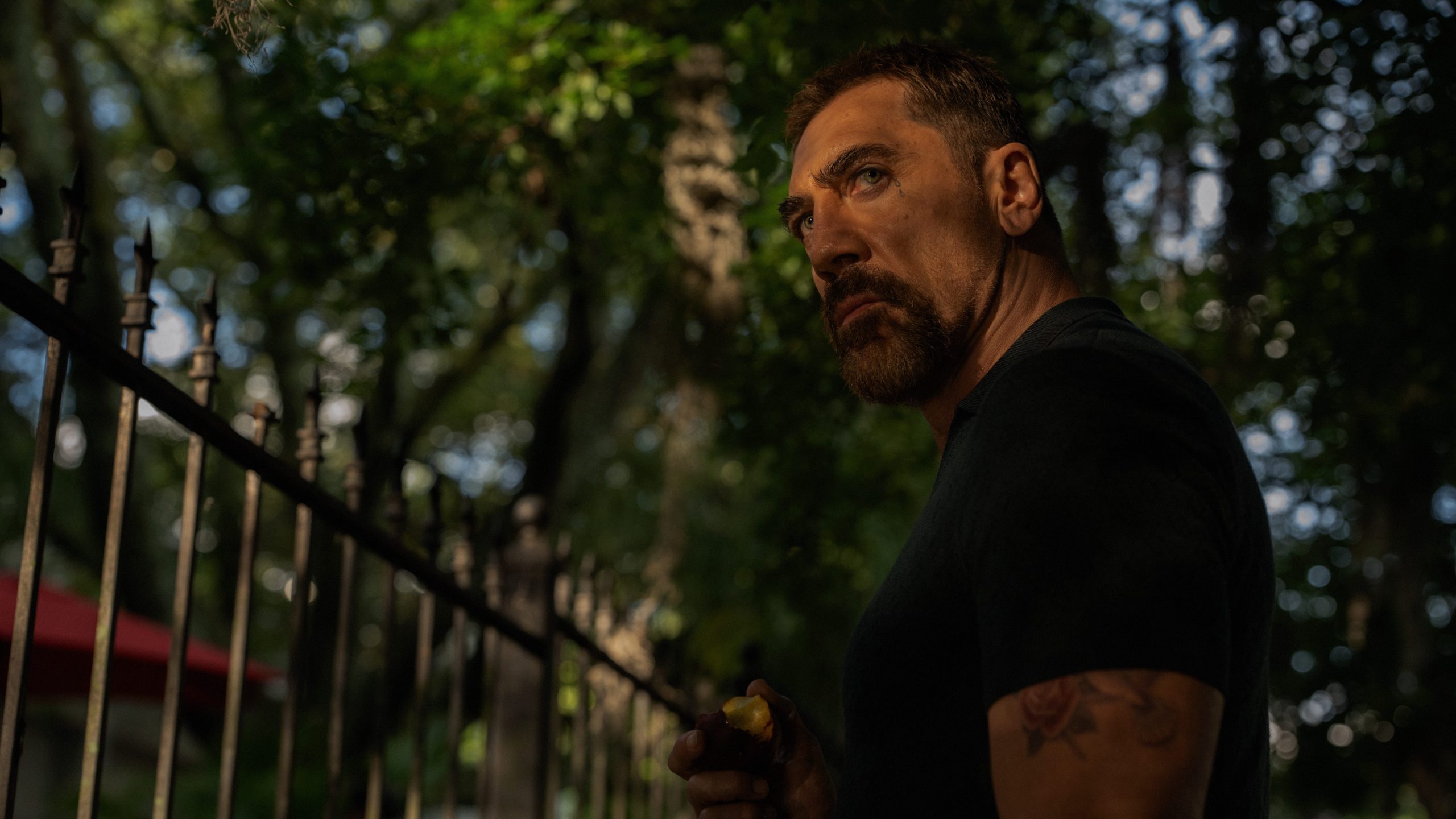
In the first episode, there is a Florida panther, it’s called? That’s Max Cady—this animal that’s wild, that is really fascinating to look at, and it’s attractive and charming. You can freeze looking at the beast and then all of a sudden, boom, it will jump on you. But it’s beautiful. There must be something there that attracts your look, your eye to it.
It captures your attention.
And also, I had in mind that he’s born by an American father with a Spanish mother. We wanted to bring that Florida panther light brown color to his hair and the goatee beard to make the shape of that animal. And then it comes to the eyes. It makes sense that those eyes are that color because of his father.
He has emerald eyes. But they’re different from each other. The one has a larger pupil, which creates an unsettling effect.
We were trying different lenses that were comfortable enough to play with them for hours and hours, for months and months. The day of the camera test I, by error, put two different contact lenses in: one smaller, one bigger, one color lighter than the other one. It was my fault. It was an accident. And then we saw it and I went to Nick and I said, ‘Hold on, this makes sense because his skull has been split in two [during his prison years.] And that side of his face, it could have been harmed very badly, his side and his ear.’
We investigated and it made sense. If you have this [injury,] if they break your skull the way they did, you can have that problem in your eyeball, and also you will lose some of your hearing. So it makes sense. It was an accident, but it happened to be a very realistic outcome of what he would have. Then we went for it.
One of your most famous characters is Anton Chigurh, another terrifying figure. I wondered if that character was in your mind as you made sure that you differentiated these two relentless, lethal roles?
I guess the differentiation is that Max Cady has a goal and Anton Chigurh does not have any goal. Anton Chigurh— I guess that was the challenge. He was somebody that won’t justify or excuse or explain himself. We don’t know where he’s coming from. We don’t know what he wants, why he acts the way he does. It’s just violence. It’s death. [In Cape Fear,] here is a man who’s broken and has feelings and has a goal—a goal that has to do with revenge. One is human, a broken human being, which is Max Cady. Another one is just a violent act of fate.
Chighur has almost an absence of humanity, doesn’t he?
Absolutely. And that was where I had to go to a place where my eyes won’t feel anything. But here, even if I have contact lenses, I have feelings. It hurts. There are things that hurt for Max Cady. That’s why he’s alive—and he doesn’t want to die yet.
