


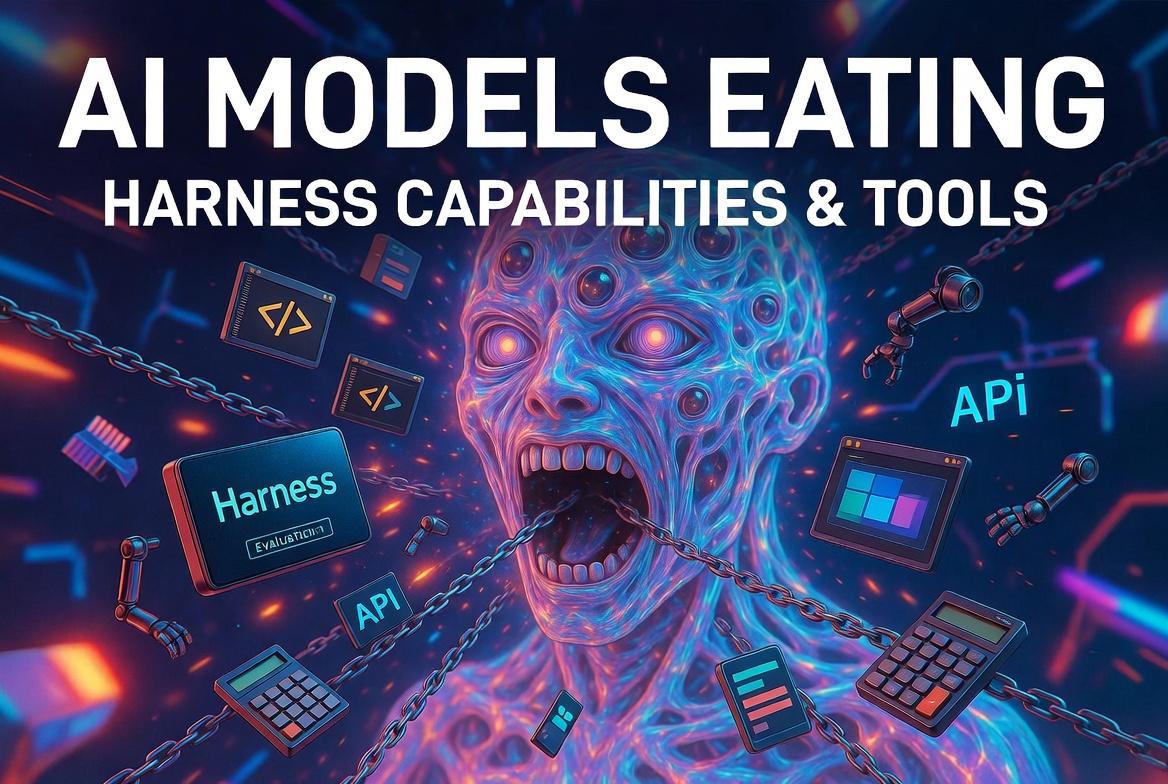
Kilpatrick of Google Deepmoind is claiming what we historically thought of as “the model” is no longer just weights — it’s a sprawling system of tool calling, hosted search, code execution, containers, and an agent harness.
The harness is the quintessential current example of scaffolding that the model will “eat” — within roughly 12 months, that capability gets upstreamed into the model and the alpha moves elsewhere. He argues lock-in fears fade because a truly general model should be able to adapt to any harness, and separately that Google’s Antigravity harness (born from the Windsurf team) is becoming the connective tissue across Search, the Gemini app, Cloud, and AI Studio.
The absorption of capability has happened repeatedly with AI. AI prompt-engineering tricks, chain-of-thought scaffolds, RAG orchestration hacks, and multi-agent routing layers have all been partially absorbed into models via post-training. Betting on absorption is extrapolation.
Every frontier lab now ships model + tools + execution environment + harness as one product. The unit of competition genuinely shifted.
Verticalized domain expertise lets startups run laps around even the best model labs, because focus is the superpower of startups.
The model eats the harness has been predicted continuously since 2023. The harness layer has gotten bigger, not smaller, in that time — context management, sandboxing, permissioning, memory, checkpointing, cost control. Some scaffolding gets eaten BUT new scaffolding appears one level up. The frontier moves, but there has consistently been a frontier.
If harnesses are commoditized in 12 months, why did Google pay for the Windsurf team and make Antigravity the through line connecting all of Google’s products? He even admits it’s really hard to make a great coding model without a product that does long-running work — that’s why the Windsurf deal happened. So Google’s own behavior says: the harness matters enormously, especially as a data flywheel for training the model.
The gaps that will define the landscape for the next 12 months (rather than raw benchmark scores, which will compress).
Reliability and calibration at long horizons — the difference between a model that’s brilliant per-turn and one you can leave running on a week-long task. This is where Anthropic/OpenAI currently lead most and where parameter scaling helps least.
The data flywheel gap — labs with owned agentic products (Claude Code, Codex, Antigravity, now Cursor-Grok) compound. labs without one can’t easily buy their way in anymore because the assets are gone.
The policy gap — a genuinely new axis: US export controls and release restrictions now sit between US labs’ capabilities and their markets, while Chinese open weights face no such friction abroad. Early 2027 may feature a world where the most capable systems are American but the most deployed ones are Chinese.
The economics gap — if beyond-Mythos systems cost $10–50/M tokens while 85–90%-as-good open weights cost cents, the frontier labs must keep finding tasks where the last 10% of capability is worth a 30x premium (deep agentic work, research, high-stakes reasoning). That’s exactly the “jagged vertical superintelligence” world Kilpatrick described.
The safety/dual-use gap — the Fable/Mythos split and the GPT-5.6 rollout limits suggest that by early 2027, “who is allowed to use the best model” may matter as much as “whose model is best.”
Brian Wang is a Futurist Thought Leader and a popular Science blogger with 1 million readers per month. His blog Nextbigfuture.com is ranked #1 Science News Blog. It covers many disruptive technology and trends including Space, Robotics, Artificial Intelligence, Medicine, Anti-aging Biotechnology, and Nanotechnology.
Known for identifying cutting edge technologies, he is currently a Co-Founder of a startup and fundraiser for high potential early-stage companies. He is the Head of Research for Allocations for deep technology investments and an Angel Investor at Space Angels.
A frequent speaker at corporations, he has been a TEDx speaker, a Singularity University speaker and guest at numerous interviews for radio and podcasts. He is open to public speaking and advising engagements.
