


Our product picks are editor-tested, expert-approved. We may earn a commission through links on our site. Why Trust Us?

 8 min read
TOM KING ISN’T supposed to be here.
I mean this on both the micro and macro levels. Small scale: he’s arrived at the National Gallery of Art Library in Washington, D.C., roughly 15 minutes ahead of our scheduled meeting time. It’s as if he appeared out of thin air.
After greeting each other, we trot up the stairs to the Gallery’s famed Rotunda. The open space serves as quite a contrast to the intimate galleries below. The sound of water from a nearby fountain is loud but also serene, something King takes in. “This is the place, right?” He asks. “You go back and watch old movies of DC, they always show this one shot.” We stroll around the corner and find ourselves standing in front of Johannes Vermeer’s Woman Holding a Balance. We look at it for a second, and King remarks, “My whole life is just putting images with words. I just want to write balloons on all these things.” What would he write for this one? “Well, right now I’m writing the Archie movie, so I’d probably be like, ‘Is it going to be Betty or Veronica? Why won’t he make up his fucking mind?’
Big picture, King’s career shouldn’t look like it does at this moment: a writer who has successfully made the leap from the funnypages to the big screen, with a shocking amount of his creative input intact.
KING GREW UP in Orange County, California, with his mother and eventually attended Columbia University in New York in the late ’90s. Along the way, he found his way to internships at both DC and Marvel. At the former, he spent time at the DC Comics imprint Vertigo, which was, in its heyday, publishing titles like Preacher. At Marvel, he worked as an assistant for iconic X-Men scribe Chris Claremont. However, the comic book boom and bust of the ’90s, when both publishers bet heavily on juicing their franchises with tons of collectible variant comic book covers alongside frequent line-wide reboots and title delays, still loomed large in King’s mind. Reading the writing on the wall, King left the industry and relocated to the District. Soon after 9/11, he applied to join the CIA.
That landed him in Iraq. Years later, he’d draw on that experience to inform his own Vertigo miniseries, The Sheriff of Babylon, with art by frequent collaborator Mitch Gerads. On the series, King once said that, “everything is as right—or as wrong—as I can remember it… by the time I got there—about a year after the invasion—it wasn’t about politics anymore.”
He eventually left the agency to pursue comics once again—and to be a more present parent. “I literally left the CIA on Friday and was with the nannies on Monday,” he says as we turn away from the Vermeer painting. “I would walk the kids, every day, to the museums just to get them out of the house. It was free. We’d do a different museum almost every day. I know where all the elevators are. I know all the best bathrooms to change a diaper in. My kids have shat in every room in Washington. It’s a rare feat.”

King is the co-creator of Lanterns, which will debut on HBO in August and stars Aaron Pierre and Kyle Chandler.
While changing diapers during the day, King worked at night, writing a novel about a group of superheroes who give up their powers to save the world. A Once Crowded Sky published in 2012. From there, King landed a co-writing gig on 2014’s Grayson alongside Tim Seeley and artist Mikel Janin. The story follows Dick Grayson, the man who was once Robin—yeah, that Robin, Batman’s sidekick—becoming an undercover spy for the shadowy Spyral agency. It’s fair to say that’s subject matter King probably knew a thing or two about.
In comics, a steady job writing on a recurring title is about as cushy as a gig gets, and King continued working, including jumping over the aisle to Marvel, to pen The Vision alongside artist Gabriel Hernandez Walta. The 2015 title, which would later serve as an foundation for the Marvel Cinematic Universe series WandaVision, saw the hero and his robot family relocate to Fairfax, Virginia, as a series of tragedies unfold. The miniseries earned King immediate praise and is considered a modern masterpiece by many comic book pundits. A quotation on the back of the collected edition from Ta-Nehisi Coates gushes, “The Vision is the best comic going right now.”
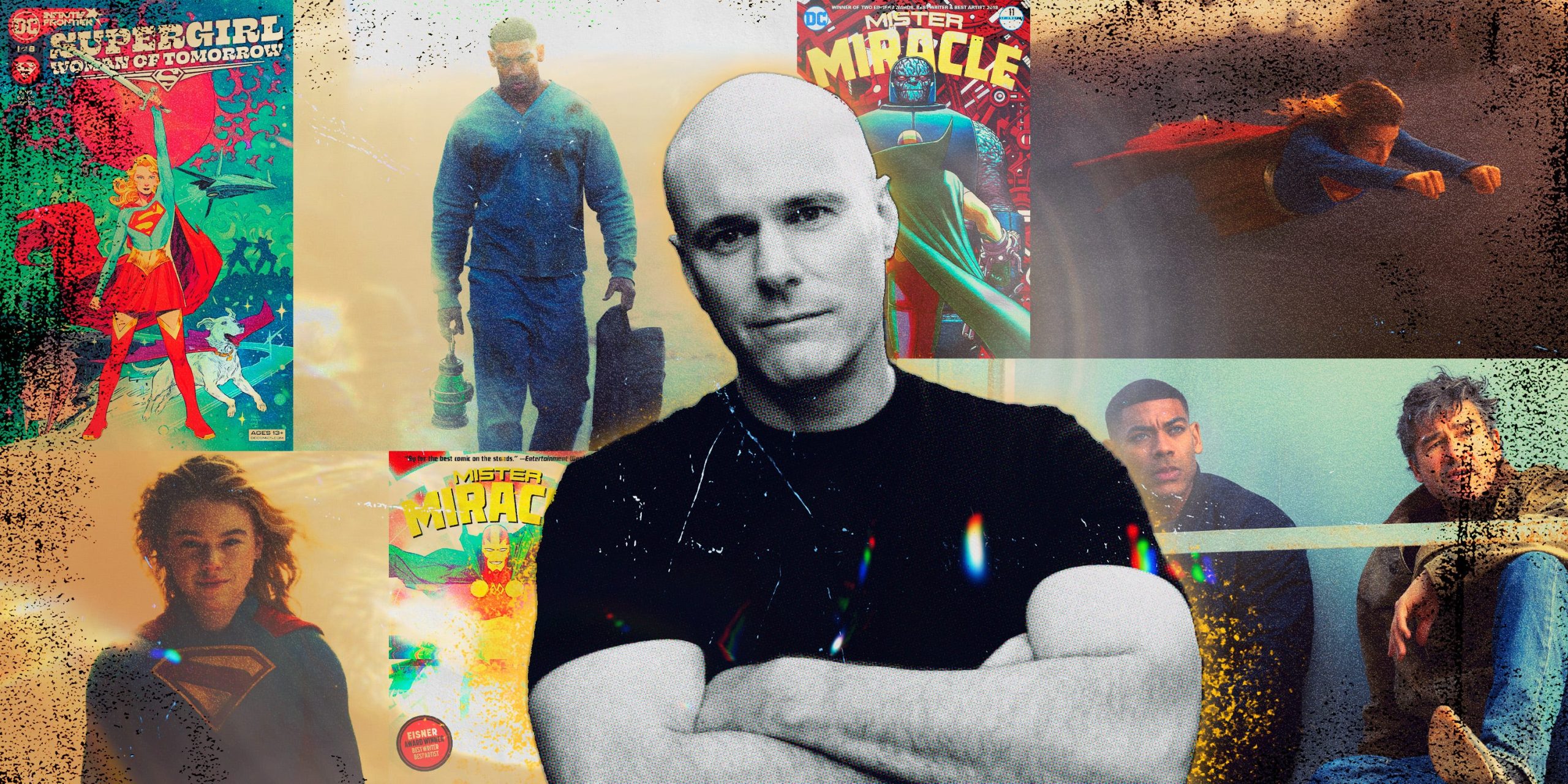
After signing an exclusive contract with DC Comics in 2016, King once again teamed with Gerads to launch Mister Miracle, a limited series featuring the eponymous escape-artist superhero as he tries to outrun death itself. The title is a decidedly mature look at PTSD, trauma, and mental health. In fact, its first issue contains a suicide attempt. Critics called King “arguably the finest writer in superhero comics today.”

If that wasn’t enough, King was tapped in 2016 to be the writer for Batman. Working alongside Janin and David Finch on art, he began writing an arc of what was a planned 100-issue narrative for DC’s flagship hero. That is, until his run ended abruptly at issue #85 due to a new editorial mandate for DC’s entire publishing line. King didn’t get to finish the story how he’d originally envisioned —the conclusion of the story was told in a limited series—and even had a major plot twist spoiled by The New York Times of all outlets.
Any one of these works in isolation would have made King a household name in comics. All the work culminated in a series of Eisner Awards—the comic book industry equivalent of an Oscar—in 2017, 2018, and 2019. More limited series followed in the wake of his award: another Gerads miniseries, Strange Adventures, which reinvented science-fiction adventurer Adam Strange as someone whose past as a planetary hero is called into question; a mini-series sequel to Watchmen, starring the vigilante Rorschach, also hit shelves to acclaim.
In a matter of a few years, King established himself as a writing wunderkind, particularly as someone capable of delivering grand epics in a mini-series format. King’s work comes in self-contained editions; he doesn’t have to deal with decades of continuity. For the price of a popcorn and soda at the movies, readers could get a complete narrative full of big ideas and staggering art.
“This was the museum that first entertained [the kids] the least, because nothing’s moving,” King says as we head further into the Dutch and Flemish paintings gallery. “But eventually, this became their favorite, because we go here and we’d make up stories about these things,” he continues, gesturing toward Deborah Kip, Wife of Sir Balthasar Gerbier, and Her Children. He then explains how the process would go as we gaze at the painting of this woman and her children. “‘Oh, so who’s this person?’ My daughter was super into princesses. I was like, ‘This is obviously a fairy queen and her four princesses. Only one of them can become the queen of the castle, and she’s choosing which one has the destiny. And my daughter is like, ‘Which one is it going to be?!’”
LAUNCHED IN 2021, Supergirl: Woman of Tomorrow was yet another King mini-series. And with it, her destiny has changed forever. On its face, it wasn’t guaranteed to be a hit in the way King’s previous works were. The Man of Steel’s cousin has always had a difficult time sustaining her own ongoing title. Comic book fans have their favorites through the years—mine happens to be the Sterling Gates and Jamal Igle run, which began in 2008—but even then, the character doesn’t really have a signature story in the way Batman does with The Dark Knight Returns or Superman’s All-Star: Superman. That is, until King’s story came along.
Alongside artist Bilquis Evely, Woman of Tomorrow is basically True Grit in outer space. On her 21st birthday, Kara Zor-El, aka Supergirl, seeks out a planet with a red sun, intentionally dimming her superpowers to enjoy getting trashed alongside Krypto the Superdog. While there, she comes across a young girl named Ruthye, who is aiming to hire a bounty hunter to track down the man named Krem who killed her father. When Krem attacks and injures both her and Krypto, Kara teams up with Ruthye to pursue Krem in a quest for revenge.

King and I sit for lunch in the museum’s famed Cascade cafeteria that straddles the line between the west wing, where we just came from, and the east wing, which contains the museum’s modern art collection. In front of us, the titular water cascades. To our right is a people-mover encased by an overhead light feature with a Star Wars hyperspace vibe. As children run around a few feet in front of our table, King smiles and mentions that his children used to do the same.
He tells me about Woman of Tomorrow’s origin, and the effort sounds about as exhausting as Kara and Ruthye’s odyssey. “They’re like, ‘No, you can’t have 12 issues because people don’t buy Supergirl. You can have six.’ I had to fight for eight!” King says. DC even initially blinked at the notion of Kara partying on her birthday. “We had to fight so hard for that.”
It was worth the effort. The title became “bigger and bigger and bigger,” both from a sales and cultural perspective, eventually landing an Eisner nomination in 2022 for best limited series. It also found a fan in one James Gunn, the writer and director who Warner Bros. executives would soon tap to run a new iteration of the DC Cinematic Universe alongside producer Peter Safran. As part of Gunn’s grand vision, the second theatrical installment of the DCU would heavily lean on Woman of Tomorrow for inspiration.

Supergirl is the second feature film in James Gunn’s new DC Universe.
Supergirl will release on June 26, led by House of the Dragon star Milly Alcock as the version of Kara that King and Evely conjured years ago, with Craig Gillespie, known for his work on I, Tonya, as director. In the press leading up to the film, Alcock, Gunn, Gillespie, and screenwriter Ana Nogueira frequently mention King and Evely as the inspiration for the story. That’s not always how it goes; in the wake of the 2014 release of Captain America: The Winter Soldier and also The Falcon and The Winter Soldier television series in 2021, writer Ed Brubaker was extremely vocal about how he felt Marvel had not properly compensated him for his work in generating the character of the Winter Soldier.
Gunn’s willingness to put creators’ work on front street isn’t lost on King. “In the very beginning, I just didn’t believe it,” King says. “Anyone who’s played the Hollywood game, especially from the comic book side … knows that these things hit walls. When James was like, ‘Yeah, we’re going to make a movie out of this,’ I was like, ‘Sure, James.’”
“THIS IS THE book I most did with my kids, or my kids are so into this book,” King says of Woman of Tomorrow. “Not into it like they love it, but I just created it with them. You run out of things to talk about with your kids in COVID—I was like, ‘This is what I’m writing. What do you guys think?’ And they’d be like, ‘Okay, do this and this and this.’ And I see so many moments they created in those comics. I can be like, ‘Here’s this thing that became this big thing, and it came out of my children.’ It’s wonderful.”
As we chat, I notice King often takes a beat to consider the question before speaking. But once he does, he chats very quickly, and his thoughts come out full-formed.
But as we continue to talk about this adaptation, his tone shifts. “To have James Gunn find it and turn into a movie, you’re just like, ‘Thank you.’ It sounds stupid—I sound like I’m giving a fucking Oscar speech,” he says. “Gratitude is the word.”


William Goodman is a freelancer writer, focused on all things pop culture, tech, gadgets, and style. He’s based in Washington, DC and his work can also be found at Robb Report, Complex, and GQ. He’s yet to meet a jacket or cardigan he didn’t love. In his free time, he’s probably on Twitter (@goodmanw) or at the movies.
