



In some ways, Egosoft founder and CEO Bernd Lehahn was a little surprised to be back at PAX East in 2026, still promoting the 2018 game X4: Foundations. The latest entry in the nearly thirty-year-old X space sim series isn’t the kind of game you expect to operate as a “live service” title. It’s a single-player franchise that propels players into an interstellar journey across increasingly complex simulated universes that grew from one of many spaceflight simulation games popular in the 1990s to a modern-day economic empire builder.
According to Lehahn, Egosoft had no intention of releasing content for X4 for so many years when the game first debuted. The studio had shipped the game anticipating it would release a couple of paid expansions to maximize its economic long tail before moving on to the next X game. But when Egosoft shipped its first two updates for X4 (titled Split Vendetta and Cradle of Humanity, something unusual happened: players loved these expansions.
Related:We tested the Steam Controller
“They had a very high attach rate,” Lehahn recalled during a conversation with Game Developer, estimating that between 70 and 80 percent of X4 players purchased these expansions. Egosoft released a third expansion named Tides of Avarice, which had a 50 percent attach rate, and according to Lehahn, that’s when they realized long-term support for X4 was financially viable for the company. Now, annual expansions for X4 are the 50-person company’s bread and butter, an unusual development for such a long-toothed series.
It’s one of many surprises that have stuck with Lehahn over the 30 years of making X games. Egosoft is one of Germany’s oldest video game studios, and to hear him tell it, the company’s success risks tripping into survivor bias (He admitted they “almost ruined the company” making the 2013 game X Rebirth and were only saved by X3 arriving on Steam and driving sales “through the roof” years after its 2005 debut).
That means taking direct lessons from Egosoft’s long run is a tricky affair, as the company has the benefit of momentum, a dedicated fanbase, and a roster of experienced developers—18 of whom have been with the company for over a decade, some for over two decades. But in a moment where game studios of all shapes and sizes are fighting to find sustainability, its story offers some compelling lessons for those looking to build their own long-lasting legacy.
How can game studios survive making niche games?
Egosoft’s decision to stick with one type of game seems obvious in hindsight, but it’s important to note how risky the genre is. The space sim—which overlapped with the flight sim genre—was so dominant it defined a huge chunk of the PC video game marketplace in the 1990s.
Related:‘Millimeters matter:’ Making the Steam Controller ‘just work’ on day one
That’s because these kinds of games were among the first games to make use of 3D polygonal graphics, making them some of the most visually impressive and eye-catching titles found on retail shelves. LucasArts’ X-Wing and TIE Fighter captured players’ excitement for dogfighting combat. But older games like 1984’s Elite laid the foundation for blending space exploration and economic trading systems that elevated games like Origin Systems’ Wing Commander: Privateer to a far more complex experience.
Some players craved that complexity. But the mass market moved elsewhere. As flight sims hit their heyday, first-person shooters like id Software’s Doom began to throw their weight around, and the expanding console market did a far better job of reaching mass audiences. So when Egosoft shipped X: Beyond the Frontier in 1999, many of their competitors were decamping for greener pastures.
Egosoft survived, Lehahn said, by sticking to an “iterative” model and serving that existing audience.” You have a game, you are in touch with your community, they tell you what they like, what they dislike, and you improve and make updates,” he said, describing a development style now popularized by the Early Access release model.
Related:The Steam Controller will retail for $99
But before Early Access, this iteration came in the form of shipping sequels. So when players picked up a new X game, they knew they were picking up an increasingly polished version of what came before, rather than a series building on its foundations with generational leaps.

Image via Egosoft
It was when Egosoft tried to break from that formula with X Rebirth that it finally stumbled (nearly destroying the studio, Lehahn said). The company spent 10 years trying to overhaul its entire tech stack and engine, and players reacted poorly to the game that was smaller than any previous X title. “There was also a communication problem with the community,” he recalled, saying that the studio tried to stress Rebirth was not supposed to be X4, but a different, standalone X game. Egosoft could have adopted Unreal Engine like many other studios in the 2010s, but Lehahn said the price of sacrificing the X series’ gameplay foundations would have been too high.
That foundation is the “bottom-up” universe simulation taking place on each X player’s individual PC. Today, X4 simulates “tens of thousands” of AI agents interacting with each other, featuring an interconnected economic system that’s so detailed, there’s a bona fide supply chain fueling the construction of every spaceship the player encounters. “It creates a lot of emergent gameplay situations, and I think this creates a lot of motivation to play for a long time,” he said.
That means once X4 sinks its hooks into a player, they want to keep exploring to see what kinds of situations the simulation produces, and to explore how their actions impact the simulation. Lehahn compared it to the kind of engagement players experience in massively multiplayer online games (MMOs), but pointed out that those games are sustained by thousands of players, which requires a whole different profession curve.
“[X4] has the advantage that we can have the same feeling [as an MMO] and we can have a much steeper progression curve,” he said, alluding to how players starting with just a spaceship and a dream can quickly assemble whole armadas, spaceships, and empires in a matter of days. MMOs, in one way or another, slow down player progression through grinding in order to drive retention and monetization.
Lehahn said the idea of an online X game is tempting, but he’s “glad” they never committed to one for fear of tying the gameplay experience too closely to the monetization requirements needed to keep an online game running. “We would have lost the core of what makes our game good,” he said. “Fast progression is part of making a fun game.”
Players’ eagerness to sink hundreds of hours into each X game and new expansion certainly explains the high attach rates, and it shows that Egosoft has done well in keeping player loyalty over multiple decades. But they’re facing the same problem everyone else is. Those players are aging. The next generation is playing Roblox and Fortnite, valuing simpler gameplay experiences that let them spend time with friends. How can you plan for the future if you aren’t sure your audience will still be there?
Egosoft sees players “age into” their interest in X4
Lehahn is the first to admit the X series has a “problem” with approachability. “It’s so complex, and it has so many features that it’s hard to get into,” he said. “The user interface sometimes scares people away because it looks too complicated. We struggle with a good onboarding experience.”
It’s not like Egosoft hasn’t tried to address this. Over X4‘s eight-year lifespan, the studio has implemented new kinds of tutorials and overhauled the new player experience to offer a better hands-on educational approach to learning the game’s complex systems. It’s still an overwhelming experience. Thankfully the usability improvements that came with these modes benefitted older players, so it wasn’t all for naught.
Complex games face a particularly uphill climb when attracting younger generations of players who could potentially become future customers. As the game industry wrings its hands over how this audience has glommed onto more social-friendly games like Roblox, it’s fair to be anxious over if they’ll still want to play games like X4 as they age out of that group.
Egosoft isn’t entirely free from that concern, but Lehahn said the studio’s taken a long-term view on the subject of audience growth. “We want new players, and we want younger players,” he said, acknowledging that when a game’s interface and gameplay is exceptionally complex, that makes it harder for that audience to pick up a game. “But I think what we’ve learned over the years is that there is a barrier when you make a game this complex. It’s very, very rare that we get teenagers to play this game. It does work sometimes, but it doesn’t work for the masses.”
But. That’s the thing about aging. It happens to everyone, and as younger players grow older, some gather the patience to meet X4 where it’s at. And thankfully “cool space action” has multigenerational appeal. “Cool action in space attracts 20-year-olds now the same way it did 20 years ago.”
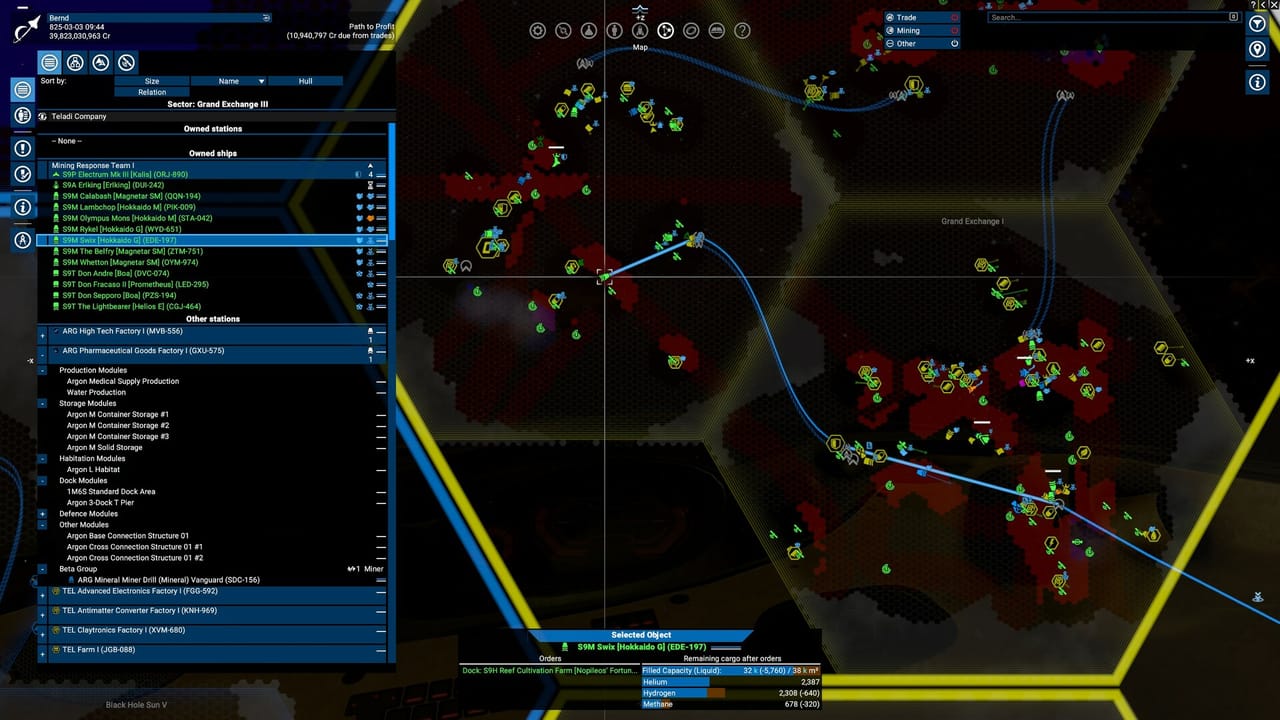
Image via Egosoft
In some ways it’s not that different from the audience challenges that Egosoft faced in 1999, when it was catching the tail end of the space sim and flight sim heyday. “There was never a doubt that people would be attracted to the setting,” he said. Even as the genre dipped, the debut of Star Wars Episode I: The Phantom Menace sent X: Beyond the Frontier “through the roof.”
“What saved us, I would say, is that the game is more than just the [basic] space sim. It has that deeper level of building an empire and trading. That works in space—it would also work in an entirely different setting. But we have it in space so there’s always this connection.”
Committing to the simulation technology powering X4 and its many expansions does mean the company is “doomed” to make space games (Lehahn’s words, not ours). In a way, it can’t do anything but cater to this niche audience. Abandoning the simulation tech that it’s iterated on for so long would gut the company’s core competency and put it far behind its competitors in every other regard.
Luckily there’s no reason to do so. Lehahn said the company hopes to make a new X game one day. But funnily enough, every time the studio starts work on features for a new game…they become content for yet another expansion for X4. “We’ve been working on some things for a future game—we do all the time, because some things are not compatible with the idea of bringing into a live game.”
“But over and over again, we basically ported a lot of that stuff into X4. A lot of stuff that we originally thought wasn’t possible in a live game turned out to be possible.”
Update 4/20: This story has been corrected with the proper spelling of Lehahn’s surname.
About the Author

Senior Editor, GameDeveloper.com
Bryant Francis is a writer, journalist, and narrative designer based in Boston, MA. He currently writes for Game Developer, a leading B2B publication for the video game industry. His credits include Proxy Studios’ 4X strategy game Zephon, Iron Anchor Studios’ Down With The Ship, and Amplitude Studio’s 2017 game Endless Space 2.
