


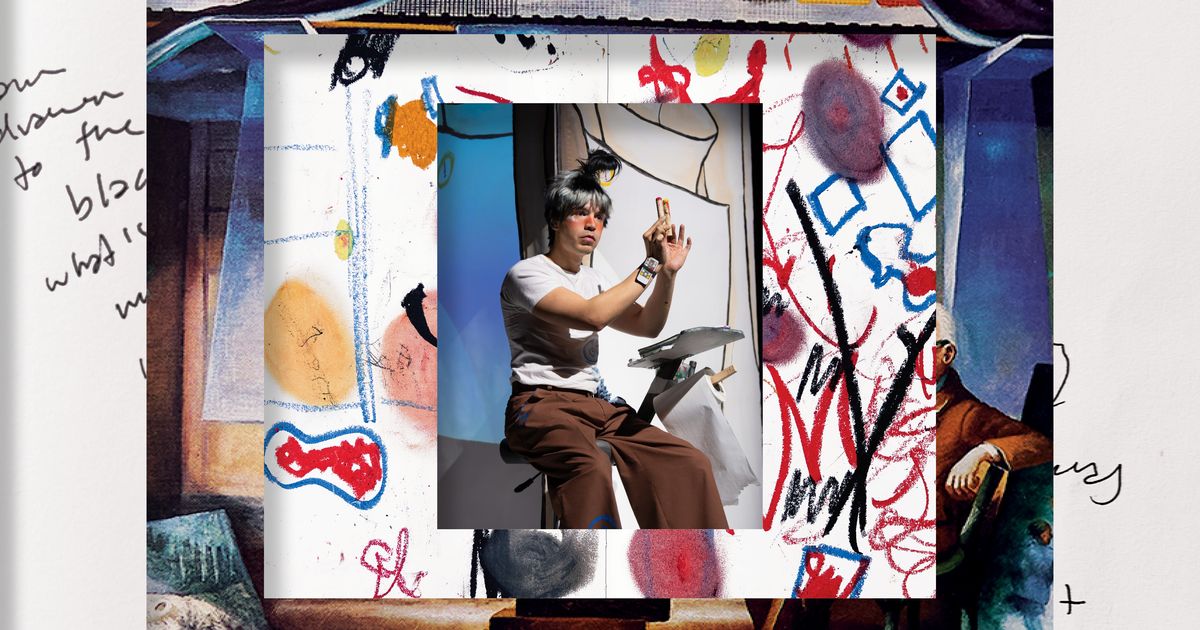
Julio Torres’s Second Brain
Before it became an Off Broadway show and now an HBO special, Color Theories began as scribbles in his notebooks.

By
Adam Moss,
who edited New York and The New York Times Magazine,
is the author of “The Work of Art: How Something Comes From Nothing,” tracing the evolution of transcendent paintings, jokes, movies, songs, and more.
Photo-Illustration: New York Magazine; Photos: Frankie Alduino, Emilio Madrid, HBO
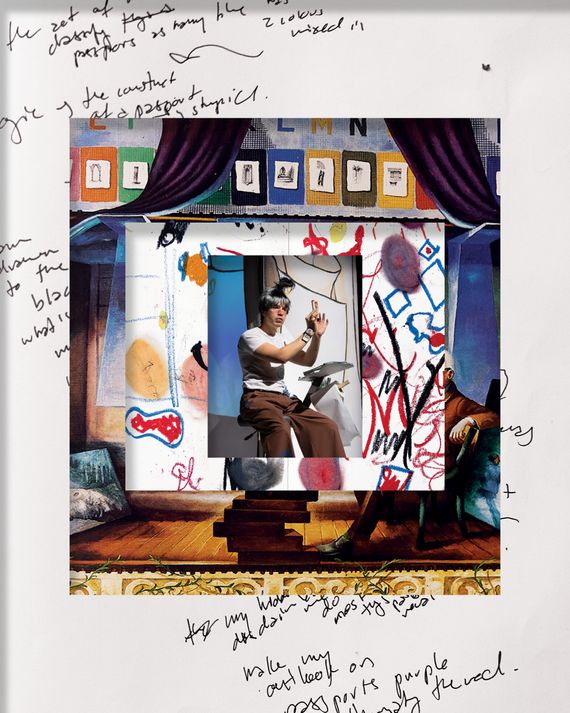
Photo-Illustration: New York Magazine; Photos: Frankie Alduino, Emilio Madrid, HBO
Photo-Illustration: New York Magazine; Photos: Frankie Alduino, Emilio Madrid, HBO
This article was featured in New York’s One Great Story newsletter. Sign up here.
The Julio Torres of TV and movies and sketch comedy and stand-up is an adorable idiot, a stubborn, often petulant child with insights that elude adults. He seems so strange and naïve you want to protect him from the ugliness of a world he actually sees clearer than you do.
The Julio Torres who was sitting next to me in his big bright Greenpoint studio is only sort of like that. He’s boyish but not at all naïve — he knows exactly what he is doing. He is so good at playing the wise fool that I realized that’s who I expected to meet. Julio Torres is “an unconscious construct,” he explained, when I asked the obvious question. “It’s like when you have a service job and you do your customer-service voice. ‘How’s everything tasting?’ That person’s not rehearsing in the mirror before they go to work. But they ask in a way that they have landed on so that the answer is ‘great.’ We all do it. There’s a version of ourselves that we put on when we go to work. My persona is as much of a persona as those.”
In front of him was a pile of notebooks I had asked to see. He used them to write Color Theories, the new HBO special based on an Off Broadway show he wrote and performed last year. I knew he used notebooks as a tool in creating, and I’d hoped they might offer a map to the very particular way he thinks. And they do.
We flipped the pages together. In the notebooks, you can see shards of the material he was developing, sometimes written out, sometimes drawn,
but also doodles of clothes and furniture he is designing. This is a room divider with hangers; on top is a mirror in the shape of his silhouette that sits in his apartment.
You’ll find ideas for movies — this one for a movie he’s writing about “overlapping auras”
— and books he is making — this is for a book about gifts (Trojan horse, Statue of Liberty, that kind of gift), which is coming out later this year.
One page has handbag ideas, and, true to form, there is a cuckoo-clock purse, a pyramid purse, a purse shaped as a well.
His peculiar, and very fertile, brain is on every page. And like Torres himself, the notebooks are anything but linear. “It’s multiple things. It’s Color Theories when I’m thinking about Color Theories. It’s a couch that I want to make in my apartment. It’s measurements for the couch. It’s a layout of a book that I’ve been working on.” On one page are dates he was considering for a trip to Fire Island. The notebooks are all-purpose. “I’ve never had a dedicated journal to a project,” Torres said. “When a project starts taking over, then it starts dominating.”
Torres grew up in El Salvador, born in the later years of its civil war, the child of what he described as an “eccentric” family that encouraged his ambitions, of which he had plenty. He was a student of American movies and TV and came to New York with the dream that he might become a screenwriter. He went to college at the New School while trying to get a visa to stay. Then, looking for a way to get his writing out into the world, he found his way to stand-up. He hoped it might get him a job writing comedy, which it did. But first Torres had to learn what made him funny. He clearly had an original way of seeing, which led him to make juxtapositions that are what jokes are made of. Yet as a child he was considered more clever than cutup. And when he started in stand-up, he recalled in a public conversation with his old collaborator Fred Armisen, his “observations were accurate but not funny.” It took a lot of bombing before he figured it out.
The Work of Art
A series by Adam Moss, the author of The Work of Art: How Something Comes From Nothing, featuring the evolutions of works from Stephen Sondheim, Louise Glück, Kara Walker, Moses Sumney, George Saunders, Sofia Coppola, and many others. Each installment dissects the making-of of a show, novel, painting, song, or other work through conversations with artists and their artifacts.
“Open mics were my school,” Torres told me. “And the most valuable thing I learned from there was how the context of the world you create is as important as what you’re saying. Sometimes something on paper isn’t funny, but the person saying it is. And so in doing stand-up, I kept being very precise and very careful, and I didn’t trust myself to memorize anything, so I would just read, holding smaller versions of this notebook, and then someone was like, ‘I really like that character that you do.’ And I was like, ‘Oh, that’s sort of just me.’ And that was the lesson there.”
In short order, he was hired to write for Saturday Night Live, joined Armisen in creating and performed in a series he co-created for HBO called Los Espookys, and later went on to write, direct, and perform in a movie with Tilda Swinton, Problemista, and another show, Fantasmas. In 2019, he released an HBO hour that is a kind of precursor to Color Theories called My Favorite Shapes. In what seems like no time at all, he became a cult, veering on mainstream, comedy brand. One highly unusual worldview with multiple applications.
A lot of Torres’s humor is rooted in classification — that’s just where his mind goes, whether for comedy purposes or not. Right now, he is very busy, maybe more than he’d like to be. He has created a Julio Torres taxonomy. “I think of it this way: dividing myself in five. No. 1 is doing all the human things. It’s socializing, it’s exercising, it’s going to the doctor, it’s doing all the little grocery shopping. But because he’s out there doing these things, he’s the one that gets the inspiration and has the ideas.
“No. 2 is the one I resent the most. He is promotion and socializing with an agenda. He goes to the premieres. He always says ‘yes’ to getting his picture taken, but he’s also important because he’s the one that pitches the ideas that the No. 1 came up with. He’s the one that convinces people that we should do this. Three and four are film and TV. Three and four actually do the work. They write the script, they direct it, they produce it, they’re there in the edit room. And then five is miscellaneous projects, children’s books, furniture lines, Whitney Biennials. And so now in my calendar, I try to color-code them and see what a week is looking like, how much of a particular Julio will be activated that week. Julio one is green, and Julio five is purple.”
Which brings us to Color Theories, the work I’d come here to talk about. At the risk of killing jokes by dissecting them, I wanted to examine Torres’s method in writing it, to see if his work follows patterns visible in art-making across all fields.
In Color Theories, as Torres explains it, “I am creating a rubric for young people to see the world using colors as a classification system.” This is actually a line from the show itself. He says it on a set designed as a pop-up storybook with giant pages to be turned, with color splotches on his face, his hair in a goofy updo, while talking to a bluish robot named Bibo. Color Theories is like a TEDTalk for 4-year-olds. Julio, the bratty, charming man-child, is the lecturer. His presentation is classification run amok in which colors are anthropomorphized, and the world is recast as a kind of color war. Like most of Torres’s work, it is preposterous and yet makes perfect sense.
Yellow is “joy, it’s wonder… Have you ever seen a child draw the sun like this? I think this is healthy, because this is the child saying, ‘I can only depict something as big and complex as the sun from within the narrow viewpoint of my own experience.’”
Red is passion and fury, what you’d expect, so orange is its fusion — childlike wonder and rage. Orange was where he started. “Orange felt like the easiest way in. The most immediately recognizable one that isn’t — because red is completely obvious, but orange is the right balance of, Okay, now you have to think a little more. It’s not like saying red is angry. Orange is When you see, wait, there’s actually some logic to these.”
The whole show is very orange. It’s got a lot of rage in it. Ostensibly, the show is just Julio riffing on the various colors, but the show you see (it wasn’t always like this) actually sort of has a plot and even a politics, and that has a lot to do with navy blue. Navy blue is the show’s villain. We’ll get to that.
During COVID, Torres was bored. And he’d always seen colors as having personalities. He was drawn to “the idea of impression and people that are very good mimics of doing famous people, and I was like, Well, I don’t know that I can do any of those, but I can do purple.” It was 2020. “I was just thinking of little dumb things to do online during lockdown.” He made some Instagram posts along this line.
When the lockdown ended, he ventured out for some comedy sets. He found himself doing more and more of the color bits. “Color Theories is the result of finding a common denominator of things that kept coming up in those shorter sets.” He drifted to other projects (Problemista, Fantasmas), but continued to play with the color jokes in stand-up. During the sets, he started to understand that the colors gave him a template for something new — “like a worksheet to fill in these blanks.”
“And then I’m like, Okay, I made the movie, I made the show, I have ideas for other things that I want to make. And I always have these ideas, but those are years down the line. Where’s the next paycheck?
“So, Oh, you know what? I should go on tour. I’ll massage these color ideas into something.”
Torres toured comedy-theater clubs across the country to do his massaging. All the evidence is in his notebooks. The notebook pages are like an archaeological dig. The pages restate themes and jokes, the same words on many pages, each with little iterations. “I come from stand-up comedy; there’s a lot of repetition,” he said. Repetition is productive. “Repeating it over and over for yourself — it’s almost like you’re molding. It’s like in music, you keep playing the note to see if it becomes something.”
The notebooks are generally where it begins. “I do some scribbling in the notebook, chew on something, bring an idea to a conversation with someone, maybe, and then that conversation yields something, and it’s back to the notebook.” Then he’ll trot it out in public to see how it is working.
An example: Early on, he fixed on navy blue as the color of law and order (police, men in suits), and “the first thing I thought of is how navy blue makes one feel like you’re in a cell and in a grid, everyone in their place.”
He drew that grid over and over in the notebook.
“And then that squeeze makes you feel red. And violating the lines of those navy-blue walls is a crime — that’s how we define a crime, right? It’s like crossing a line.”
One thing you can see in the notebooks is how visual his mind is, how he uses making images to work out jokes. On many pages, you can see him smushing colors together,
hoping that’ll yield a joke. And for this bit, he just kept drawing lines in the notebook. The lines became not just a metaphor but also the mechanics for the joke itself. “And then I think of the various ways in which those in power cross lines and the way they do it is by being like, “Actually, no, the lines changed.”
One of the tricks he employed in My Favorite Shapes is to draw for the audience (initially just projecting from the notebook itself). He brought it back. Which allowed him to make visual jokes like this: “Well, this is a rich person doing their taxes …”
“And then this” — he drew a huge blue perimeter around a huge red line — “is a war crime.”
The joke landed. And it became a highlight of the show he was touring.
“With war crime, it was like, Okay, what is the biggest, most horrible crime I can think of? And then navy blue has the audacity to be like, ‘Actually, actually no line was crossed.’ It’s like, right, because navy blue just follows you wherever you need to go. And this, I think, was a very visually satisfying way of depicting it. And I started by drawing it in the book and then doing it live and seeing people follow the logic.”
That was pretty much his method. He thought of purple. (“Purple is when the red in you gets to make fun of the navy-blue walls,” as he describes it in the show. “Purple is mystery. Purple is intrigue … What’s navy blue? Lawyers, the criminal-justice system, courtrooms. What’s red? Surprise. Shock. What do you get when you combine them? A surprise witness.”)
This is what it looked like as a visual joke.
“What else is navy blue? Organized religion. Red? Blood. Passion. Combine them — “Catholicism.”
It’s a very funny moment in the show (maybe a little less on the page.) But he arrived at it through association and experimentation. “There were other ones that didn’t quite make it,” he said. “I had the reading of a will or poisoning someone. A chalk outline is blue. A crime scene is purple. Looking down at the top of the stairs to see the dead body at the bottom of the stairs, that’s purple.”
On one page of the notebook are anecdotes he toyed with to see if he could turn them into bits. There are good jokes he rejected. “It’s deeply embarrassing when navy blue wants to be fun,” followed by the word Hillary.
I liked that one especially. He’d forgotten about it.
The pages are full of revised set lists — the Ellen DeGeneres joke that now opens the show kept moving around — with bits going in and out. Line readings shifted mostly through synthesis and truncation. “It’s a combination of a stand-up comedy background and OCD and repetition.” Things just come out in the same way— so the joke’s syntax suggested itself — “or they get recalibrated. I have a thought that is a paragraph. I can actually relay it in a sentence. And then also, Okay, no one finds this funny, or This is completely unclear.”
Order was dictated by need — “So, for example, orange needs to come before beige because I want to present beige in contrast to orange” (beige, goes the joke, is the color of “Pixar acting”) — but mostly the adjustments he was making on the road had little to do with structure or coherence. He was just trying to assess what was funniest — and also, maybe more importantly, what he was interested in. So while he was paying attention to the audience reactions, what he was really listening for was his own reaction. Like for most artists across many fields, much of the work is recognizing what he is responding to.
In this way, Torres likens his comedy mind to an algorithm.
“I just sort of start playing with things that I’m attracted to, and then it’s when I’m organizing them and putting them next to each other, then a theme starts emerging naturally,” he told me. “It’s sort of like … I don’t know, if you look at your Instagram algorithm, for example, it’ll show you things based on what you’ve been seeing lately. So it’s like, okay, there’s a theme to where you are mentally here. It’s like, oh, you’re looking at a lot of diet and exercise shit.” It’s a useful metaphor.
For a long while, he was playing with a joke about lanternflies.
“Oh, you know what did not make it in? That occupied a big chunk and was close to becoming the through-line? Lanternflies.” This was the premise: “Lanternflies were presented to us as a threat, and that was very successful because navy blue gave us permission to be red, which is killing and how quick people were to just use their killing permission slip gleefully. And how sometimes red knows that sometimes maybe blue knows that people need to let out their red a little bit. So it’s like, Take it out on the lanternflies.”
“It was taking up a lot of the show,” he said. So he killed it — “if you instinctively start losing interest in dogs, then you’ll see less and less and less of them on your Explore page.” But he never wastes a good joke, and this one, he said, he just stored away to use again sometime.
On one page, there’s a note: “passport drama.”
Many of the bits he was devising for the show involved travel — like being detained for 12 hours in a bleak room at Heathrow airport — navy blue impersonating beige— over a visa issue, which really did happen to him. So toward the middle of the tour, “I was considering making the whole show about passports.” He considered making the set a giant passport. But it was still a show about color, so the themes competed. “It felt like a hat on top of a hat,” Torres explained. “Which I’m prone to do. Metaphor on top of metaphor.” It’s the risk of a hose for a brain. Simplification becomes just as important a link in the process as generating ideas in the first place.
As he originally conceived it, he’d just move from one color to the next. It would be an equal-color-opportunity show. But his mind wouldn’t let him. If you look at these notebook pages carefully, you’ll see how often navy blue shows up.
“I’m clearly obsessed with navy blue,” Torres explained, recalling what was happening to him as the show started to take form. “I start seeing that like, Oh my God, I’m constantly comparing it to all of these colors. Something that follows me through every work that I do is this preoccupation with attempting to live a life within the systems that we didn’t choose and being, for lack of a better term, gaslit into believing that those systems are there just because they make sense. And here it was just like, Well, that’s very navy blue. It’s logic with something hidden.
“And so for a while I think, This is so lopsided. I need less navy-blue material and more material about all the other ones. So then I would just force myself to think of other colors. And then it’s, well, it just seems like I just want to talk about navy blue, so I should investigate what that’s about. And that is when larger themes for the show started.”
And the show, through no conscious decision of Julio’s, began to have a shape — and also a politics. Navy blue versus all the other colors. Order as antagonist.
By the time he took Color Theories to Melbourne, he began to think he might have the makings of “a theatrical experience” — a show he could take to New York that might work in a conventional theater with production values and a more baked through-line. But though the show was becoming less and less random, it also didn’t cohere in a way he felt it would need to in order to shift venues. “I take it to Melbourne and then I feel like, Okay, this needs to be more whole.” The “iceberg ahead” is that he’s going to need an ending. “So I play with through-lines and endings. I need to leave people with a reason why they saw this other than a collection of amusing thoughts. I arrive at imperfect ideas in Australia and then I’m like, Okay, let’s do a run in New York, which I’ve never done.”
So it was off to New York. He began imagining what the show would look like. At first, he played with a surrealist set similar to a picture he’d seen in a book.
But that didn’t work. And then, “I’m sitting in front of my notebook and drawing ideas for sets, and I just look at the notebook, and I’m like, Oh, it’s the notebook!” So I sent a very confusing picture to a production designer of my notebook. ‘No, no,” he said to the befuddled designer. “The set is the notebook.”
As I mentioned, the notebook is multipurpose. The set became a huge pop-up book with pages he could turn.
He imagined what the stagehands, who are visible during the show, could look like, including one who made it in he called Spilled Wine and one who didn’t as a pencil sharpener.
And then, crucially, he introduced another character, a robot called Bibo he could play against, almost like a co-star. Torres is a recycler. As I mentioned above, he doesn’t throw anything away. He’d first introduced Bibo in Fantasmas. “I thought, Okay, what are the navy-blue constraints of having this show?
“Well, time.” He brought Bibo back as the timekeeper. “Bibo felt like so appropriate, because it’s like Bibo is given a job, which is tedious to me. I love it when a cute little creature is nagging. And Bibo as the timekeeper is really fun because it’s annoying, but it’s also a reality of performing. It’s like the show cannot go on forever. People do need to physically go home.”
“Also,” he said, “I’m a big fan of clocks. My artistic lineage is clocks.” He was talking about Surrealism. Dali and his melting clocks. “Also Kafka. Because time is logical but absurd at the same time.”
Throughout the show, Bibo interrupts Julio, changes the subject. That has a structural benefit, eliminating the need for some transitions. But at the same time, “we’re going to see this show through Bibo’s eyes” — which opened the door to that iceberg he’d been fearing — the ending.
True to form (he is nothing if not multi-talented), Torres was the director of his own show. But he had never directed theater before. His producer suggested he work with a dramaturgist. A dramaturg is “a sort of script therapist. I came to those conversations saying like, ‘The end is my biggest thing.’”
And, as it turned out, the dramaturg was actually very much like an actual therapist. They talked for a while. In a sense, they put Julio on the couch. “And it was through those conversations where it was like, well, ‘Oh no, no, no, no, no —’”
The dramaturg pointed out that the act of classifying is itself navy blue.
And I know it may sound silly in the context of an absurd comedy show about colors, but this observation was actually a revelation to him. It hit hard.
“It’s the kind of truth you don’t want to hear that is lingering in the back of your mind,” said Torres. “And it’s just sort of appalling to hear at first.” But what it meant was that while Julio, whose whole ethos is grounded in an opposition to authority, might be all the other colors, he was navy blue as well!
So with that cathartic moment, Torres found his ending. As the show concludes, Bibo confronts him:
Bibo: Julio, you have hidden biases. You make fun of Pixar because you’re scared you’ll become too twee and commercial… And you didn’t RSVP to my birthday party because you said it was an oppressive navy-blue system, but I wasn’t trying to police you. I just wanted to get you vegan snacks … I understand why order rubs you the wrong way … But we can’t be unbiased, all seeing oracles. Every classification we make is informed by our experiences … We overclassify things when we feel angry and scared because there’s something soothing about making our emotions sound like common sense.
Julio: Wow. I’m a real Housewife. Squeezing my red into color theories. In times of fear rage and panic we trend toward navy blue … I’m sorry I boxed you in just because I myself felt boxed in. This whole thing feels limited.
Bibo then says, “Well, I wrote you an ending …” And there’s a little more, but that little exchange tied his show together. And it’s a bit of a metapoint. Order is intrinsic to an artist — it’s just as crucial as imagination. Also, I couldn’t help but noticing, navy blue is adult.
Torres is 39 now. He’s stepping back a bit from performing. He’d like to write and direct theater without starring in it. “I feel like if I wanted to do different kinds of work and tell different kinds of stories, it can’t always be me. I’m not really an elastic performer.” He’s co-writing an opera (“with no singing”) to premiere at Little Island this summer. He’s been working on a furniture collection, writing a movie that, he said, will be more “abstract.” Also a video installation. All pretty arty and grown-up.
We closed the notebooks. Does this mean, I wondered, that he is abandoning the Julio Torres so many of us have come to love? Has he aged out of his inner child? I was already feeling a little sad. I wasn’t prepared to lose him.
“Oh, I don’t know,” he reassured me. “I mean I get it, but —” He flashed his devil grin. “I think an old man doing Color Theories is funnier. It’s better. I’m looking forward to it.”
The mirror was designed for Fantasmas. He brought it home.
The movie “is about our inability to see each other. It plays with the idea that creating a bond is [just] when our auras overlap.”
The well is a reference to one of his most famous and funniest SNL sketches, “Wells for Boys,” a fake commercial featuring a sensitive boy staring meaningfully into his new toy well.
“It was always the sense of a dangerous and violent place,” said Torres. “But for me, what was most consequential were [the dominoes from the war]. My mother ran her own clothing store. It was very popular. We had a little apartment on top of it, and I loved living there. But then the economy took a turn and you really felt an incoming cascade of American companies. Remember Payless Shoes? Those Payless Shoes became a villain in the household because my mother also designed shoes. My mom had to close her store, and suddenly in my home money became a huge, huge stressor. It was like the better days were behind us.” Still, for all of that, the U.S. (“Not the U.S., New York,” he said) was where he was determined to go. “El Salvador’s always had a love-hate relationship with America. It’s like the U.S. is this abusive partner that is wooing you and then you try to get close but it pushes you away.”
All quotes from the show itself are from the Off Broadway version. For the HBO version, some of the language shifted, but not all that much.
The joke goes, “Ellen, my peer Ellen … she presents yellow, but now we know she’s actually … red.” It more or less opens the show. Julio tried it at the end too, more trial and error, and the notebooks show bits where he tries to draw the joke out in various little bitchy ways. “Oh God,” Julio said to me. “I’ve never met this woman. I’m sure she’s … I’m so sorry. I’m so, so sorry.”
For what it’s worth, almost every artist I talked to for this series and the book that spawned it thought they had OCD.
It was a big moment for him. “Those lightbulb moments that you have as a person are very helpful to what you’re making,” said Torres. “I’m saying how much I hate feeling like men walking around in suits; I’m just making assumptions about people I’ve never met. And I think the willingness to confront is where exciting things can happen.” Which, if you talk to enough of these guys, whether they’re writing 600-page novels or little dopey jokes, is what all artists will eventually tell you.
Julio Torres’s Second Brain
Your product is saved! You’ll receive emails when your saved products go on sale. Manage preferences.
