


Artificial intelligence giant Anthropic and the U.S. government are finding their interests inextricably linked, even as they go head-to-head about the best way to balance innovation with national security safeguards.
A White House meeting this week was the latest chapter in the company’s battle over unprecedented export controls. The restriction on access by foreign nationals forced it to recall its latest AI model.
The dispute centers on whether the model could be used by foreign countries to help conduct sweeping cyberattacks against the United States – and it highlights an increasingly complex dynamic between the government and AI companies. Developers want to minimize regulations they say hinder innovation. The government has asserted the need to regulate that innovation, but also to make use of it, including increasingly in military operations.
Why We Wrote This
Rapid advances in artificial intelligence models raise questions about national security. One example: The face-off between developer Anthropic and the federal government is highlighting the unusual leverage that some companies have in talks on regulating the technology.
On June 12, the Trump administration banned foreign nationals from using Anthropic’s two newest products: Mythos 5, which the company released only to vetted organizations, and Claude Fable 5, a public model similar to Mythos but with extra safeguards. In order to comply with the order, Anthropic says it had to disable access to both.
Now, the company is trying to get the government to backtrack. Senior representatives met with the Trump administration in Washington on Monday, but nothing has changed.
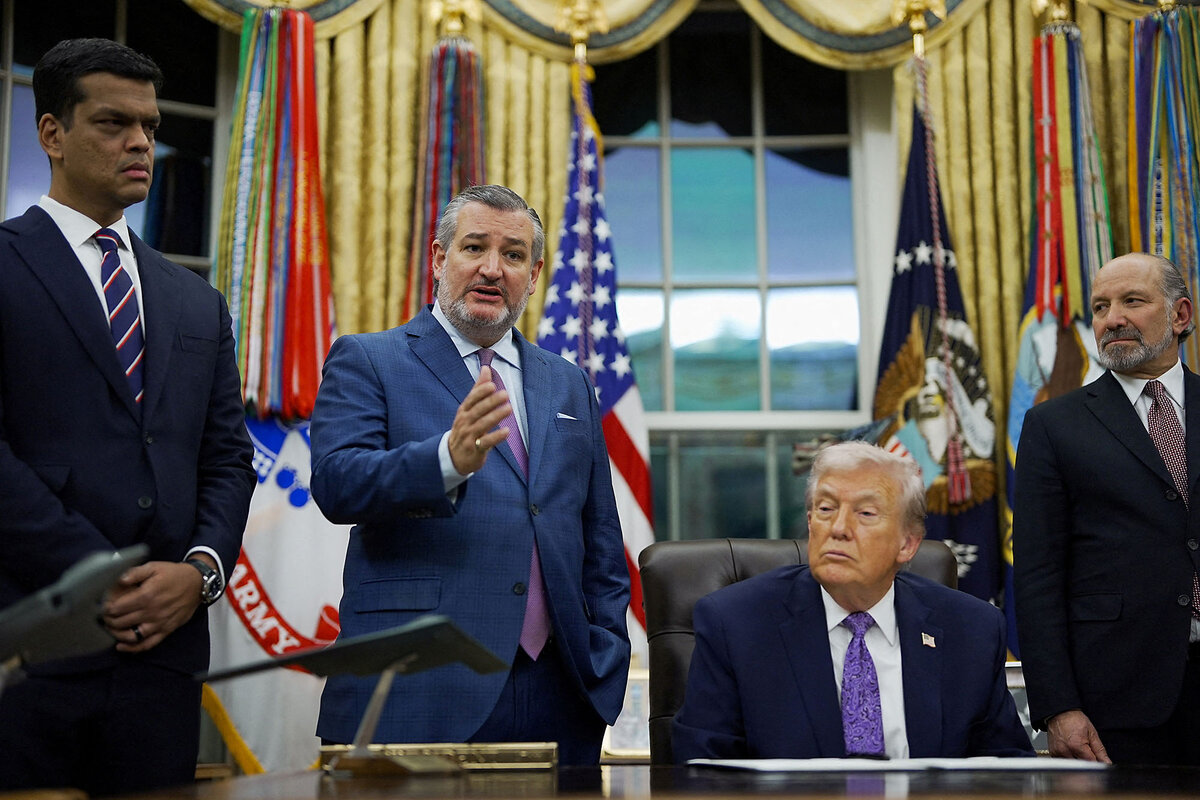
U.S. Senate Commerce Committee Chairman Ted Cruz, a Republican from Texas, speaks while next to U.S. President Donald Trump; Sriram Krishnan (far left), senior White House policy adviser on artificial intelligence; and U.S. Commerce Secretary Howard Lutnick as Mr. Trump signs an executive order on AI in the Oval Office at the White House in Washington, Dec. 11, 2025.
CNBC reported that Amazon alerted the administration to security concerns with Fable days after the model’s release. The Trump administration, already concerned about Mythos’ cyber capabilities, quickly directed Anthropic to suspend access.
Anthropic said in a public statement that the government hadn’t specified the concern, but the company assumes it has to do with a user’s ability to bypass the model’s built-in cybersecurity safeguards. Anthropic says this issue is minor and is already present in other public models.
The conflict over Mythos spotlights a growing national tension over what role the government should take when a private company’s product could affect national security. It is playing out in a tug-of-war between AI developers and the federal government as companies like Anthropic try to leverage their expertise to push for more say in how the technology is regulated.
“AI is a general purpose technology that is reshaping the world,” says Michael Horowitz, senior fellow for technology and innovation at the Council on Foreign Relations, in an email to the Monitor. “The frontier AI labs in the United States have enormous power and influence, but so does the U.S. government.”
A new “playing field”
AI could be wielded by militaries to create or enhance weapons, for instance, or to conduct cyberattacks. Experts across Washington are already war-gaming potential scenarios in which one country gets the upper hand in AI.
The Trump administration has largely taken a hands-off approach to AI’s development. But the high stakes are prompting it to get more involved. After Anthropic’s partial release of Mythos, President Donald Trump signed an executive order calling for major AI companies to voluntarily submit their cutting-edge models for a 30-day period of government review.
The potential national security concerns are “giving the government enormous leverage,” says James Pethokoukis, a senior fellow at the American Enterprise Institute.
When the internet was being developed, the government took a largely hands-off approach to encourage innovation. Many tech analysts have argued for that approach concerning AI. But Mr. Pethokoukis says that because of AI’s increasingly apparent relevance to national security, “that argument is now lost.”
The current “playing field,” he says, isn’t between a hands-off approach and a hands-on approach. AI’s advances mean the question now is how much – not whether – the government should intervene.
The speed and magnitude of AI development is transforming what’s usually a bureaucratic and deliberative approach to national defense into one where the administration has started to take sweeping actions very quickly.
“Usually the problem that we have with government action [on defense] is that it is way too slow,” says Emily Kilcrease, director of the Energy, Economics, and Security program at the Center for a New American Security. “What happened over this past week with Anthropic was interesting to see that the government moved very quickly. … They are not afraid to move swiftly and do the cleanup later.”
Companies’ unique expertise
AI developers, however, can use their unique understanding of the rapidly developing technology to pressure the government to engage with them.
The government wants to prevent countries like China from accessing Mythos’ cyber capabilities, but it wants the technology available so it can improve its ability to thwart potential attacks – a situation that Susan Ariel Aaronson, a professor of international affairs at George Washington University, calls a “catch-22.”
Anthropic has had a rocky relationship with the federal government. In addition to the current dispute about Mythos, the Pentagon declared it a supply chain risk in March when the company refused to give the government unlimited access to its models for defense.
Despite their disagreements, though, the two sides continue to collaborate. After Anthropic released Mythos in March, the government met with company representatives to discuss the model’s capabilities. Anthropic also worked closely with government officials to test safeguards before releasing Fable 5 to the general public.
Companies like Anthropic have a lot of leverage because very few people understand how the latest frontier models really work, says Ms. Kilcrease. She estimates the number of engineers in the world with a sophisticated understanding of how those AI models work to be around 200 – and notes that they’re not working for the government.
Even government employees with expertise in AI have no way of keeping up to date on day-to-day progress or changes with these models.
“[The developers] are always going to be the ones that have the most recent, up-to-date, in-depth knowledge about how the technology works,” she says.
