


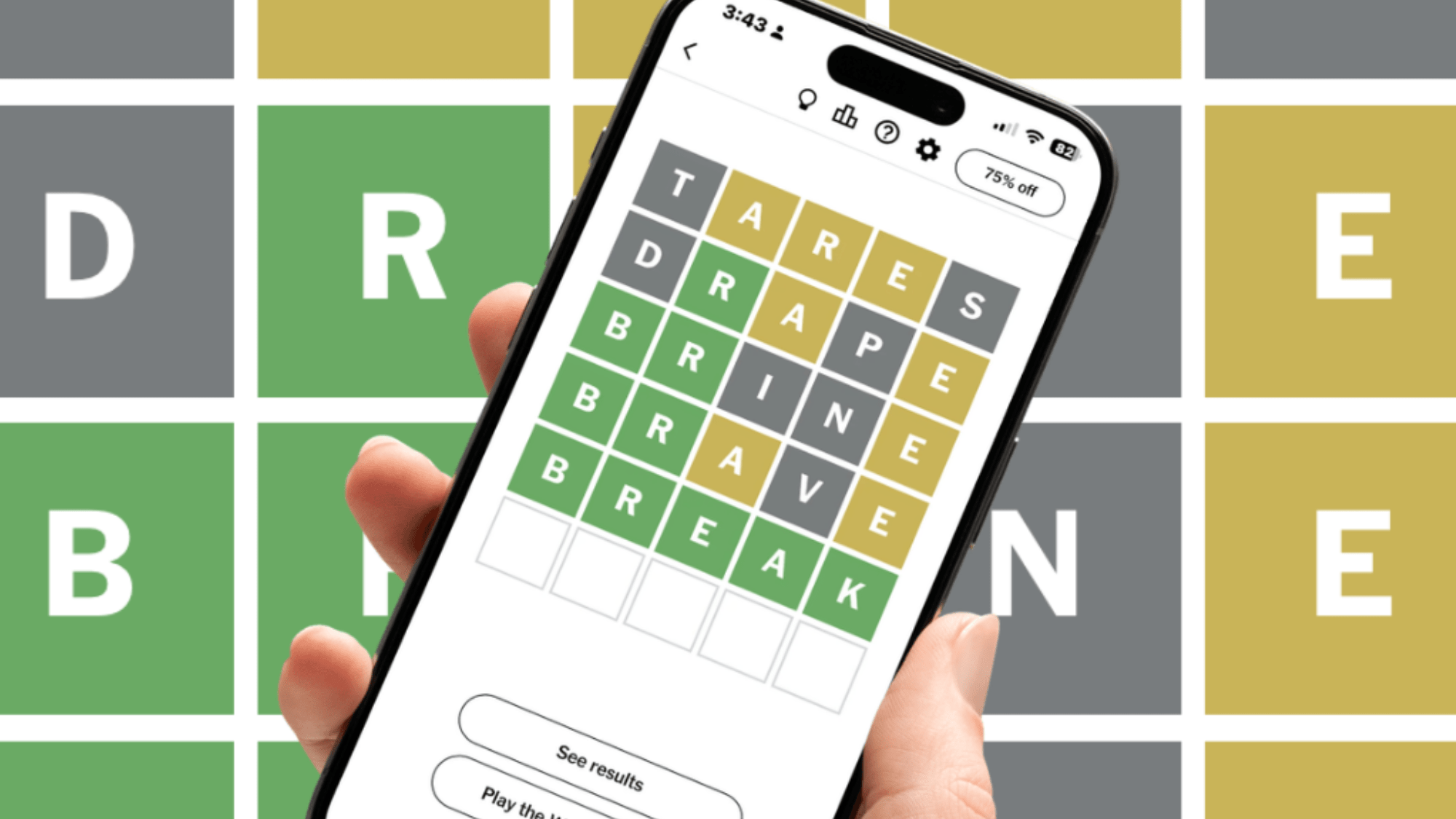
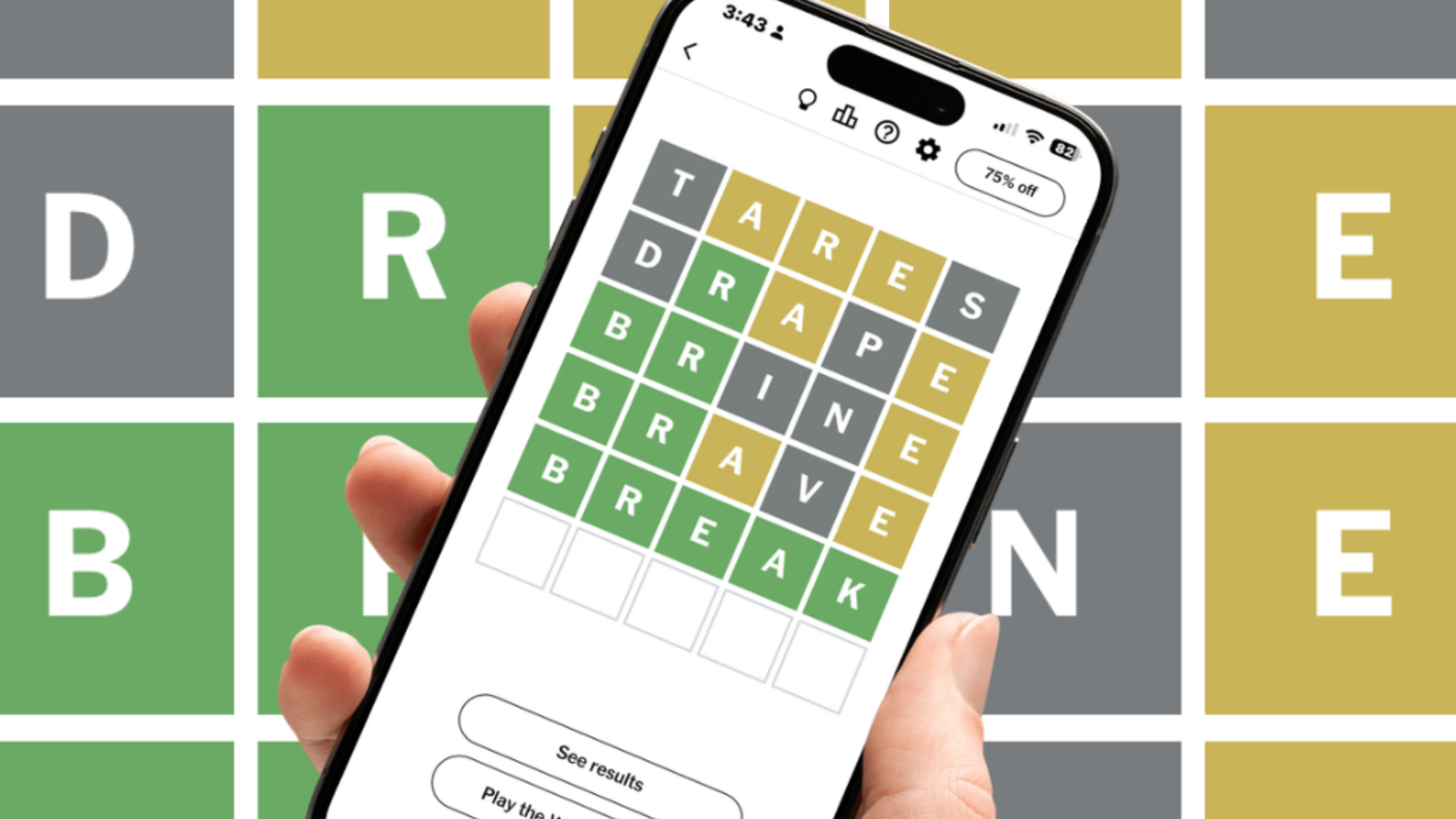
Wordle is currently celebrating its fifth anniversary and a team from Binghamton University has a new way to solve the fun word game.
Image: Binghamton University, State University of New York
Get the Popular Science daily newsletter💡
Breakthroughs, discoveries, and DIY tips sent six days a week.
By signing up, you confirm you are 16+, will receive newsletters and promotional content and agree to our Terms of Use and acknowledge the data practices in our Privacy Policy. You may unsubscribe at any time.
It turns out one of the best ways to solve the massively popular New York Times puzzle game Wordle isn’t really about words at all. It’s math. Specifically, information theory and a mathematical concept called Shannon Entropy.
Though the typical Wordle player tries to use their six allotted guesses to correctly guess the game’s hidden word, researchers at Binghamton University in New York took a slightly different, counterintuitive approach. Instead of trying to solve the word outright, they applied the principles of uncertainty outlined in information theory to optimize for the guesses that provide the most information possible, steadily narrowing the pool of remaining candidate words.
By using this method, rather than simply guessing words using commonly occurring vowels, the team crafted a system that found the correct word 99 percent of the time. It turns out a strategy built around reducing uncertainty actually outperforms trying to guess the correct word outright. The team findings are detailed in a study published in the Northeast Journal of Complex Systems.
“By applying Shannon entropy, the objective shifts to maximizing the expected reduction in uncertainty rather than the probability of being right,” study co-author and systems engineer Congyu (Peter) Wu said in a statement. “In practice, this approach can lead to solving the puzzle in fewer guesses.”
The basic Wordle strategy leans heavily on vowels
For those who haven’t played Wordle in a while, here’s a quick refresher. The game gives players six attempts to guess a hidden five-letter word that changes every day. That word is presented as a row of blank squares. When a player guesses a word, the squares change color to provide feedback. Gray squares mean that none of the letters in the guessed word appear in the secret word. Yellow squares mean a letter is in the secret word, but is in the wrong position. Green squares are a success: the letter is in the secret word and in the correct position.
Players often approach the puzzle by guessing words dense with commonly occurring vowels like A, E, or O. In fact, a recent analysis of over a billion Wordle games conducted by The New York Times found that the most popular starting word, by some margin, is ADIEU. That seems to follow logically, but that same analysis found that ADIEU is actually one of the least efficient of the most popular starting words when it comes to solving the puzzle quickly.
With a systems engineering background, the team at Binghamton University approached this problem differently. They see the game as a dynamic feedback system. Each guess provides information that shapes subsequent guesses, progressively reducing uncertainty around what the actual word is.
In mathematical terms, that uncertainty is measurable as entropy, and players are essentially trying to reduce it with every guess. This framework draws on Shannon Entropy, a concept from Claude Shannon’s information theory and outlined in his 1948 paper A Mathematical Theory of Communication. When applied to Wordle, the goal is to pick each subsequent word so as to cut down on entropy as quickly as possible.
The team tested this approach against a system using the more typical vowel-heavy guessing strategy. The entropy-based version solved the puzzle 99 percent of the time, compared to 90 percent for the more traditional approach. That 90 percent figure may still sound high to players who struggle with the game, which is really a testament to how much any consistent strategy helps.
Related Stories
‘Winning’ Wordle isn’t always the point
While the Shannon Entropy approach is technically superior, it still probably isn’t the go-to strategy for most casual players. For starters, pulling it off requires running a computer script alongside the game, laboriously entering each round of color feedback into a separate application. That might appeal to some, but it also risks undermining the very human element that makes Wordle so enjoyable in the first place.
“I don’t want to know how the trick is done. I just want to be amazed,” University of Chicago linguist Professor Jason Riggle wrote about Wordle in a separate blog post. Riggle acknowledged that he too had written a program meant to “beat” the game but quickly realized it missed the point.
“I even started to write an algorithm that would optimize the playing of Wordle, but then I realized that if I completed it, Wordle wouldn’t be fun anymore, because once utility is optimized and you’ve ‘solved’ a game, you’re just mindlessly choosing what a computer predicts the next best move to be,” he said. “So too much understanding will rob you of using your own intuitive sense of how common letter and sound sequences are, which is where the joy comes from.”
In other words, the struggle is the game. But hey, we won’t judge anyone who feels the need to invoke information theory to keep their hard-earned streak alive.

2025 PopSci Best of What’s New
The 50 most important innovations of the year
