


Christian de Looper/BGR
The line between health and tech has been blurring a little. It’s not unsurprising — most people in the U.S. are dissatisfied with the healthcare system, even if they don’t agree on how to fix it. As a result, there’s potentially a lot of money to be made by innovative new companies that can at least solve some of the issues, especially at a low price. Companies like Function Health have started popping up with the promise of putting control of people’s health in their own hands, and since then, competitors have started appearing — competitors like Superpower.
Superpower’s claim is that it can do much of what Function does, but at a low price. It relies on AI and a slew of tools to give users insights into their health that they might not otherwise get with reactive health insurance that puts a bigger emphasis on attempting to solve issues after they’ve become apparent, rather than preventing them in the first place.
Superpower may not give you superpowers, but it does at least fulfill its promise of telling you things about your health that you might not otherwise know. It also, of course, puts an emphasis on trying to help you solve issues that it sees. Unfortunately, not all of those identified issues are real issues, not all of Superpower’s fixes are real fixes, and it can be difficult to distinguish misinformation from the real health data.
Far be it for me to be the one to diagnose Superpower’s maladies -– I’m no doctor — but after using Superpower for a little while, I definitely have some thoughts on the platform and whether or not it’s something that you might find useful.
Starting up with Superpower
Christian de Looper/BGR
Getting started with Superpower is extremely simple. As part of this review, I was provided a discount code to apply at checkout, but everything other than that payment step was exactly what new users would experience.
You’ll start by creating an account, after which you’ll be asked a few questions about your health, your goals, and information related to how any medications you take might impact your blood tests. You’ll also be given options to upgrade your subscription from the Baseline panel that comes included. I didn’t love this part — it felt a little too much like all Superpower cared about was upselling me, even if, obviously, that’s the goal. I had to click through a number of screens to get to the next step.
If you do want to upgrade, you’ll be able to select the Advanced panel, which adds a slew of additional “biomarkers” that can be tracked. That said, you’ll want to look at what’s offered in the Baseline and Advanced panels before you sign up and pay, as it’s not necessarily super clear right off the bat.
You might worry about scheduling, given Superpower is a new company, but the good news is that the company has partnered with Quest Diagnostics for the blood draw and analysis step. So, you’ll simply head down to your local Quest at your appointment time, and they should have the information they need, just like they would if your provider ordered a blood test for you. You don’t need to pay at the Quest location on top of what you’ve already paid Superpower.
From there, you just need to wait for the analysis to be done. This can take a week or two, so you’ll need to sit tight. Once your results are in, you’ll receive an email.
Biomarkers
Christian de Looper/BGR
So, what’s a biomarker? Well, most of them are basically results from your blood draws –- things like the levels of glucose or potassium in your blood. These are the kinds of measurements your doctor might order for you.
Some other “biomarkers” are slightly less conventional. These are data points that are derived from two or more of the actual measurements. They could include things like bilirubin-to-albumin ratio. Now, I want to be careful here –- this is actually the subject of a lawsuit, whereby Superpower competitor Function Health has sued Superpower for false advertising, arguing that while it advertises “100+ biomarkers,” it actually only offers 55 lab measurements and gets the rest of its measurements from derivatives of that data.
I’m certainly not going to pass judgement on whether or not these derivatives could be useful. In fact, I’m sure that some of them could be when handled properly (more on that later). But I do think that this should be more clearly highlighted. When I read that Superpower was offering “100+ biomarkers” in its base plan, I definitely assumed that meant I’d be getting 100+ direct measurements. Again, I’m not a doctor, so maybe if I knew the definition of a “biomarker,” I wouldn’t have thought that –- but the vast majority of Superpower’s customers likely won’t know either.
Website and AI
Christian de Looper/BGR
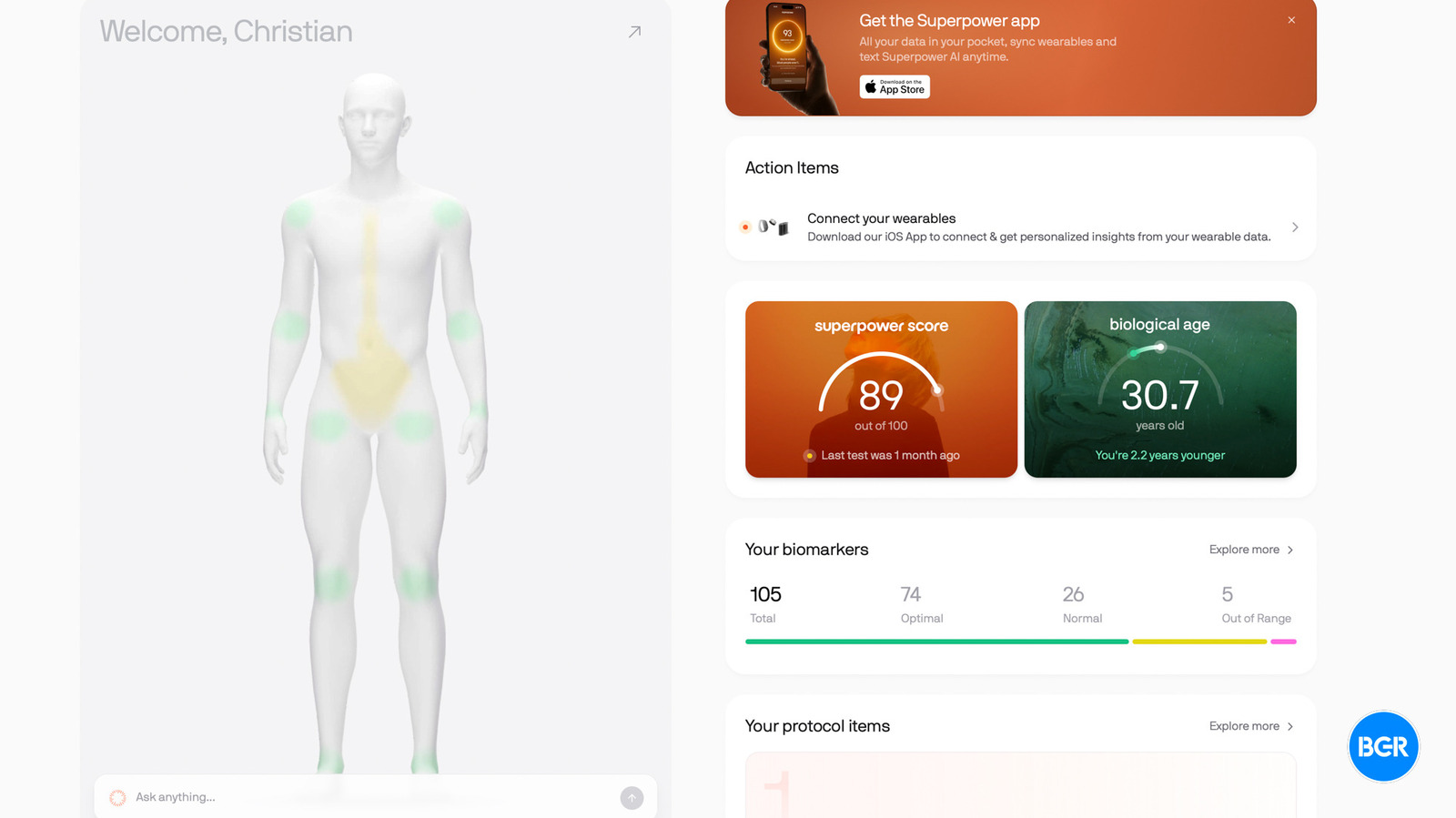
Setting aside the number of data points you’ll get after testing, the way that you’ll actually see them is on the Superpower website, the app, and through the company’s AI service. The website is well designed and easy to navigate. Once your results are available, you’ll see general results, like your “superpower score” and your “biological age.” You’ll then be able to dive into results individually and navigate different tabs for things like seeing all the data together, getting a look at your “protocol,” and buying recommended supplements and other products.
The “protocol” is essentially Superpower’s plan for your health, based on the goals you entered into the platform when you first started and the test results that were returned from the lab. I didn’t really find it to be the most useful tool, but I was a lot more interested in the lab data anyway. Also, there’s a close tie between the protocol and buying Superpower’s additional products, which put me off a little. If you do want actionable steps, you might find the protocol useful though, and not all of them revolve around selling you products. For instance, my vitamin D levels were on the lower side of normal, so my protocol involved going outside, which is indeed free.
A lot of what Superpower offers hinges around AI, for better or worse. I found it helpful, but that’s arguably because Superpower’s derived data was unhelpful in the first place. I was told I have a high “bilirubin-to-albumin ratio,” which is a metric that drew on two lab results that were said to be in “normal” range. The ratio between, however, was “high.” This, of course, was slightly concerning. Most people will see something like that and wonder what a high ratio could mean for their health.
So, I asked Superpower’s AI tool, and was told, in more words, that the ratio was high on a technicality, and that I don’t need to worry about it. In its explanation, the AI told me that the ratio “isn’t a clinically meaningful elevation — it’s a mathematical artifact of having bilirubin in the upper-optimal range rather than the lower-optimal range.”
One of two things is true here: Either the ratio should be adjusted so customers aren’t needlessly alarmed when they get their results, or the AI is wrong. Either way, that’s an issue -– and it’s Superpower’s responsibility to fix. Of course, that’s ignoring the very fact that me not knowing if the AI can be trusted is another issue. AI services perhaps simply aren’t trustworthy enough for health-related questions yet, especially when they provide conflicting information as to whether a test result is “high” or not a “clinically meaningful elevation.”
Your health in your hands
Christian de Looper/BGR
I like the idea of having more control over my health. I also recognize that it can be dangerous. Some of that starts with scores like the “Superpower score” and “biological age.” These essentially gamify health in a way that might be useful for some, but anxiety-inducing for others.
The larger problem with services like this is the fact that average people aren’t equipped to know what their test results actually mean, and the AI isn’t either. There are plenty of experts in the medical field that think that this kind of mass testing can lead to more false positives, leading to more follow-up tests, wasting time and money. For the most part, mainstream medicine actually recommends against these kinds of services for healthy adults. The fact is, if you don’t have a medical degree, you don’t understand your lab results, and with services like Superpower, there’s often no actual doctor to help you interpret them.
For the record, Superpower does have a tool to schedule a “consult” on the website, but when I went to do so, it revolved entirely around getting prescriptions, and not around discussing test results. This isn’t to say that we shouldn’t be more proactive than reactive when it comes to personal health, but, at least for now, it’s probably a good idea to make sure medical experts are in the mix when it comes to communicating with patients.
Conclusions
Medicine should be more focused on ensuring people stay healthy in the first place rather than simply testing after a problem has already arisen. More testing in general could be part of that change, but it’s still just one element, and it has to involve doctors helping patients interpret test results. Simply providing data points is not enough when the vast majority of people don’t understand what those data points mean.
Now, Superpower could be decently close to that. My experience with the service was mostly good -– I like the website design, and the testing process was very easy. But when I was seemingly inaccurately told some of my biomarkers were high, I became needlessly concerned.
If you’re an extremely level-headed person who simply wants the data, and knows results that seem off won’t concern you, Superpower might be worth considering. Just make sure you don’t rely solely on the AI service to diagnose lab results, and if you have any concerns about said results, you should get in touch with your actual doctor.
The competition
There are a few similar services to Superpower that are designed to give users access to a huge range of lab tests taken over time. Few of them are as cheap as Superpower, though. The most obvious is Function Health, but it costs $365 per year and offers 100+ markers. In this price range, a better alternative might be InsideTracker, which costs $149 per year, but is more focused on athletes. For now, Superpower is perhaps the most comprehensive option in its price range.
Should I subscribe to Superpower?
Maybe, but you should be very aware of the potential pitfalls of AI health analysis, and the fact that studies have shown that more testing in asymptomatic adults isn’t helpful.
