


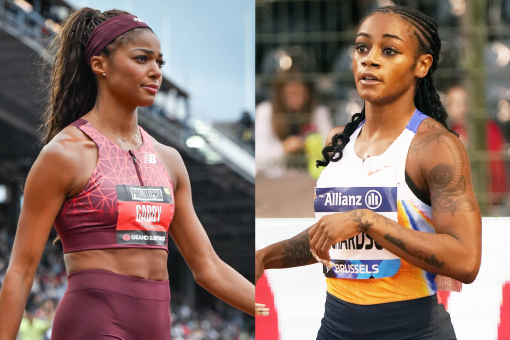
The road to the 2027 World Athletics Championships in Beijing is getting tougher for Sha’Carri Richardson, Gabby Thomas, and other top athletes. As World Athletics has tightened entry standards ahead of the qualification window opening on 23rd August 2026, only about 40 percent of athletes will qualify through direct entry marks, while the remaining 60 percent will come through world rankings. It is no longer just about one fast race. Instead, the system now rewards both speed and consistency across the season.
On 26 May, World Athletics released the updated sprint standards. In the women’s events, athletes now need 10.96 seconds in the 100m and 22.45 seconds in the 200m to qualify directly. Back in 2015, the marks were 11.33 seconds in the 100m and 23.20 seconds in the 200m.
But does this put Sha’Carri Richardson in danger? Maybe. Her personal best of 10.65 seconds in the 100m, along with her 2023 World Championship-winning form, keeps her well above the qualification level. In the 200m, her best of 21.61 seconds is also faster than the standard, even though her recent season mark sits around 22.38. This shows that the entry line is not her challenge.
However, problems can appear based on how her season looks. If she does not regularly compete in Diamond League or Continental Tour Gold meets, or if she does not finish near the top in those races, her world ranking can slowly drop. We already saw in the 2026 season that her appearances are limited.
In the Xiamen Diamond League, she ran 22.38 in the 200m and finished 4th. In the Shanghai/Keqiao Diamond League, she ran 22.42 in the 200m and again finished 4th. She was also part of the USA relay team that ran a world-leading 41.70 in 2026. These results show she is still competing at the top level, but she is not always in winning positions. In the World Athletics ranking system, that matters because points depend heavily on placement and consistency across the season.
Similarly, Gabby Thomas is also in a strong position. Her personal best of 21.60 in the 200m is world-class, and her season best of 21.89 still keeps her in the elite range. But her situation has an important background from 2025.
She suffered an Achilles tendon injury first suffered around May 2025 but worsened in July the same year, which forced her to miss the 2025 World Championships and limited her Diamond League appearances later in the season. Because of this, she had fewer chances to collect ranking points during that period. She returned to the tracks for the 2026 season after rehabilitation.
Even so, her situation can still carry pressure. If she does not race consistently in Diamond League events or if she has mixed results, her ranking position can fluctuate.
Beijing 2015 VS. Beijing 2027 World Championships qualification standard side-by-side comparison for women!
Wilddddd.😭 pic.twitter.com/ETIN7wqwle
— Track & Field Gazette (@TrackGazette) May 26, 2026
In the women’s 400m, the expected standard for 2027 is 50.00 seconds. Back in 2015, the mark stood at 52.00 seconds. Sydney McLaughlin-Levrone, with a personal best of 47.78 seconds, sits far beyond the entry requirement. However, she is currently not competing due to pregnancy, so her focus is away from racing for now, which means she is not collecting ranking points during this period, and that can still affect her position in the world rankings if the break becomes long.
The men’s sprint events face a similar tightening in standards. The expected qualification marks for 2027 are around 9.95 for the 100m, 20.07 for the 200m, and 44.45 for the 400m. Because of this, more athletes will rely on world rankings rather than entry standards.
The 2025 performances that already meet or beat these levels in 100m, 200m, and 400m are:
In the women’s 100m (10.96 standard), countries regularly represented at or above this level include the United States, Jamaica, Great Britain, Nigeria, Ireland, Côte d’Ivoire, Germany, and Canada.
In the women’s 200m (22.45 standard), the same core sprint nations appear again, with the United States and Jamaica leading. They are joined by Great Britain, Nigeria, the Bahamas, Ireland, France, Canada, Côte d’Ivoire, and Germany.
In the women’s 400m , the field becomes slightly wider. The United States, Jamaica, Great Britain, Germany, Bahamas, Canada, France, Netherlands, Poland, Spain, Italy, Czech Republic, Kenya, South Africa, and Belgium all feature athletes capable of meeting or beating this mark.
On the men’s side, the same pattern appears. In the men’s 100m, the main countries include the United States, Jamaica, Great Britain, Nigeria, Botswana, Brazil, Canada, Cote d’Ivoire, and France.
In the men’s 200m, countries such as the United States, Jamaica, Great Britain, Botswana, Nigeria, Côte d’Ivoire, Brazil, Canada, Japan, Australia, South Africa, and Seychelles appear regularly.
In the men’s 400m, the leading countries include the United States, Jamaica, Botswana, Nigeria, Great Britain, South Africa, Germany, India, Canada, the Philippines, and the Bahamas.
In the sprint events, countries that may feel more pressure include India, the Philippines, Turkey, Indonesia, Malaysia, and parts of Eastern Europe such as Ukraine and Bulgaria. These nations sometimes have athletes close to the standards, but they often rely on regional meets rather than frequent Diamond League appearances.
Even the 800m standard in the women’s event has dropped from 2:01.00 to 1:59.00, but elite athletes are already running below standard. As for consistency, Keely Hodgkinson and Athing Mu are unbeatable, but the qualification also depends on consistency. After all, they haven’t been running much.
In the 1500m, the standard has shifted from 4:06.50 to 4:02.50. The 5000m and 10,000m events show a similar pattern with standards now at 14:50.00 and 31:00.00, compared to much slower marks in 2015.
In hurdles, the shift is just as sharp. The 100m hurdles have dropped from 13.00 to 12.60, the 400m hurdles from 56.20 to 54.00, and the 3000m steeplechase from 9:44.00 to 9:06.50. In the marathon, the change is the most dramatic, with the standard falling from 2:44:00 to 2:23:20.
But this shift is not limited to tracking events. It is just as clear in field events.
Field events under pressure as qualification standards rise for 2027
In the high jump, the standard has moved from 1.94m in 2015 to 1.96m in 2027. At the top level, it’s a small change that makes a huge difference. It is only those who are truly the best that can comfortably be above it. Others, such as Nicola Olyslagers (2.04m) and Yaroslava Mahuchikh (2.10m world record), are well clear of the pack, while many will have no certainty of even qualifying on a poor day.
In pole vault, the rise from 4.50m to 4.75m has made a big gap. In the long jump, the standard has increased from 6.70m to 6.86m, and this has made the event more demanding overall. Even though Tara Davis-Woodhall and Malaika Mihambo are well above it, they still face a threat.
In the triple jump, the standard has increased from 14.20m to 14.40m. Athletes such as Leyanis Perez Hernandez, the world No. 1-ranked, and Yulimar Rojas, the world record holder, could also face threats.
This rise is even more evident in the throwing events, where strength and consistency are now more important than ever.
The shot put standard has been increased from 17.75m to 19.30m. The world No. 1-ranked thrower and consistent 20m+ thrower Chase Jackson, as well as major championship-level thrower Jessica Schilder, are all athletes to watch, but still can face a threat.
In the discus throw, the mark has increased from 61.00m to 64.50m. In the hammer throw, the standard has gone from 70.00m to 74.00m. Camryn Rogers, the world No. 1-ranked, regularly throws beyond 80m, while DeAnna Price, a former world champion and 80m+ thrower, remains a major threat when in form.
In the javelin throw, the standard has moved from 61.00m to 63.40m. Athletes like Elina Tzengko, world No. 1-ranked and a consistent 60m+ thrower, and Adriana Vilagos, one of the brightest young talents in the sport, are already competing at or above this level. Overall, the field events show the same pattern as the track events.
