


Cities are heavy. Take New York, for example. America’s most populous city has almost 1.1 million buildings weighing roughly 1.68 trillion pounds (764 billion kilograms).
New York City is sinking. But the Big Apple’s fate is not a lonely one; it has plenty of unfortunate companions. All over the world, the soil can no longer support our rapidly growing metropolises, and many are now being consumed by marshes, mines, or compacting soil.
The cities include historical sites and capitals, and most are home to millions of people. The phenomenon threatens their homes and cultural heritage alike. While most of the cities on this list might suffer serious damage to infrastructure before a solution can be found, not every case is so bleak.
In New Delhi, a grassroots movement is trying to save the city with rainwater, and the Swedish government is moving Kiruna, a city near the Arctic Circle, back to solid ground—brick by brick.
Related: 10 Modern Cities That Are Actually Built on Ancient Ruins
10 Mexico City, Mexico
Why Mexico City’s Geography SUCKS
The Mexican capital, Mexico City, is home to 22 million people. This sprawling city also covers 3,000 square miles (roughly 7,800 square kilometers) of what was once an ancient lake bed, making it one of the biggest and most densely populated urban areas on Earth.
In 2026, NASA revealed that Mexico City is also one of the fastest-sinking metropolises in the world—falling by nearly 10 inches (about 25 centimeters) a year in some areas.
After actively sinking for over a century, many of the city’s older buildings are now leaning to one side. Some important landmarks even require constant intervention. For instance, over the years, the Angel of Independence monument received 14 additional steps as the earth around the base continues to sink. Critical infrastructure, including homes, streets, the drainage system, and the water system, is also being damaged.
Like so many other cities in the same predicament, Mexico City is sinking mainly due to heavy urban development on soil that is becoming increasingly unstable from excessive groundwater removal. In other words, adding more weight on “soft” soil…and it’s no wonder that Mexico’s capital is facing a grim future.[1]
9 New Orleans, United States
Why No One Can Save New Orleans From Sinking
In 2005, Hurricane Katrina devastated New Orleans. The storm drew attention to the city’s vulnerability against the ocean, but it also exposed another problem—New Orleans is slowly sinking. Scientists cannot agree on why this is. Still, geologists have blamed groundwater removal, oil drilling, and soft soil for most of the region’s issues. But in 2006, a geologist named Roy Dokka suggested that nature, not humans, was the main culprit.
Dokka studied the Michoud area, which is free of any type of mining. Even so, it suffers one of the highest sinking rates in the south-central United States. To discover why, Dokka examined 50 years of NOAA (National Oceanic and Atmospheric Administration) surveys of the Michoud.
The surveys recorded data about a steel well that reached about 1.3 miles (2,000 meters) deep. The well showed that the area was sinking about 0.6 inches (1.5 cm) a year between 1969 and 1971, and then at a slower rate of 0.27 inches (0.7 cm) a year between 1971 and 1977.
Since all human activities, like drilling and natural land settling, occur above the well’s depth, any sinking is likely caused by tectonic movement. Supporting this theory is the fact that the Michoud sits on a 4.3-mile (7-km) deep fault. Dokka estimated that 50% to 73% of the sinking recorded by NOAA was caused by the moving crust, and the rest by draining or compacting soil.[2]
8 Chicago, United States
Chicago is sinking: Research shows heat has contributed to sinking ground in Chicago
Chicago isn’t the speediest of the sinking cities. Over the last 100 years, the Windy City has lost about 4 inches (10 cm), and over the next century, it will sink at the same rate. This sounds safe enough. But in reality, this tiny drop can interfere with the effectiveness of the city’s sewer system and increase the risk of flooding.
For now, the city cannot do anything about the steady downward movement. The problem is simply too old and big. Chicago’s fate was sealed thousands of years ago when ice sheets blanketed most of North America. Some were miles thick, and this weight warped the Earth’s crust. Around 10,000 years ago, the last of the glaciers receded. Free from the crushing weight, the crust could now bounce back, but this process isn’t instant. It can take millennia.
To understand why Chicago is not lifting into the air, one must look to Canada. Here, the ice sheet was the heaviest. When the ice disappeared, a lot of crust material flowed back into this region. Chicago is located where this material is leaving to flow back under Canada, thus sinking the city.[3]
7 Venice, Italy
Why Venice is SINKING Irreversibly
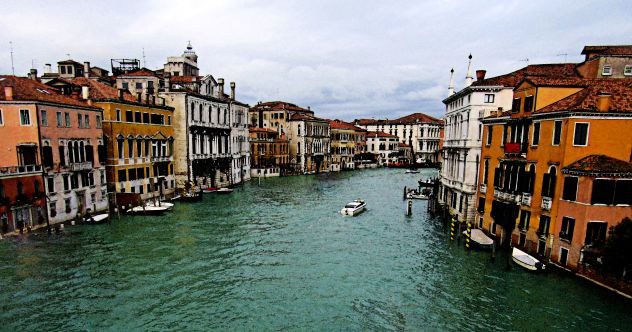
Not all sinking cities are slowly disappearing into the soil. Some drown. A famous example is Venice, a UNESCO World Heritage site located in Italy. Venice is iconic for its canals and romantic gondola rides, and, ironically, rising sea levels could threaten this city within 300 years if no solution is found.
Saving the so-called “floating city” is no small task. Rising water is not the only problem. The very land that Venice rests on is also sinking. Some options might keep the 1,600-year-old city safe from the rising sea, at least. These include ring dikes, portable barriers, closing the Venetian Lagoon, and relocating the entire city. However, these solutions aren’t perfect.
Moving every house, monument, and resident would cost €100 billion. Closing the lagoon will permanently shut down Venice’s port, and only protect the city until the year 2300, when sea levels are expected to reach 4.1 feet (1.25 meters). Ring dikes can block water up to 20 feet (6 meters) high, but they will cost billions, sever the city’s connection with the lagoon’s ecosystems, and kill the cultural vibe that tourists pay for.[4]
6 Tehran, Iran
Tehran: The Sinking Capital in the Middle of a War
The capital of Iran has a growing population that draws heavily on the groundwater beneath the city. With 15 million people needing a glass of water, and adding their own weight and buildings to the land, it’s no surprise that Tehran is sinking nearly 10 inches (25 centimeters) a year in some places. This dramatic drop is now cracking walls, deforming the land, and even causing earth fissures to appear.
Finding a solution won’t be easy. Tehran is the most densely populated city in Western Asia, so any restorative project will face complex logistics, planning, and deep pockets. Even if the capital undergoes a successful physical overhaul, it will mean nothing if the city cannot move away from its traditional water management practices.
For instance, the government must find a better alternative to Tehran’s dependence on 32,000 wells and several agricultural dams, both of which are depleting the region’s groundwater.[5]
5 New York City, United States
New York City Is Sinking Under Its Own Weight
In 2023, satellites took the first round of measurements across New York City. Over time, the same places were analyzed and compared to detect any differences in elevation. Sure enough, large parts of the city were sinking by an average of 0.06 inches (1.6 mm) per year. This is not the most dramatic shift, but given enough years, a lower New York can face serious flood risks from rising sea levels.
Two things are pulling New York down: landfills and glaciers. In the past, building over a landfill seemed smart. It hid the rubbish with something useful, like a mall. But a dump’s overworked soil is looser and not ideal to support the weight of a building. Indeed, the LaGuardia Airport runway and the Arthur Ashe Stadium were built on landfills, and both are sinking three or four times faster than the city’s average rate.
New York is also being pulled down by the ghosts of ancient glaciers. Roughly 24,000 years ago, massive ice sheets covered most of New England and Albany. The land outside the edge of the sheets was elevated (since developed), and the same region is now lowering as the Earth readjusts to a landscape without ice.[6]
4 Jakarta, Indonesia
In the past 30 years, Jakarta has fallen by 13 feet (4 meters). This is a major problem for the ten million Indonesians who live in the coastal city. Unfortunately, Jakarta was built on a marsh, and the large population is draining so much water that the city is sinking into unstable soil. If this continues unabated, Northern Jakarta could disappear under seawater by 2050.
In 2015, Indonesia announced plans to build the “Great Garuda,” a massive seawall. Adding a touch of art, the wall was designed to resemble a garuda, a bird-like mythical creature and Indonesia’s national symbol.
Jakarta’s existing seawall will first be reinforced. The Garuda will then be added to the city’s west, at a cost of $40 billion. When completed, the wall will stand 80 feet (24 meters) high and have a wingspan of 25 miles (40 kilometers). The project includes “extras,” like 17 artificial islands capable of housing hundreds of thousands of people. An eastern seawall, an airport, and a port expansion are also in the works.
Despite the noble cause and artistic flair of the Great Garuda, the wall might not solve the underlying problem. Sure, it will stand between Jakartans and the ocean, but experts believe it ignores the real reasons why the city is sinking—unchecked development, a booming population, and the mismanagement of Jakarta’s groundwater supplies.[7]
3 Beijing, China
The hidden crisis: Why China’s big cities could end up underwater
China’s capital, Beijing, is one of the most water-stressed cities in the world. Since most of the water that residents use comes from underground sources, the removal causes soil compaction, sinking the city with it.
Beijing has been experiencing compacting soil for over 80 years, but in 2016, researchers realized that the city was falling at a concerning rate. They studied information gathered by satellite photography and global sensors that tracked ground-level changes between 2003 and 2011. The data showed that some areas had lowered by over 30 inches (76 cm) during these eight years, and that Beijing’s Central Business District was sinking the fastest by 4 inches (10 cm) a year.
Since this phenomenon risks the safety of the public, buildings, and trains, China’s government has taken steps to stop the city from going under. The plans include retiring hundreds of groundwater wells and monitoring the affected areas. In 2015, China also constructed a massive 1,500-mile (2,414-kilometer) network of tunnels and canals to bring water from outside locations to Beijing.[8]
2 New Delhi, India
New Delhi residents fight to keep India’s capital from sinking
Across India, five cities are in trouble. Mumbai, New Delhi, Bengaluru, Kolkata, and Chennai are all sinking. Despite this, people still flock to these fast-growing megacities. In recent years, their combined population has risen to 83 million.
India’s capital, New Delhi, is the worst affected. According to satellite data, the city and surrounding areas are subsiding by around 4.3 inches (11 cm) per year. Over 2,200 buildings risk structural damage, and in 2025, this became increasingly obvious. An inspector found cracks in a pillar supporting a 12-story residential building near the Indira Gandhi International Airport, an area with the fastest sinking rate among the five megacities.
The problem is a familiar one: the over-consumption of groundwater. The practice is rife in low-income neighborhoods of New Delhi, where plumbing and water pipes are not always available. People must rely on other sources, like wells, to get water. But some communities, afraid that unstable foundations can lead to catastrophic damage during an earthquake, are now turning away from groundwater use. In the Dwarka area, residents are building pits that harvest rainwater, and according to some researchers, the land there has begun to show signs of recovery.[9]
1 Kiruna, Sweden
An Entire Swedish Town Is Moving Because the Ground Is Caving In
The city of Kiruna is rather unique. Located in Sweden, close to the Arctic Circle, residents live in cold and darkness for most of the year. Not many people call this place home—perhaps a small town’s worth—but Kiruna is spread over an area so massive that every person alive today can fit into it (if we all stood shoulder-to-shoulder).
The city is also rapidly sinking into the ground. Ironically, the reason for Kiruna’s existence and its destruction is the same—an iron mine. Established around 125 years ago as a small community for iron ore mining operations, Kiruna now sits on the world’s largest underground iron ore mine. But every time ore is removed, the ground moves downward and closer to a total collapse. At this rate, the mine will swallow Kiruna by 2050.
The mine’s owners, a company called Luossavaara-Kiirunavaara AB, are planning to fund the move of the entire city 2 miles (3.2 kilometers) to the east. Every house, shop, landmark, and resident. Authorities will have to work in the dark and freezing weather, but there is a silver lining. The original Kiruna has a random design, but the new city will be denser, improve the quality of life for residents, and blend urban areas with the stunning Arctic environment. If all goes well, the project will be completed by 2040.[10]
fact checked by
Darci Heikkinen
Jana earns her beans as a freelance writer and author. She wrote one book on a dare and hundreds of articles. Jana loves hunting down bizarre facts of science, nature and the human mind.
Read More:
Facebook Smashwords HubPages
