


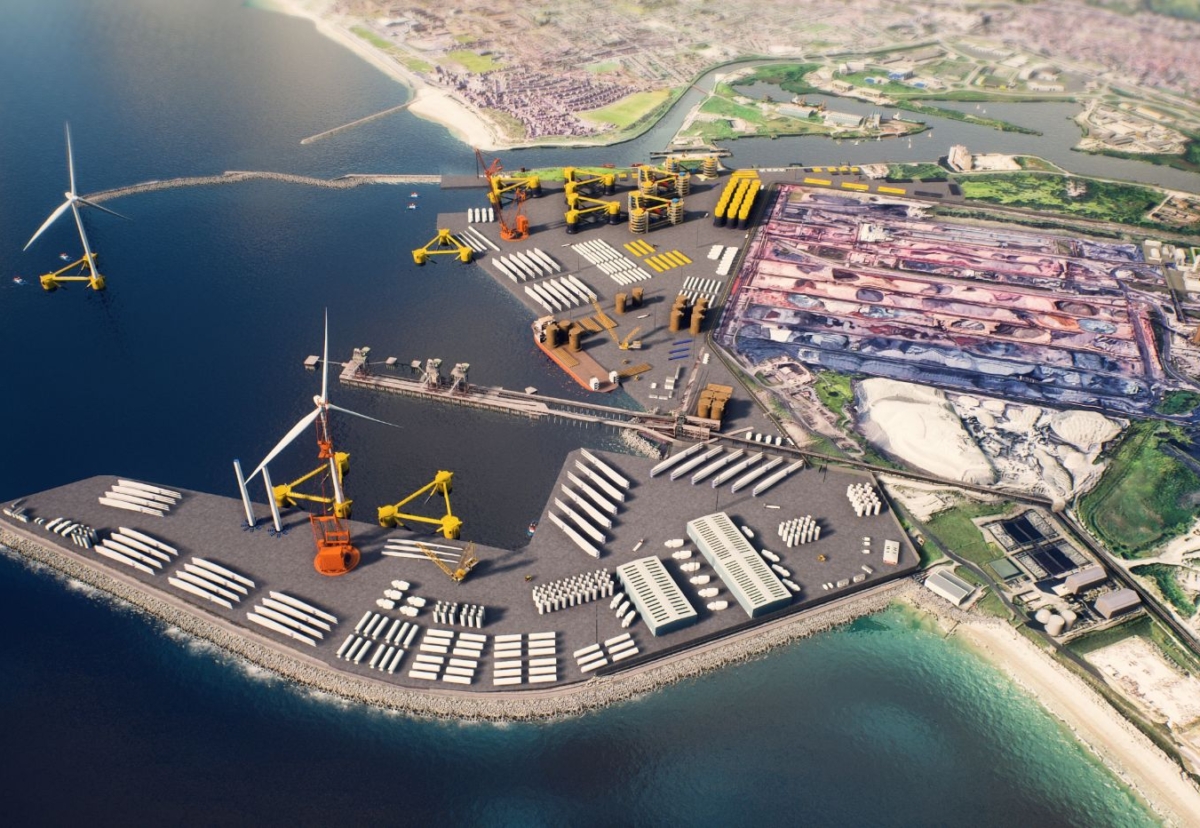
The funding deal with Associated British Ports will unlock early design, engineering and enabling works, paving the way for a full-scale redevelopment of the South Wales port into a heavy-duty assembly and marshalling hub for Celtic Sea projects.
The move signals the first real step towards building the onshore infrastructure needed to deliver gigawatt-scale floating wind, with contractors now eyeing a major pipeline of marine, civils and industrial work.

ABP has indicated the total investment at Port Talbot could exceed £500m once fully built out, covering new and strengthened quays, heavy lift infrastructure, fabrication zones and vast laydown areas capable of handling floating platforms and next-generation turbines.
Unlike fixed-bottom wind, floating schemes are still in a design race, with developers weighing up steel versus concrete platforms, different mooring systems and complex dynamic cable solutions.
That uncertainty is expected to drive demand for flexible, large-scale port infrastructure able to support multiple technologies.

Ports across South Wales and the south west of England are set to share in the build-out, but Port Talbot is being positioned as a central hub for manufacturing, assembly and deployment.
Henrik L. Pedersen, chief executive officer of ABP, said: “Agreeing terms on government support is a critical step towards further ABP investment at Port Talbot and establishing the port as a cornerstone of the Celtic Sea floating offshore wind industry.”
Energy Secretary Ed Miliband said: “With its deep waters and strong winds we are supporting Wales to storm ahead in floating offshore wind – a pioneering industry that will support thousands of good jobs, drive growth across the country and unlock the next generation of clean, homegrown power.”

The funding remains subject to subsidy control clearance, but once approved is expected to accelerate procurement of early works packages ahead of a wider contractor push.
Ambitions for Celtic Sea wind farms outstrip those built in the Thames Estuary where turbine arrays generate a combined out of 1.2Gw. The Celtic Sea is hoped to be home to large floating arrays eventually generating 4GW.


