


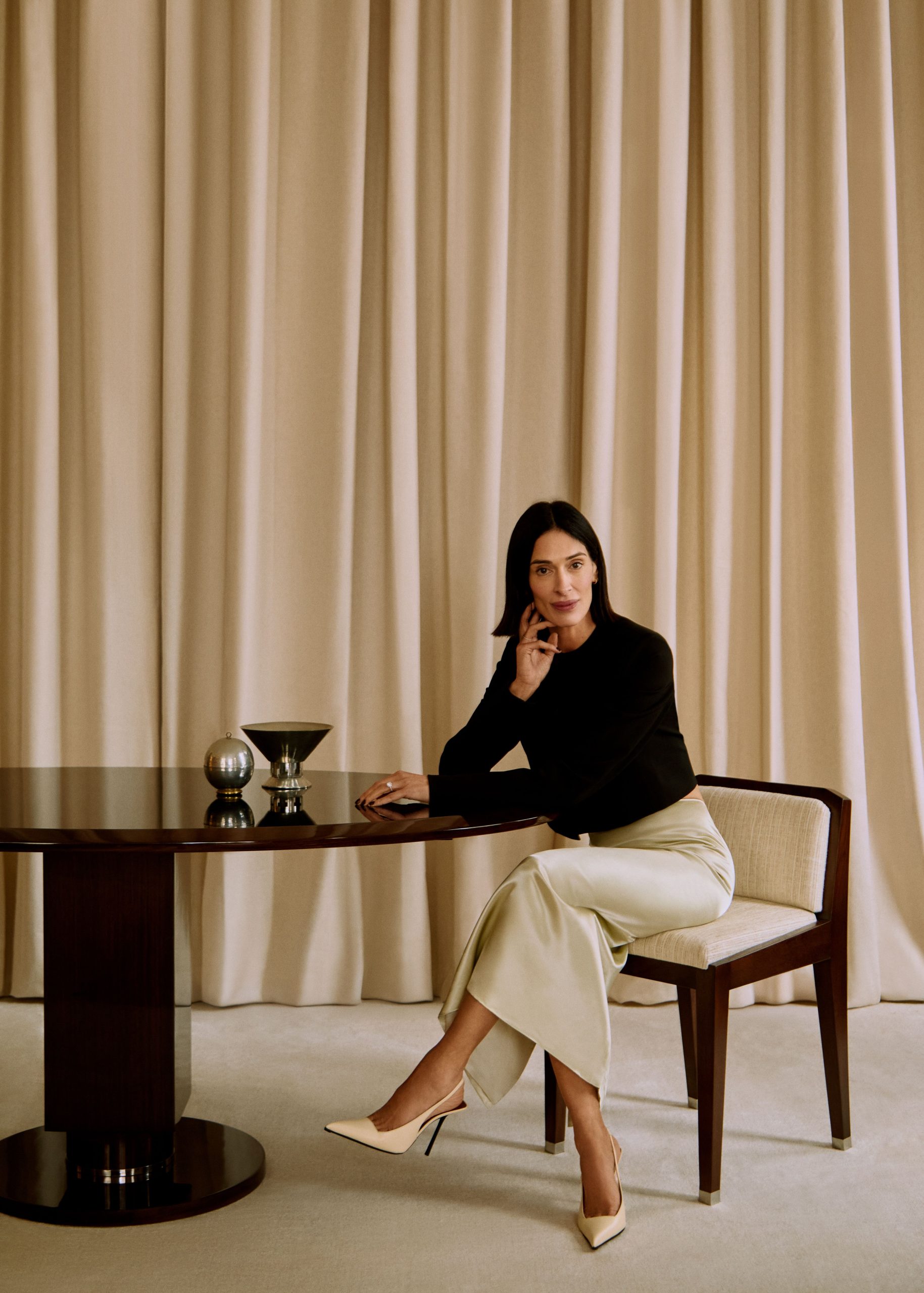
Athena Calderone has spent years operating at the intersection of fashion, food, and design, building an empire of taste through her lifestyle platform EyeSwoon—as well as two books (including the James Beard Award-winning Cook Beautiful), and an acclaimed interior design practice. (Her new Tribeca apartment graced the cover of Architectural Digest this past March.)
Now, with the debut of Studio Athena Calderone’s Assembler I—a 14-piece furniture and lighting suite unveiled exclusively at The Future Perfect, in New York—she arrives somewhere altogether new. Or rather, somewhere she has been heading all along.

Photo: Billal Taright

Photo: Billal Taright
Drawing on the lessons of French Art Deco design, Assembler I is a study in materiality and proportion. High-gloss wood, lacquer, parchment, and nickel accents sing in harmony, evoking a past that’s been fine-tuned for the present. Calderone, whose first forays into furniture design were in collaboration with Crate & Barrel, likened the process of making the collection to learning a new language. “This was the first time that my studio really owned the drawings, owned the proportions, owned the minute iterations and changes that have occurred over the past two years [of development],” she says.

Photo: Billal Taright
The pieces reward close attention. Screens and lampshades are fabricated with a vegetable-based parchment Calderone happened upon while shopping in Kyoto; a version of the material inspired Cadence, her wallpaper collection with Calico. The Courbe side table is sinuously carved, its form recalling the hand of a sculptor more than a cabinetmaker. A Prelle brocade graces the seat of a dining chair—the extent of the avowed minimalist’s introduction of color and pattern into the collection.
Together, the 14 pieces read as a coherent argument: that good design is not just decoration, but a way of thinking about how we live. “It’s never that I’m designing strictly off of aesthetics,” says Calderone, pointing out the chamfered edges on seating that allow for more ergonomic posture. “So while it looks sharp and geometric, I am always thinking about the comfort.”

Photo: Billal Taright

Photo: Billal Taright
The elegant negotiation of form and function is already something of a studio hallmark. When the lacquering process for a coffee table proved to be impractically high maintenance, Calderone and her team worked with the manufacturer to develop an inset black glass top that would be easier to clean. “When you have to feel so precious about how you live with it, it takes away the beauty,” says Calderone.

Photo: Billal Taright

Photo: Billal Taright
That marriage of poise and practicality finds its natural home at The Future Perfect, the gallery founded by David Alhadeff in 2003 that has become one of the foremost arbiters of contemporary collectible design. Funnily enough, Calderone’s installation provided an opportunity to return to the roots of the gallery’s David Chipperfield-designed townhouse in the West Village, which originally featured plaster walls that were later removed by the landlord. Kamp Studios brought the finish back, and the walls are now hung with art sourced from Calderone’s own studio as well as gallerist Amelie du Chalard’s New York City outpost, just down the block.

Photo: Billal Taright
What distinguishes Assembler I beyond its material integrity is its origin story. Calderone has spoken of her Tribeca apartment’s design process as a crucible—a space where every choice became a form of research. The collection embodies the outcome of that immersion; the work of someone who understands, through lived experience, what makes a silhouette feel necessary rather than merely decorative.

Photo: Billal Taright

Photo: Billal Taright
It’s also the first chapter in an ongoing series, which means this arrival is also, in the best possible sense, a beginning. “I have a part of my personality that never looks back,” says Calderone. “Once I close the chapter, I am done. When my townhouse was completed, I was ready for something new. I put myself in a place of discomfort because I want to see what can be born from there.”
