


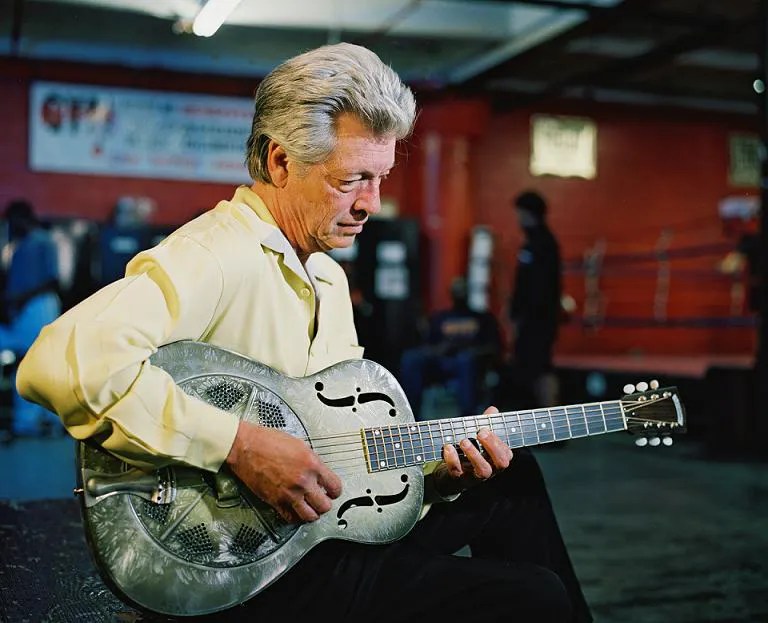
John Hammond (1942–2026) spent more than half a century bringing the blues to audiences around the world, carrying forward the country-blues tradition in his commanding solo performances. Below are excerpts from interviews that appeared in Acoustic Guitar magazine over the years.
How did you first get into the blues?
I grew up in the Village, on Macdougal Street in Manhattan, and I could hear blues on WLIB in Harlem, in the ’50s. Late at night, if the moon was bright, you’d pick up WLAC from Nashville from a good radio, for Howlin’ Wolf, Little Walter, Muddy [Waters], Sonny Boy Williamson, Lonesome Sundown. I went to the Apollo in Harlem three times a year, on blues night, where you’d see five artists for two bucks.
When I was 15 or so, I collected records, and it was around then that I first heard Jimmy Reed. I was just a fan then, but I thought he was so compelling. Probably when I was 16 in New York, I went to see him play. I had never seen anyone play harmonica and guitar at the same time. I guess a seed was sown at that point. It was inspirational. When I was 18, I got a harmonica and tried to put it together.
There were many artists that I was inspired by, from Bo Diddley to Chuck Berry and Robert Johnson to Blind Willie McTell. In my early career, when I began playing gigs, I was put on the show with a lot of the great country-blues players who were being rediscovered. Artists like Skip James, Bukka White, Fred McDowell, Roosevelt Sykes, Big Joe Williams, I could go on and on. I was on gigs with these players who were still really happening. I admired these guys so much, to be on a show with them was a thrill beyond words.
Who, among the first generation of electric blues players, were you closest to?
I knew Muddy real good, was on a lot of jobs with him, hung out, shared a lot of good times. He was a real country guitarist that played electric mostly on the top-a lot of slide. He’d always have a guitar player behind doing the chords. He used two guitarists in his last band, when he laid back a little.
As an art form itself, do you feel that there’s been an evolution to the blues, or does it need to evolve?
Blues is hard to articulate exactly. It’s a genre that if you do too much to it, or too little to it, it isn’t blues anymore. You have to capture that essence. There always will be new songs, but in terms of the style, in order for it to remain blues, it has to be within a parameter. But it demands that you give all of yourself to it.
How do you improve over the years, the decades?
Trying to be consistent every night. There are times when you’re physically tired but must mentally perk up for each show. You gotta dig down and make it happen. The only way you get good at that is by trying over and over. It’s a matter of focus, to be excited every night. Sometimes you’re naturally on; other times you gotta do your mental magic. The more audiences you play for, the better you get. It makes you bust your ass. That’s the crucible, that’s what separates a pro from, say, a guy who can play great but isn’t prepared for the heaviness of playing for an audience every night. A taskmaster. If the audience gives me half a chance, I can sail right into it.
When there’s a great audience, it just sort of brings out more in me, and brings up the level in my playing.
Having honed a sound over a career, is there advice that you’d give to young players who want to play the blues?
I tell them to listen to a lot of blues, to go back to the early recordings of the artists who started the whole thing and see how it has evolved. A lot of the early blues record- ings were with little jazz combos. Bessie Smith and other female blues artists, who had piano and trumpet and that kind of thing. The heavier stuff, I think, came from the players who encapsulated the whole thing within a solo format. I would suggest to a young artist to go with what they like and find out where it came from.
Do you ever play those guitars through any sort of amplification?
No, I just play them acoustic, because they sound so great by themselves. When you put a guitar through a pickup, I’m sorry, it doesn’t really sound acoustic anymore. It isn’t the same, raw sound.
The beauty of that is that any street corner or café can then be your stage.
That’s right! I’ve done that so many times. In the beginning of my career, of course, I was playing a lot of parties, street corners, little clubs, the “basket houses” as they called them in the Village. And you just bring your guitar—you’ve got no time to set up, you just get up there and play. When I began my career, I’d play anywhere at any time, no problem. Nowadays, I’m more picky-choosey. I do so many gigs a year that when I have off-time, I like to be off. But when you’re starting out, and you’re all about being seen and heard, you just have to go for it.
You just returned from Hong Kong. Did the audience understand the lyrics?
There’s so much passion blues that it just translates. There are people who know the music and words without speaking fluent English. You’d be amazed how many blues fans there are all over the world, familiar with the idiom.
More than in the States?
his is the home of the blues; it’s taken for granted. I would say blues is the most popular nightclub fare in the U.S. It doesn’t get the airplay, it’s not top of the pops, but when you talk nightclubs, it goes over as big as anything.
Then why aren’t there a thousand guys out there touring as solo acoustic blues acts? How come only a handful?
Well, it seems like bands get the most work. You gotta have a lot of cojones to do it solo. It’s a tougher way. A band provides a cushion to fall back on.
There are blues clubs around the country that have told me they simply don’t book solos-except for John Hammond.
[Laughs] It’s only taken me 31 years to get here.
No, it hasn’t. You were playing the Fillmore East 23 years ago. But you don’t have a road manager to act as buffer, and you have to actually deal with club owners.
Promoters and club owners tend to feel you’re as good as the crowd you draw in, the liquor sold. So even after a great set, they may say, “Ah, he sucked.”
They have the audacity to insult even you?
Oh, I’ve been insulted many times. But I’ve dealt with promoters enough to know the nature of the biz and let it roll off my back. The music can sometimes be incidental to their trip. But, You gotta go on the road to make a living, unless you have a real sweet deal as a studio musician. I love to travel and play. I believe if you’re really gonna make it, that’s the only way.
Which guitar players have had the biggest influence on your career?
Robert Johnson was my main inspiration to want to play the guitar. When I heard his stuff I said, God, that was just the synthesis of it all. But so many others, too, from Blind Willie McTell and Blind Boy Fuller, Lightning Hopkins, I could name you so many who I was so inspired by, and I wanted to be able to play something like that. Of course, the Chicago electric-blues stuff was also a major inspiration in terms of the songs and that feeling. I never thought of myself as the electric-guitar guy, but I’ve played electric over the years and I’ve worked with some amazing players—Robbie Robertson, Jimi Hendrix, Eric Clapton, Duane Allman, Michael Bloomfield.
Is there a reason you embraced the acoustic over the electric guitar?
I just felt that what I did solo was unique. I’ve always thought that the country-blues format was where it all came from and that was really important to me. That’s where I came from, and that’s where I am.
Excerpted from interviews conducted by David Knowles and Josh Alan Friedman
