



When President Donald Trump initiated strikes against Iran in late February, he did so without explicit backing from Congress, which holds the constitutional authority to declare war. Since then, members have argued over whether Mr. Trump illegally bypassed them.
Now, even some Republicans are showing unease about the length and cost of the war, just as a deadline approaches that could test Mr. Trump’s control over military action – and whether Congress has the will to push back.
Under the 1973 War Powers Resolution, the president is legally required to notify Congress within 48 hours of military action and is barred from deploying armed forces for more than 60 days without Congress’s permission. On May 1, that 60-day deadline will expire.
Why We Wrote This
A U.S. law from 1973 sets a 60-day limit for military operations that haven’t been approved by Congress. The Iran conflict is hitting that deadline. It’s the latest test of how Congress – and the president – view the war and their respective powers.
On Wednesday, tensions between the White House and Congress came into sharp relief when Defense Secretary Pete Hegseth answered questions from the House Armed Services Committee, which pressed him on the administration’s strategy and the war’s costs to taxpayers.
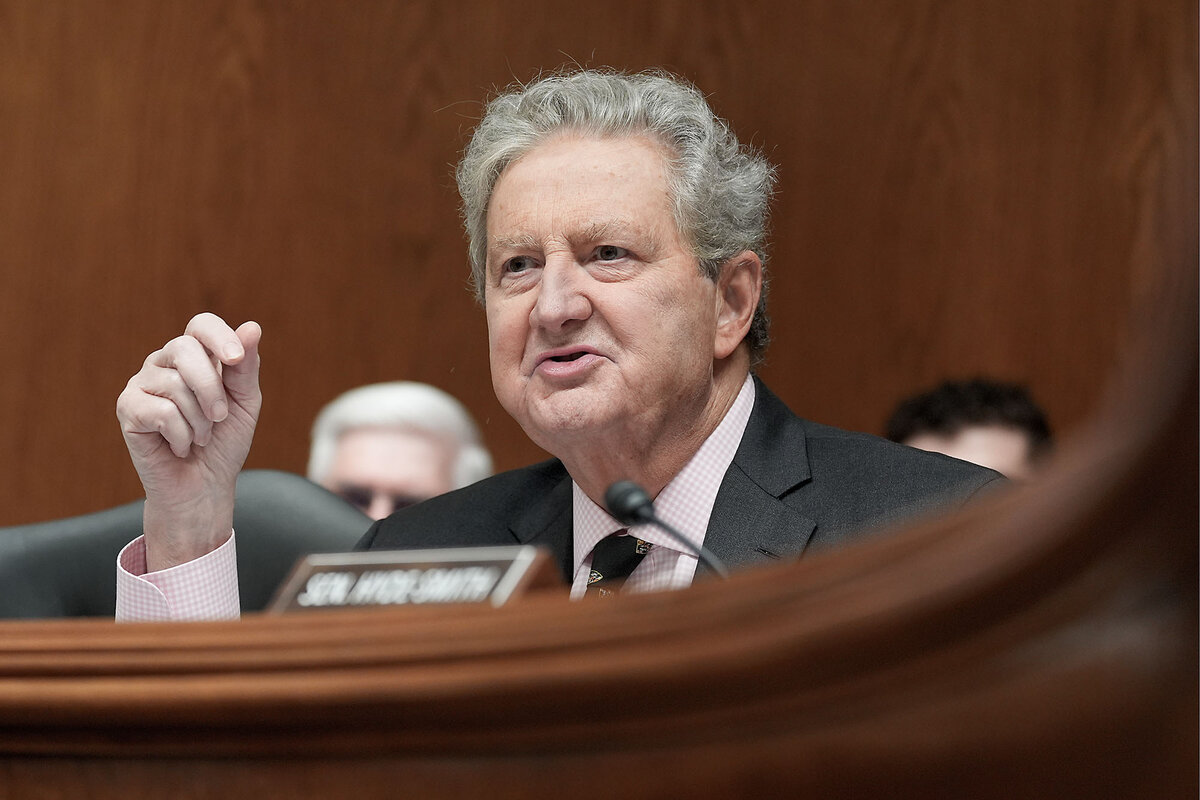
Republican Sen. John Kennedy of Louisiana says the 1973 War Powers Resolution, which stipulates that presidents must get congressional approval for military action after the first 60 days, is not a priority in Congress.
Democratic Rep. John Garamendi of California told Mr. Hegseth that the war is a “quagmire” and criticized the administration.
“You and the president have offered ever-changing reasons for this war. … The strategy has been an astounding example of incompetence,” Mr. Garamendi said.
“You call it a quagmire, handing propaganda to our enemies? Shame on you for that statement,” Mr. Hegseth responded.
Ahead of this week’s authorization deadline, Democrats have increased focus on the War Powers Resolution. They have forced weekly votes – with the help of Republicans Rand Paul of Kentucky in the Senate and Thomas Massie in the House – to require the president to withdraw armed forces absent congressional authorization. These efforts have all failed, though a recent House resolution came within two votes of passing.
Republicans in the House and Senate have broadly supported the president’s Iran strategy, though a few have expressed a desire for a faster end to the conflict. Most have not expressed urgency about the 60-day deadline.
Republican Sen. John Kennedy of Louisiana told reporters on Tuesday that the War Powers Resolution was not a priority.
“Nobody is walking around the United States Senate” – he pantomimed checking a watch – “going, ‘Oh, it’s 20 seconds till 60 days!’”
Mr. Hegseth is scheduled to appear before the Senate Armed Services Committee on Thursday, one day before the deadline’s expiration.
“More Republicans” eyeing the deadline
Under the law, a president can use a 30-day extension if there’s an “unavoidable military necessity” for extra time to withdraw forces. The president must certify the decision, in writing, to Congress.
The law also directs a president to “consult” with Congress “in every possible instance” before initiating hostilities. When the United States struck Iran on Feb. 28, Secretary of State Marco Rubio called some members to alert them immediately beforehand. Mr. Trump officially notified Congress of the strikes two days later, on March 2.
Some Republicans have since indicated that the 60-day authorization deadline matters. Republican Sen. John Curtis of Utah wrote in an op-ed this month that he would not support the war beyond that timeline without congressional approval.
“A period of 60 days is a fully sufficient window for presidents to take emergency measures in response to a national threat and then remit a decision to the duly elected representatives of the people,” he wrote in the Deseret News.
A number of Republican senators – including Susan Collins of Maine, Josh Hawley of Missouri, and Lisa Murkowski of Alaska – have indicated that, by May 1, they would either like to see action by Congress or more communication from the administration.
“I think there are more Republicans that are talking about, with the 60-day deadline, that they may consider invoking the War Powers Act,” Senator Paul, a rare and vocal GOP critic of the Iran war, said in an interview on Tuesday.

Republican Sen. Rand Paul of Kentucky talks with reporters as he arrives for a vote at the Senate chamber on Capitol Hill, March 4, 2026.
Many more Republicans aren’t taking a hard line. Several GOP senators told the Monitor on Tuesday that they would support a 30-day extension.
Moderate Republican Rep. Brian Fitzpatrick of Pennsylvania told Punchbowl News on April 23 that he respects the 60-day deadline, but thinks the clock should be stopped when there are ceasefires. A ceasefire began on April 7, though the U.S. is maintaining a naval blockade of the Strait of Hormuz.
Other members refused to say whether the president needs Congress’s permission to continue military operations in Iran beyond this week.
“There are varying opinions on that,” said GOP Rep. Buddy Carter of Georgia on Wednesday.
“That’s something we’re discussing. I don’t have a yes or no answer for you on that,” said Republican Rep. Celeste Maloy of Utah.
Meanwhile, many Democrats say the War Powers Resolution has already been violated, and that Secretary Rubio’s call to members immediately before the strikes did not fulfill the administration’s responsibility to “consult” with members of Congress.
“The war’s already illegal,” said Democratic Sen. Chris Murphy of Connecticut in an interview. “The president doesn’t have 60 days to wage war without the consent of Congress.”
War powers then and now
In 2011, President Barack Obama allowed U.S. hostilities in Libya to extend beyond the 60-day mark despite not having authorization from Congress. When Republican Speaker John Boehner wrote to Mr. Obama warning that he was running out of time on the War Powers Resolution deadline, the White House claimed U.S. support of NATO intervention in Libya was not “sustained fighting” and thus not subject to the deadline.
A bipartisan group of lawmakers filed a lawsuit at the time, accusing the president of violating the law, but a federal judge later ruled they did not have standing.
Mr. Trump might attempt to make similar arguments now, as American troops are not deployed on the ground. Tens of thousands of troops have been deployed to the Middle East as part of the conflict, and at least 13 U.S. service members have died so far.
During Wednesday’s House committee hearing, Massachusetts Rep. Seth Moulton and other Democrats focused on the potential length of the war as well as its cost. After Pentagon comptroller Jules Hurst III had said that the war had so far cost $25 billion, Mr. Moulton pressed Mr. Hegseth multiple times on how much the war would cost average taxpayers.
“I’m just asking if you know what your war cost the average American taxpayer,” said Mr. Moulton.
“What is the cost of Iran having a nuclear weapon that they wield over us?” shot back Mr. Hegseth.
Mr. Moulton said the average cost to taxpayers was $600. “I’m just wondering if they have an extra six hundred bucks lying around to pay for your war, [and that is] a question that we ought to ask.”
