


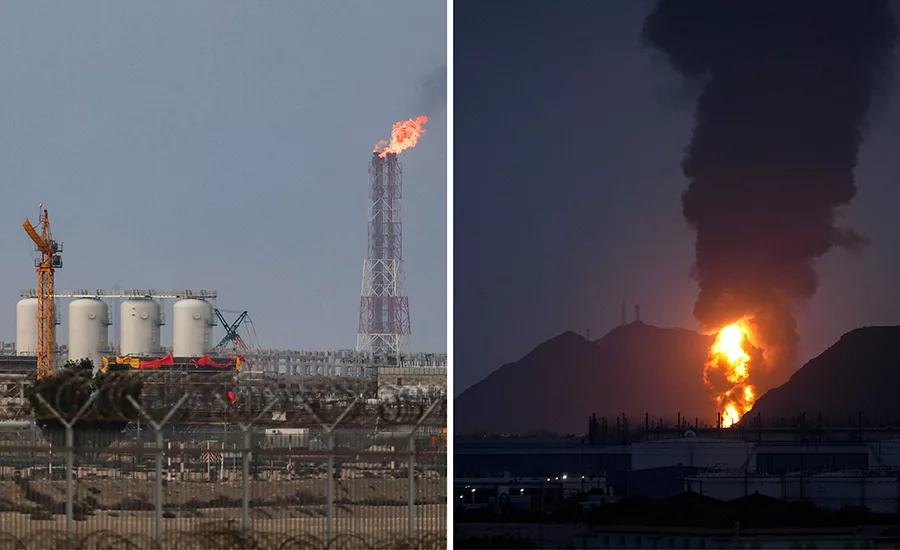
The U.S.-Israel-led war with Iran has already had global economic impacts, with oil and gas price spikes and stock markets dropping around the world on fears of supply disruptions and economic chaos. Some construction projects in the region are facing forced shutdowns and uncertain futures, with no clear path to maintaining supply chains and security.
Just over one week after airstrikes began Feb. 28, the price of both Brent crude and West Texas Intermediate oil exceeded on March 9 the $100-per-barrel price for the first time in four years with disruptions at Persian Gulf and other production facilities caused by military strikes, pre-emptive shutdowns and Iran’s effective closure of shipping through the Strait of Hormuz. The per-barrel rise continued to $120 but leveled at about $91 at ENR posting time on March 10.
“The scale and duration of a price spike will depend on how much oil is kept off the market—and for how long—due to danger in the strait, higher shipping insurance rates or damaged Gulf infrastructure,” analysts at S&P Global Energy CERA said in a note.
On March 9 in social media posts, President Donald Trump termed the price increases “short term” that will drop, while U.S. Energy Secretary Chris Wright said in a TV appearance that global energy sector disruption would last “worst case … a few weeks” and that the U.S. “has no plans to target” Iran’s oil or gas sector infrastructure.
But Vandana Hari, founder of Singapore-based market analysis firm Vanda Insights, said the “lid has come off the oil market” and “with both sides digging in, the worst may be yet to come,” according to reporting March 9 by energy online publication Upstream.
Some engineering and construction firms working in the region have noted disruptions in comments to ENR, particularly in energy projects, although they declined to specify impacts or project locations. Industry observers have speculated how a conflict lasting months will have broader impacts on other construction sectors such as transportation and building development.
Saudi Arabia’s Energy Ministry confirmed March 2 there was sustained “limited” damage at unspecified energy production sites after the interception of two drones.
Looking for quick answers on construction and engineering topics?
Try Ask ENR, our new smart AI search tool.
Ask ENR →
State-owned QatarEnergy said it was halting production of liquefied natural gas after military attacks on two facilities, including the giant Ras Laffan oil production plant. It has also declared force majeure at that site as a protection against contract obligations. About 20% of global LNG comes from Qatar.
While there are some media reports that QatarEnergy’s broad halt on LNG production also affects its gas field expansion efforts, a spokesperson for Italy-based contractor Saipem working on that project told ENR that the site is not affected by a declared force majeure, He declined to confirm whether work is proceeding on the expansion project or on those of its other region clients.
Saipem announced in February award of a $500-million contract from Saudi Aramco for work to further expand the state-owned firm’s giant Safaniyah offshore oilfield under an existing long-term agreement, online publication Upstream reported. Work involves engineering, procurement, construction and installation of a 48-in.-dia., 77-km onshore and offshore trunkline at the oilfield and other subsea structures, Saipem said. The field produces 1.3 million barrels per day.
Israel said it shut down some offshore natural gas production at two Mediterranean Sea sites, while Bahrain’s news agency confirmed Iranian drone strikes hit the country’s Al-Ma’ameer oil refinery, causing fire damage, forcing shipments to halt and also generating force majeure declaration by its national energy company Bapco Energies.
Iraq temporarily closed its Basra refinery after the country was hit by a nationwide blackout on March 4, while oil storage and bunkering activities at the United Arab Emirates port of Fujairah were suspended due to a fire caused by an intercepted drone, reported multiple media outlets. Missile and drone strikes also were reported at Dubai International Airport and at Teheran’s Mehrabad Airport, with extent of infrastructure damage unclear.
“ I do not think there’s precedent for this kind of region-wide conflict with facilities coming under attack from all kinds of methods, over a wide era, and all types of facilities at basically the same time,” said Robin Mills, CEO of Qamar Energy, an energy consultant based in Dubai in a National Public Radio report.
Supply Chain Impacts
Cargo ships are not exempt from these wartime dangers. Insurance companies have either hiked or canceled their war-risk coverage and freight rates are soaring, making the shipment of essential construction materials and equipment to the region much more costly.
Steel, special rebar grades, aluminum, heavy machinery, engineered components, and virtually all other supplies arrive by sea at ports that are now targets, including Saudi Arabia’s King Abdulaziz Port in Dammam and the Jubail commercial port.
Delays in deliveries are reportedly already forcing schedule changes in construction projects. Anything that touches the supply chain, from the Gulf states’ much touted renewable energy projects to their latest theme parks, are expecting to see escalating costs and delays, with developers already recalibrating scope and schedule.
Saudi Vision 2030—the country’s plan for a modernized, artificial intelligence-driven, renewable energy-powered future—wass already getting a rethink. Prior to the war on Iran, Saudi Arabia’s NEOM project—a huge, futurist city planned on the Red Sea coast—was under reviewed for a reduction in scope. NEOM includes Oxagon, a partly floating industrial city; Trojena, a mountain tourism resort geared toward luxury and The Line, a planned 170-km strip of ultra-modern city, 200 meters wide and 500 meters tall.
The UAE has halted plans to expand its aviation hubs of Dubai International Airport and Zayed International Airport, both of which have suffered damage from Iranian drones. The expansion project at Jebel Airport has also been suspended. The Emirates’ railway company, Etihad Rail, could also face trouble with its planned expansion with connections to Saudi Arabia and Oman, as well as plans to begin a high-speed rail project.
Water Infrastructure Also Targeted
Water desalination plants in Iran and Bahrain also have suffered damage in recent days as the war threatens civilian infrastructure. A U.S. airstrike on an Iranian plant in early March prompted Iran to direct drones at Bahrain where falling debris struck a producton site at an undisclosed location, the country’s Ministry of Interior confirmed on March 8.
The ministry said water and electricity supply had not been interrupted, but that several Bahrainis were injured during the attack. The targeted plant is likely the Al Hidd water and power supply
facility in Muharraq on the northeastern side of the island. Bahrain’s largest, the plant
was built in three phases and began operation in 1999, able to produce 90 million imperial gallons
per day. Alstom, Sidem and Suez were involved in its
construction. Bahrain’s desalination plants have total capacity of about 240 MIGD.
The country’s government has accused Iran of random attacks on civilian infrastructure, with drones also hitting hotels, ports and residential towers on the island, with one fatality.
Iran’s Foreign Minister Abbas Araghchi said U.S. missiles from the US Fifth Fleet naval base in Bahrain had struck and severely damaged a desalination plant located on Qeshm Island in the Strait of Hormuz. He said the attack resulted in a cut in water supply to the island and 30 nearby villages. The iIsland has no natural freshwater sources. “The US set this precedent, not Iran,” he said.
Iran also launched attacks on UAE desalination plants but causing minimal damage to key facilities at Jebel Ali Port in Dubai, where there are 40 desalination units that produce about 490 million imperial gallon per day, and Fujairah, which is outside the Strait of Hormuz. The attacks are seen as a warning from Iran to the UAE to force a halt to Iran attacks by US forces from UAE territory.
Bahrain and the other Arab Gulf states rely on desalinated water to meet domestic needs, making desalination plants strategic targets. About 90% of Bahrain’s municipal water supply is desalinated. Iran historically relies on dams and wells, with only about 5% of its water demand from desalinated supply. But in recent years it has begun to build those facilities along its Gulf coast and ship water inland to desert regions.
Across Gulf Cooperation Council countries, desalination makes up nearly all supply in Qatar, about 90% in Kuwait, 86% in Oman and 70% in Saudi Arabia, say regional water studies cited in wire reporting.
The incidents have drawn attention to how Gulf cities obtain drinking water. Across the region, desalination provides most municipal water supply, with most production concentrated in a small number of massive coastal plants that distribute treated seawater through long transmission networks. More than 90% of desalinated water in the Persian Gulf region is produced by just 56 facilities, the Associated Press said.
Facilities at that scale supply water far beyond the needs of individual cities. Saudi Arabia’s Ras Al-Khair power and desalination complex, one of the largest such facilities ever built, produces about 1.03 million cubic meters of desalinated water per day, enough to supply drinking water for about 3.5 million people, according to Saudi government statistics. Water from the plant travels hundreds of miles through pipelines to Riyadh and other inland cities.
Historically, many Gulf desalination plants were built as cogeneration facilities that produced electricity and desalinated water simultaneously. Utilities favored the approach because thermal desalination systems—such as multi-stage flash distillation—can use heat from power plants to evaporate seawater, lowering operating costs but tightly coupling water production to energy infrastructure.
That design means that power infrastructure disruptions can quickly cascade into water supply problems. Desalination plants are among the largest electricity consumers in many Gulf power systems. Newer projects are shifting to seawater reverse-osmosis systems, which require less energy and can operate independently from power-generation facilities. Governments have also expanded safeguards designed to protect supply during disruptions. Saudi Arabia’s national water strategy increased strategic water storage capacity from about 1.35 days of urban demand in 2018 to 2.7 days by 2024, say government reports.
Industry Firms Share Few Details
Global engineering and construction firms working in the region who responded to ENR queries noted project disruptions in the region, but did not elaborate.
‘At this time, impacts to McDermott [International] operations are isolated. While we have taken precautionary measures in parts of the Middle East, McDermott’s global operations continue to function,” said a company statement provided to ENR. “Fabrication assets in the [conflict] region have been temporarily closed, and crew disembarked from quayside marine assets. The safety of our people remains our top priority.”
A company spokeswoman declined to confirm if force majeure steps have been taken at its jobsites. “This is a fluid situation,” she said. “We are working closely with our customers to assess and mitigate potential impacts and ensure safe operations.”
A spokesperson for Worley did not confirm if its projects in the region had suffered damage or were shut down, saying only that the contractor “is closely monitoring developments in the Middle East” and that it “continues to work with customers to manage any potential risks or disruptions in line with established protocols.” A Bechtel spokeswoman said only that the firm has “assisted colleagues in relocating from the UAE to safer locations.”
UK-based engineer-builder Wood, which had announced in December it had secured more than $1 billion in regional contracts, also declined response on the status of its facility operations or project construction.A spokesperson said that “the safety and wellbeing of our people is our absolute
priority,” and that the firm is “monitoring the situation closely.”
Its announced awards include an EPCM contract, set to generate $400 million in revenue, to expand the Habshan gas processing plant in Abu Dhabi for UAE state owned national energy company ADNOC, and projcct management awards at the West Qurna 1 oilfield in southern Iraq and on UAE’s first methanol production facility in Al Ruwais Industrial City in Abu Dhabi.
A spokesman for heavy contractor Keller did not confirm comments reported by British industry publication Building that several of its jobs in UAE and Bahrain have been paused, although not in Saudi Arabia. The firm has about 500 employees in those three countries, Building noted.
Keller CEO James Wroath, who assumed the role last year, told analysts on a March 3 investor call that its business in the Middle East accounts for about 5% of its global revenue and profit contribution. “We’re hoping the political and military situation calms down and allows us to get back to work,” he said.
