


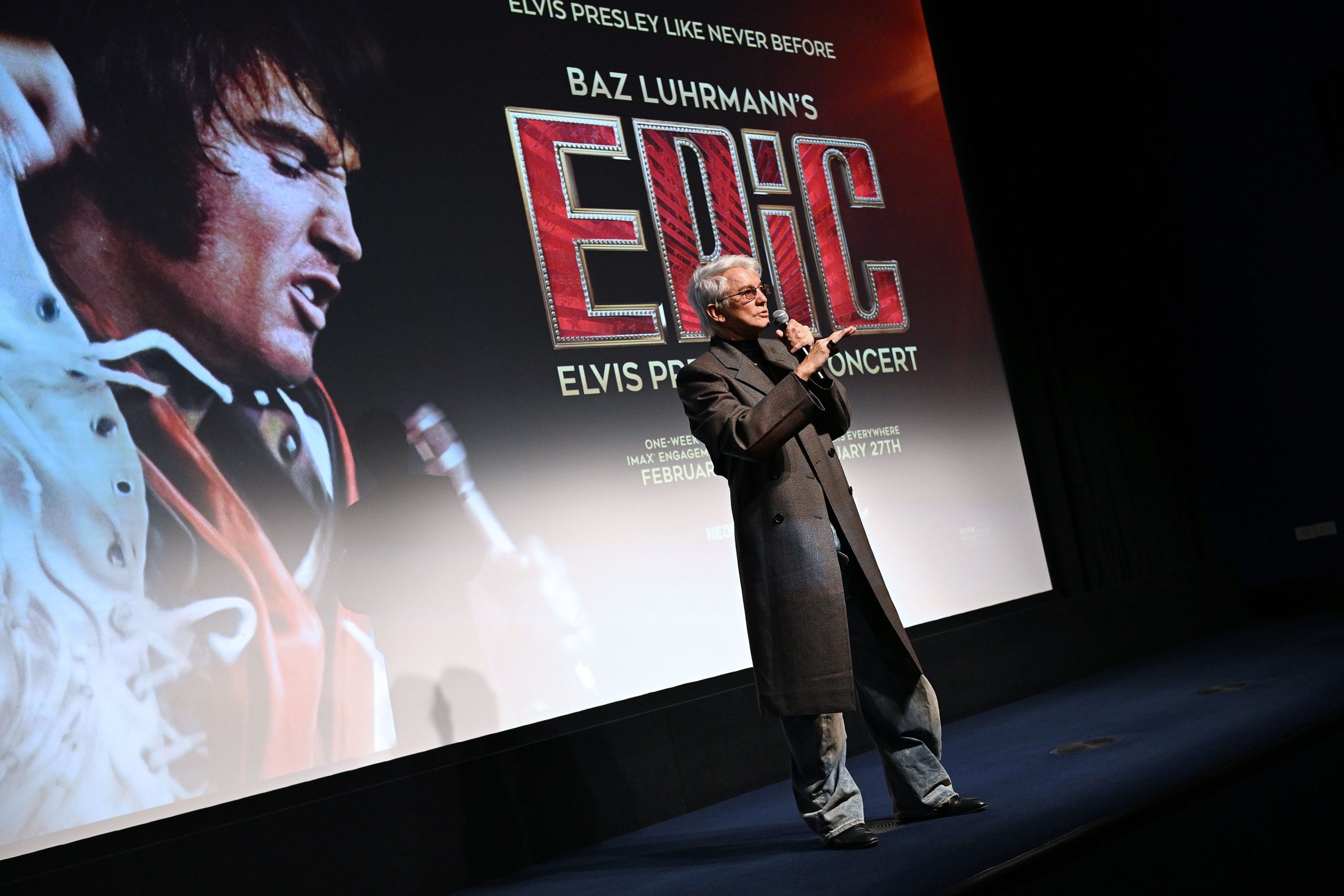
“You didn’t think I’d make it, did ya? I didn’t think so either,” the real life Elvis Presley mumbles on a Las Vegas stage in Baz Luhrmann’s documentary EPiC: Elvis Presley in Concert.
To be fair, the same could be said for the 50 or so stylish New Yorkers that showed up to Luhrmann and Vanity Fair’s screening of the new concert film at The Crosby Street Hotel. The day before, a once-in-nearly-a-decade blizzard had brought New York to an icy halt.
And late that night, even more snow was in the forecast. But against all odds, the cozy private theater was full with names that included Adrien Brody, Derek Blasberg, and Vanity Fair global editorial director Mark Guiducci. (Or maybe the odds were never bad in the first place: Luhrmann, after all, is the auteur behind Elvis, which landed Austin Butler his first Oscar nomination. EPiC is a continuation of Luhrmann’s critically acclaimed exploration into the legacy of arguably the 20th century’s greatest performers.)

Georgina Chapman, Baz Luhrmann, and Adrien Brody.
Kristina Bumphrey

Cynthia Rowley and Derek Blasberg at Baz Luhrmann and Vanity Fair‘s screening of EPiC.
Kristina Bumphrey
EPiC isn’t your typical documentary. There are no talking heads, and no real narrative structure to speak of. Archival footage of Elvis throughout the fifties, sixties, and seventies artfully and energetically blended to his music, both overlaid and diegetic. Although sometimes it’s not technically a soundtrack: Luhrmann runs clips of Elvis on stage performing for minutes straight, a choice that makes it feel almost live to the viewer.
Most of the film focuses on the King’s 1969 to 1976 residency at the International Hotel in Las Vegas, in which he played 636 sold-out shows. It changed the very fabric of Vegas itself, ushering out the Rat-Pack era and paving the way for the showy spectacles we’ve come to associate with Sin City. (Although in a cultural easter egg, Luhrmann includes footage of Sammy Davis Jr. watching Elvis perform.)
Despite the financial and cultural success, the Vegas residency wasn’t Elvis’s prime: he’s no longer the toned, muscular twentysomething whose gyrations were viewed as so obscene by puritanical 1950s culture that Ed Sullivan ordered him to be filmed from the waist up, or whose crazed fandom inspired the musical Bye Bye Birdie.

Talia Ryder, Baz Luhrmann, and Jacob Madden.
Kristina Bumphrey

Baz Luhrmann and Lexi Wood.
Kristina Bumphrey
In fact, he’s kind of washed up. By 1966, Elvis had begun a slow descent into prescription drug addiction. He died several months after the residency ended. In Lester Bangs’s obituary of Elvis for The Village Voice—one of the most famous pieces of music criticism ever published—Bang writes about breaking the news to a butcher shop counterman that the King has died.

Mark GuiducciKristina Bumphrey
“You know what? I don’t care that bastard’s dead. I took my wife to see him in Vegas in ’73, we paid $14 a ticket, and he came out and sang for 20 minutes. Then he fell down. Then he stood up and sang a couple more songs, then he fell down again,” Bang recalls the counterman telling him about Elvis. “Finally he said, ‘Well, shit, I might as well sit singing as standing.’ So he squatted on the stage and asked the band what song they wanted to do next, but before they could answer he was complaining about the lights. ‘They’re too bright,’ he says. ‘They hurt my eyes. Put ’em out or I don’t sing a note.’ So they do. So me and my wife are sitting in total blackness listening to this guy sing songs we knew and loved, and I ain’t just talking about his old goddamn songs, but he totally butchered all of ’em. Fuck him. I’m not saying I’m glad he’s dead, but I know one thing: I got taken when I went to see Elvis Presley.”

Alexandra Richards and guest.
Kristina Bumphrey
Luhrmann’s film doesn’t quite square with Bangs’s counterman source there. After the screening, he tells Vanity Fair that Elvis at this point of his life was completely co-opted by his questionable manager, Colonel Tom Parker, who only let him tour in America and sometimes made him play up to three times a day.
Parker had him in Las Vegas, playing nightly, for close to a decade. “He’s fatter, he loses his spirit. He’s deteriorating, that’s what you’re seeing. Imagine wanting to tour overseas and doing that for seven years?” Luhrmann says. “But Clive Davis told me to this day he still has never been to an opening night as great as that Vegas show was.”
Indeed, while some moments of the film show Elvis sweating, sluggish, and struggling to get through his set, others show his once-in-a-lifetime performing prowess, like when he belts out Simon and Garfunkel’s “Bridge over Troubled Water.” For those of us who weren’t alive when Elvis was, it feels like an a-ha moment: where you finally get why the generations of the past were obsessed with the guy. (As well as the artists of the present: there is no Mick Jagger or Harry Styles without Elvis.) Oh, and his costumes? Bejeweled and amazing. “Elvis didn’t have a stylist,” Luhrmann notes. His stage costumes felt like a forebear for Alessandro Michele’s Gucci, with its flamboyant colors and ornamentation. And, frankly, they probably were the reference.

Amy Fine Collins and guest.
Kristina Bumphrey
Why, after the success of his dramatized Elvis film, did Luhrmann decide to do another? Part of it was the richness of source material—in a speech to the crowd, he describes going to the MGM archive and discovering 67 boxes of negatives. Another part of it was, well, artistic duty. At one moment in the documentary, Elvis, blue eyes wide, tells the crowd that one of his life wishes is to perform in New York or Britain. He never got to do so in his lifetime. “We’re giving Elvis the world tour he dreamed but never had,” Luhrmann says, gesturing around the crowd at The Crosby. Indeed, EPiC opens worldwide on February 27, bringing The King and his rich baritone to the global masses. Who knows, maybe it’ll start a new wave of Elvis fervor too.