


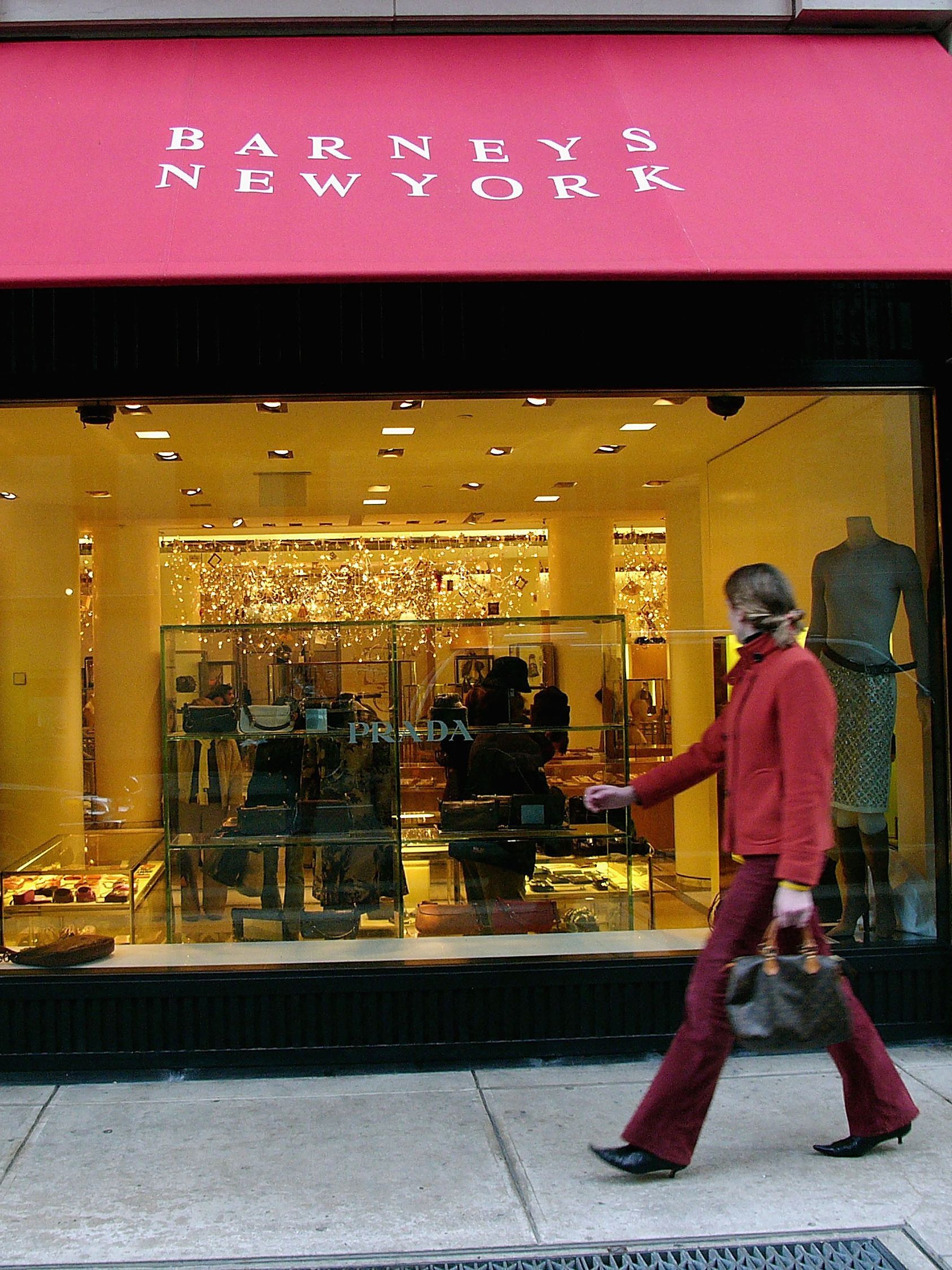
When Plum Sykes was a fashion writer at Vogue in the 90s, she’d spend all of her Saturdays at Barneys. “We’d book a table at [Barneys’s restaurant] Freds, where we’d have these amazing chopped Cobb salads, and just sit and run into all our friends like we were in a private club, because that’s where everyone went on a Saturday lunchtime.”
Afterwards, she’d peruse the racks of Yohji Yamamoto, Dries Van Noten and Helmut Lang, some of the brands that Barneys had brought over to the US. “They always had the newest, coolest designers,” Sykes remembers.
This was the magic of Barneys, says Gene Pressman, former co-CEO, creative director, and head of merchandising and marketing for Barneys, whose grandfather founded the company and who last year published his memoir, They All Came to Barneys. “Barneys was about dreams and it really was a club,” he says.
Earlier this week, outlets reported that, according to sources, Authentic Brands Group, which acquired Barneys’s intellectual property for about $271 million in 2019, is planning to revive the flagship location on Madison Avenue. Authentic is reportedly also considering opening smaller Barneys concept stores in other parts of the US. Authentic did not respond to a request for comment.
Authentic, which also owns brands including Juicy Couture, Vince and Hervé Léger, is known for its brand licensing chops. Since the Barneys acquisition, Authentic has established a partnership with Laox Holdings for locations and outlet stores in Japan, opened Barneys New York Residences in Tulum, Mexico, and licensed the Barneys name out to Saks for a shop-in-shop. But that license expired when Saks Global filed for bankruptcy.
Two years ago, Authentic confirmed that there were no plans to open the original Barneys flagship. Now, plans may well have changed — but should Barneys really attempt to come back?
There’s no denying that nostalgia for the ultimate fashion insider’s store is as strong in 2026 as it was when the fashion-favorite store shuttered back in 2020. “Barneys has left an enormous void in the retail landscape and people do miss it. They miss the exclusive brands, the sense of discovery. And it also had very much a social element; it was the place to be seen,” says luxury consultant Robert Burke.
But can a revamped Barneys fill its own void? Neither Pressman nor those who loved Barneys in its heyday rule it out. But they all have big reservations. “The essence could be brought back. Could it be made cool again? Yes,” Pressman says. “But it would come in a different iteration. The fashion industry is a lot different now. Who is going to create [the magic?] Now people just want to sell products.”

Robert Pressman and Gene Pressman outside Barneys in 1994.
Photo: Getty Images
Bringing Barneys back as people remember it can’t simply be a business transaction, says fashion consultant Julie Gilhart, who was SVP, fashion director at Barneys for 18 years. “Barneys started out of a love and a passion for retail, and for people and talent. That was the secret sauce,” she says. “The business followed that.”
The key to getting a relaunched Barneys right would be balancing the fond nostalgia so rife within the fashion industry, with a focus on creating something novel for the modern retail scene. “With the 90s nostalgia at its peak after Love Story, it feels like a great time to revive Barneys — as long as they don’t dilute or cheapen the original vision,” says Malcolm Carfrae, founder of Carfrae Consulting and Calvin Klein’s former chief communications officer. “It needs to be relevant for now, not a copy of what worked decades ago.”
Gilhart agrees. She’s not confident that the ‘old’ Barneys can ever return, but does believe that there are lessons to be learned from the store’s approach to business. “If you put the right partners together, you could probably come up with a Barneys-esque store — but you would have to have real, true merchants and retailers that have their finger on the pulse, are willing to take risks and aren’t looking at how their neighbors did it,” she says. “If they wanted to do something fun and inspiring, that would create business.”
Money matters
The number one factor that would determine Barneys’s success in 2026 is investment, Pressman says. “Whoever is financing this [must be] willing to infuse enough capital to make it happen. There’s no cutting corners,” he says.
Though Authentic has said it would look at opening smaller Barneys concept stores, Pressman is strong in his conviction that, if it’s going to operate large stores, Barneys should only exist in two places: New York and Los Angeles. (It can — and should — have an internet presence, he adds.)
Burke is also dubious about Authentic’s reported plans to open Barneys in its original location. “It would be compared to the original Barneys, which was built over decades,” he says. Instead, Burke would like to see Barneys open in stages, starting smaller to better execute its curation.
After all, Barneys’s most important investment will be in its merchandise. Here, the store must lift from its pre-2000s playbook and focus on young, emerging designers. “It’s about energy, belief, commitment and working with young designers — but it needs capital,” Pressman says. Taking the time — and the risk — to seek out and invest in unknown talent is a tall order in 2026, when margins are thin and each dollar must be spent wisely. It’s also the only way to stand out.
“You don’t want another rack of Chloé, another rack of LVMH [brands],” Sykes says. “They’ve got to go out there and find the cool, smaller brands that get people excited because they haven’t seen them on every single person they know.”
Back in the day, the Barneys team was also fiercely competitive, says Burke, who worked at competitor Bergdorf Goodman at the time. “The demands of exclusivity by Barneys were very important to them, and they would get behind the brands and support them,” he says. This would be even more competitive in 2026, as independent boutiques are better able to discover and enlist early-stage brands, and bigger legacy players like Bloomingdale’s and Nordstrom lean further into emerging designers, earlier on — once again, requiring a bigger investment from Barneys.
People moves
Experts put stock in the fact that Barneys was a family business, and question whether a capital group or investment fund could ever match that level of care and curation. “These corporations need to hire the right people to find the good stuff — not everyone has a fabulous eye,” says Sykes. “People can be a bit cheap on that stuff now,” she says.
Ultimately, to discover and enlist the brands that make the shop, the people at the top need to know what they’re looking for. Barneys must be run by a merchant, Pressman says: “Not an accountant, not a politician, not a department store or wholesale executive”.

Lady Gaga at the opening of her Barneys workshop in 2011.
Photo: Getty Images
Sykes describes Pressman as a “fashion-crazed” businessman, and attributes Pressman’s taste and knack for newness for Barneys’s success. Pressman believes there are very few people who could feasibly make Barneys happen now. He hints strongly that a successful Barneys would require his involvement. “I’m very expensive,” he says. “Whether it’s me or somebody else, it’s not getting done unless those people really, really live it, love it, and are true merchants with great taste.”
But Pressman also emphasizes the importance of curating a team, made up of both experienced professionals and new, young people. “I could assemble very talented people that would follow,” he says.
A clubhouse for the future
Barneys of yore, Pressman says, was in the entertainment business. A new Barneys would need to take this up a notch. “Things are so dour, there’s no sense of humor. That was one of the great things that Barneys had, was a wonderful sense of humor,” the ex-CEO says.
In 2026, as AI tools proliferate and tech accelerates, retailers are gung-ho on personalization, intent on responding to consumers’ every need. This won’t work, Pressman says. “I used to have an expression: never give the customer what they want because they don’t know what they want. You have to show them.” In an era where discovery is hard and consumers are fatigued, an authoritative — but fun — space to showcase new fashion could fill a void.
Sykes, who repeatedly likens Barneys to a private club, believes people want an experience beyond the racks when they shop. “Barneys did that way before the word experiential shopping existed,” she says. Freds, the restaurant, was at the epicenter. Carfrae recalls having all of his lunch meetings there 10 years ago when he worked in PR at Ralph Lauren, before founding his own agency. “It was fashion and social central — always more my vibe than the other power media lunch spots,” he says. Feed Me’s Emily Sundberg is holding out for a new liquor license filing for Freds (the last one expired in 2021).
If Barneys could pull off a comeback — successful only under a very specific set of circumstances — could Authentic be the backer to pull it off? Pressman is evasive. “If they supplied the money, gave the freedom to be creative, didn’t second guess and had the right person at the helm, yes, I think there would be a chance,” he says.
What the company can’t do, Pressman insists, is simply slap a name on a door. “If, in fact, ABG is legitimate in this, the new Barneys can’t be the old Barneys.”
More from this author:
Coachella’s Big Brand Renaissance
