


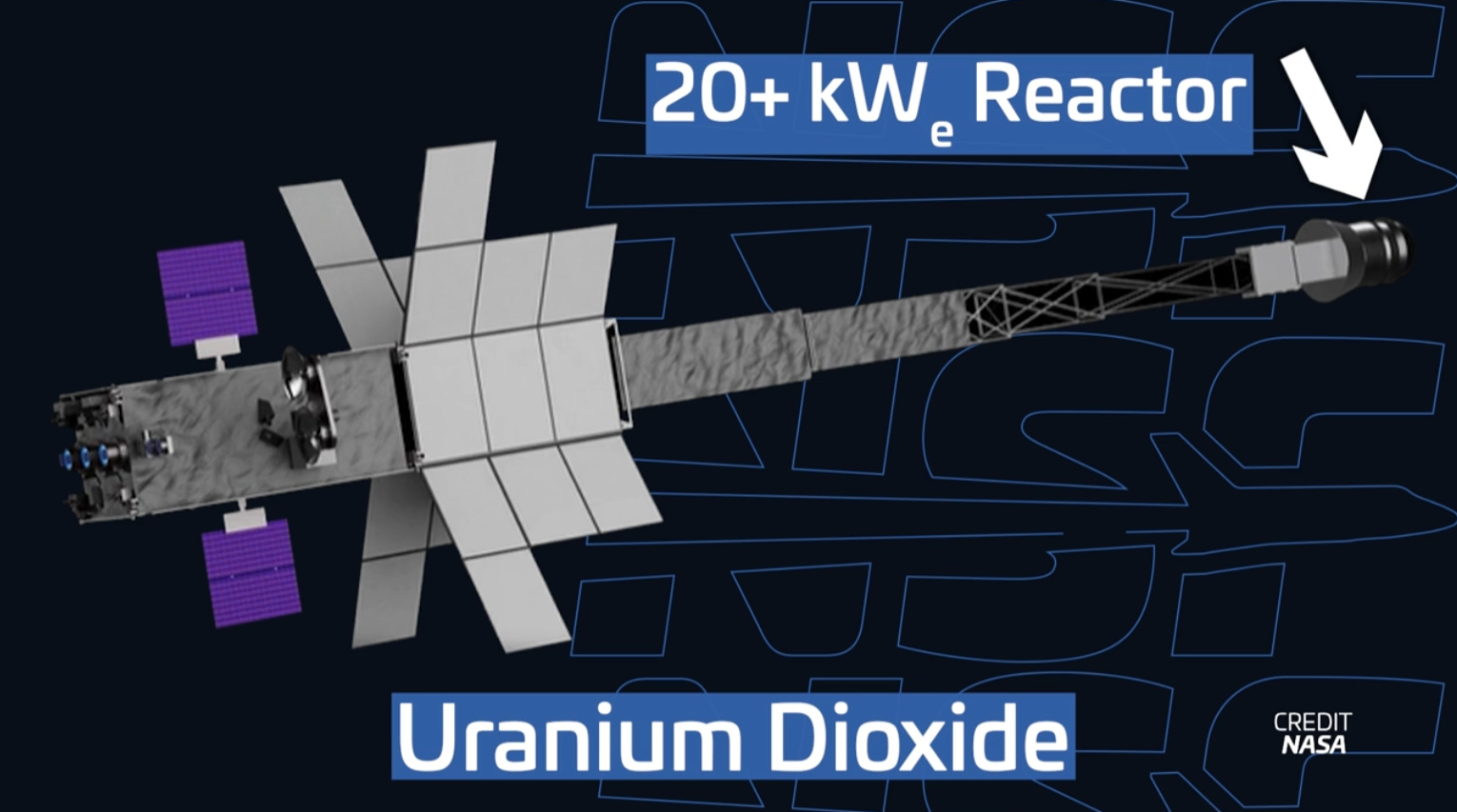
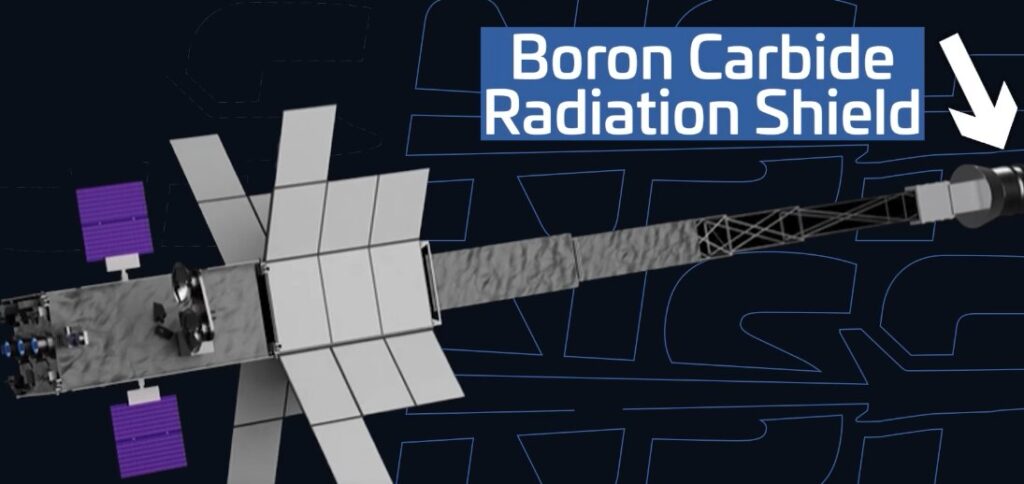
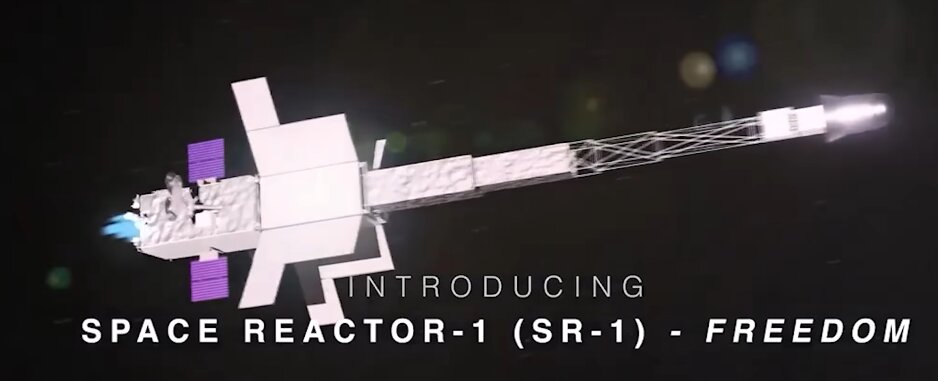
The NASA planned 2028 nuclear powered ion drive spacecraft, SR-1 Freedom will have a 20 kilowatt nuclear reactor. SR-1 Freedom will use 20-plus kilowatt fission reactor fueled by High-Assay Low-Enriched Uranium and Uranium Dioxide, encased in a Boron Carbide Radiation Shield. This will power a xenon ion drive. Previous nuclear spacecraft designs involved more powerful direct usage of nuclear to achieve propulsion. Those there nuclear thermal to achieve 2-4 times the temperature and thrust speed or nuclear electric direct drives.
The most powerful flown gridded xenon ion engine is NASA’s NEXT (NASA Evolutionary Xenon Thruster) at 6.9 kW producing up to 237 mN of thrust (Isp ~4,170 s). It has flown on DART and is the current state-of-the-art operational gridded ion engine. SR-1 Freedom would be about three ties as powerful.
Higher-power examples like HiPEP reached the 25 kW class in brief ground tests but were even less mature than NEXIS.
If we include Hall-effect thrusters — which are also xenon plasma/ion engines and are often called ion thrusters in popular/NASA descriptions — the record is the X3 Hall thruster at 102 kW / 5.4 N in ground tests. AEPS, the 12–13 kW Hall thruster, is currently the most powerful flight-qualified xenon electric propulsion system.
SR-1 Freedom (Space Reactor-1 Freedom) and the 20 kW nuclear reactor
SR-1 Freedom is NASA’s planned 2028 Mars demonstration mission (first nuclear-electric propulsion interplanetary spacecraft). It repurposes the already-built and tested Power and Propulsion Element (PPE) from the cancelled Lunar Gateway.
The PPE carries: 3 × AEPS Hall thrusters (~12–13 kW each)
4 × Busek 6 kW Hall thrusters
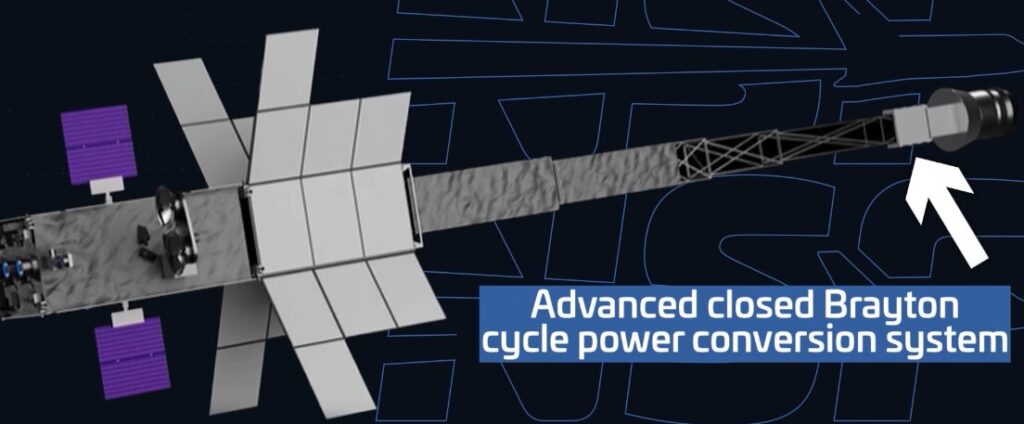
Originally solar-powered, it is now being paired with a new over 20 kW fission reactor (closed Brayton cycle, HALEU fuel) to provide constant electrical power to the thrusters.
Power comparison
SR-1 Freedom’s propulsion system gets a steady ~20 kW (reactor-limited) — roughly 3× the power of a single NEXT engine and equal to or slightly higher than the highest previously tested gridded ion engine (NEXIS).
Unlike solar-powered ion systems (which lose power as you move away from the Sun), the nuclear reactor delivers full power anywhere in the solar system.
Thrust comparison (approximate, at full reactor power)
Hall thrusters like AEPS are more thrust-dense than gridded ion engines.
With ~20 kW available Expected total thrust ≈ 0.8–1.2 N (800–1,200 mN), depending on how many thrusters are run and at what throttle.
For reference: a single NEXT produces only 237 mN at 6.9 kW.
The SR-1 system therefore provides roughly 4× more thrust than the previous most powerful flown gridded ion engine (NEXT) while also running at full power indefinitely in deep space.
The 20 kW nuclear reactor does not create a single ultra-high-power super engine. It enables a mature, already-built multi-thruster Hall system to operate at its design power level far from the Sun. This is a huge leap in capability (continuous high thrust + no solar-distance penalty) even if the per-engine power is comparable to the best ground-tested ion engines of the past. It makes deep-space missions dramatically faster and more capable than anything flown before.

Brian Wang is a Futurist Thought Leader and a popular Science blogger with 1 million readers per month. His blog Nextbigfuture.com is ranked #1 Science News Blog. It covers many disruptive technology and trends including Space, Robotics, Artificial Intelligence, Medicine, Anti-aging Biotechnology, and Nanotechnology.
Known for identifying cutting edge technologies, he is currently a Co-Founder of a startup and fundraiser for high potential early-stage companies. He is the Head of Research for Allocations for deep technology investments and an Angel Investor at Space Angels.
A frequent speaker at corporations, he has been a TEDx speaker, a Singularity University speaker and guest at numerous interviews for radio and podcasts. He is open to public speaking and advising engagements.
