


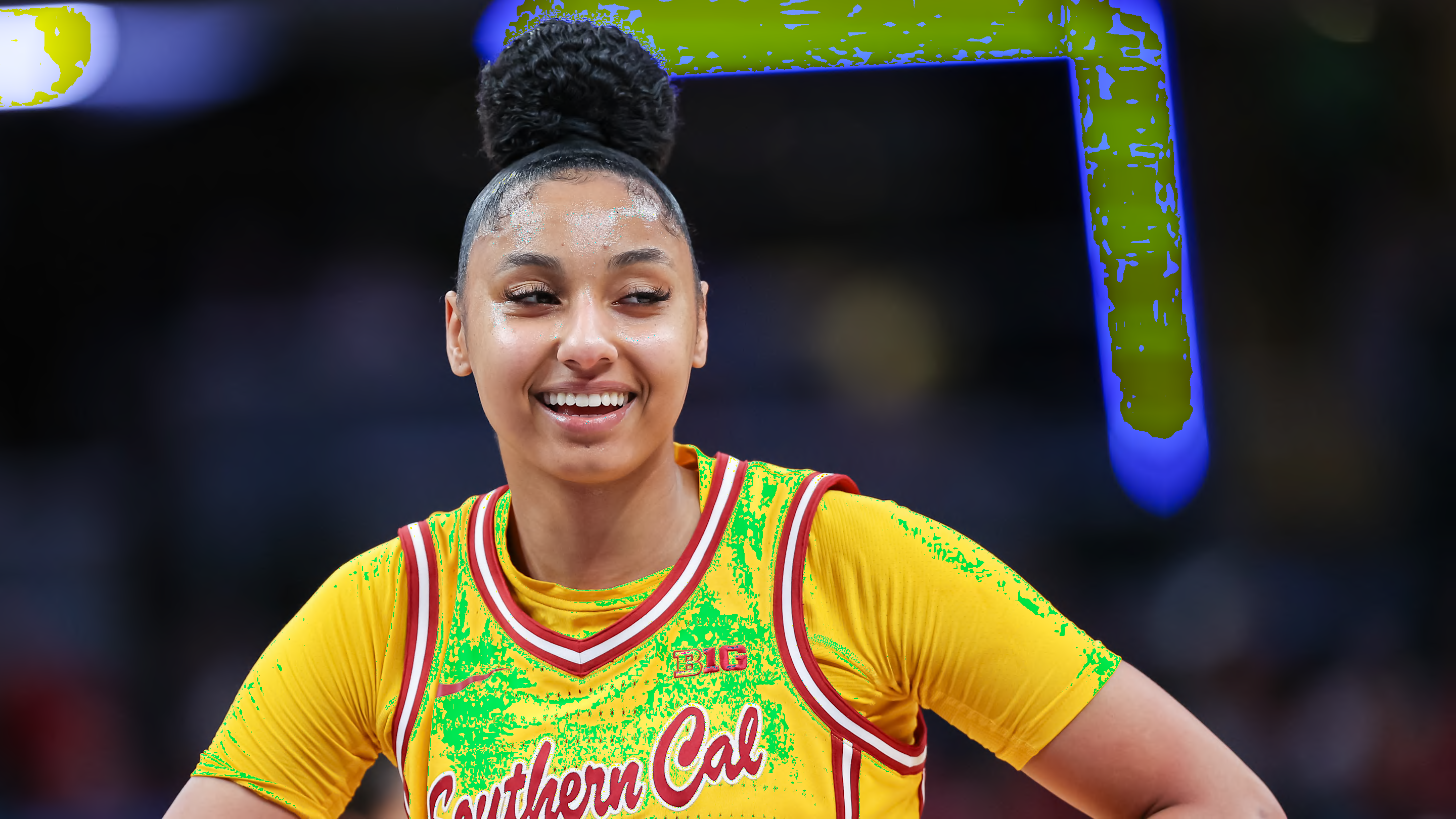
With the 2026 WNBA Draft now behind us, it’s time to look ahead to 2027. And unlike this year’s draft, next season has a superstar player who is already locked into the No. 1 overall slot: USC guard JuJu Watkins. Despite missing the 2025-26 season with injury, she is still viewed as the consensus No. 1 in the 2027 WNBA Draft.
But behind Watkins, there are a number of good players jockeying for position. From the best pure small forward prospect in a few years to a high-upside center whose defensive game is full of serious question marks, 2027 might be one of the most compelling draft classes in recent seasons.
1. G JuJu Watkins, USC
While Watkins could choose to stay in school for another season after a medical redshirt year this past season, the new WNBA CBA probably gives her ample reason to declare for next year’s draft.
Watkins has played two full college seasons, finishing in the top three in scoring both years. She’s a dual threat, capable of creating her own shot on the offensive end while playing lockdown defense on the other side. I have some concerns about her efficiency, but she won’t be asked to shoulder so much of a load in the pro game, so I’d expect the efficiency concerns to be lessened.
2. F Madison Booker, Texas
If your only exposure to Madison Booker was her nightmare performance in the Final Four, then you don’t understand how good of a basketball player she is. Booker is a versatile forward who can score from anywhere, though the lack of 3-point volume from the Texas offense means we don’t really know her full potential as a shooter from long range.
One other thing that works in Booker’s favor as far as draft stock goes is the relative dearth of small forwards in recent classes. The last pure three to go in the top-five was Rickea Jackson in 2024, and I’d argue that the position is among the shallowest in the league, as a number of players who could be elite threes are playing at the four. Booker can give a team a nice positional advantage.
3. G Hannah Hidalgo, Notre Dame
Hannah Hidalgo proved she could lead a team this year, leading the Irish to the Elite Eight while leading all Division I players in the following stats: field goals made, field goals attempted and steals.
Hidalgo is one of the best perimeter defenders we’ve seen in recent seasons and while her steal rate may not fully translate, she should be a top on-ball defender. As far as concerns go, she’s undersized and struggles with her jump shot, which makes her a hard player to project. WNBA teams will hope to see improvement from deep and midrange in her final collegiate season.
4. G S’Mya Nichols, Kansas
In an era of player movement, S’Mya Nichols deserves credit for sticking with the Kansas Jayhawks, even if it’s led to her going under the radar with the casual fan.
I don’t think she’s under the radar for WNBA front offices, though. Nichols can score at every level and is very effective at drawing fouls, making her a great lead guard prospect at the next level. She’s shot at least 38 percent from 3-point range in each of her collegiate seasons.
5. C Clara Strack, Kentucky
It will be interesting to see what teams think of the 6-foot-5 Clara Strack. She’s an elite shot blocker and shot 54 percent inside the arc this past season with Kentucky, plus she has the ability to step out and shoot from deep, though her efficiency there hasn’t caught up to her volume yet.
I think the big question here is if Strack can rein in her issues with fouls and turnovers, as well as if she’s ever able to actually shoot well from 3-point range. If she keeps shooting sub-30 percent from there at the expense of working on her inside game, that could hurt her overall projection.
6. G/F Mikaylah Williams, LSU
Mikaylah Williams is my pick to make a massive leap up the draft board during her final collegiate season. I could definitely see her landing as high as No. 2 overall with a strong season for the Tigers.
Williams can score efficiently from all over the floor, possesses the ability to create her own shot and has seen her assist numbers rise each season. She can play the two or the three for a pro team. Defensive concerns could keep her off the court in crunch time, but I think the worst-case scenario for her offense is that she’s a high-level 3-point shooter with enough creation skills to be a secondary ball-handler.
7. G Talaysia Cooper, Ole Miss
The first 2026-27 transfer player on this list is Talaysia Cooper, who is transferring to Ole Miss after two seasons at Tennessee, part of a major exodus this offseason from the Volunteers program. The Rebels should give her a great chance to shine.
Cooper needs to improve her effiency, but she’s appealing because of her athleticism and defensive ability. I’d contend that as the league gets larger and larger with expansion, players like Cooper who rely on athleticism will become more and more useful, as they’ll start to gain an advantage in one-on-one situations.
8. F Ashlyn Watkins, South Carolina
Ashlyn Watkins tore her ACL in January, so the first order of business for her will be showing she’s healthy and hasn’t lost anything from the injury.
The 6-foot-3 big excels defensively, providing rim protection but also offering an ability to defend outside the paint as well. She can score effectively in the paint and has shown some ability to step outside the paint, though in the WNBA she’ll likely just play a lot of five.
9. G MiLaysia Fulwiley, LSU
MiLaysia Fulwiley seems like the player most likely to suffer a 2026 Ta’Niya Latson-style fall into the second round, which is an interesting comparison since it was Latson who replaced Fulwiley’s role at South Carolina.
Fulwiley is an extremely athletic guard who might be the best pure ball-handler in this class. She also happens to be a very inconsistent player who struggles with her jumper, so it’s really not clear how she’ll translate to the pro game.
10. G Oluchi Okananwa, Maryland
I think a common theme of next year’s draft class is that there are a lot of very athletic guards who should translate defensively but who also have serious questions about their jump shooting. Oluchi Okananwa is another addition to that list.
The Maryland guard is a nightmare to defend in transition, but her ability to score outside of the paint is a very big concern at this point, especially considering her 3-point percentage has dropped each season.
11. G Tessa Johnson, South Carolina
South Carolina’s most reliable 3-point shooter, Tessa Johnson has knocked down over 42 percent of her looks from deep in each of her seasons, and she shot a career-high 44.8 percent this past season despite almost doubling her attempts. She’s one of the best off-ball shooters in the nation.
But how will teams value off-ball shooters next season? This year, we saw Azzi Fudd go first overall, but the other elite off-ball shooter, Gianna Kneepkens, fell to No. 15 overall. Johnson will need to prove she can do other things as well this season, and it would help if she can show she can create her own shot this season.
12. F Chloe Kitts, South Carolina
I don’t think there’s a single player in this draft class whose stock depends more on how she plays next season than South Carolina forward Chloe Kitts, who missed all of last season with an ACL tear. Now she not only needs to answer pre-existing questions about her game but also has to prove she can come back healthy.
At her best, Kitts does a lot of things very well. She’s not a high-volume player, but she can score at the rim when needed, shooting 52 percent from the floor in the 2024-25 season. She passes the ball well for a big and provides some solid defense, though her rim protection could use a bit of an improvement.
13. C Audi Crooks, Transfer Portal
Now we come to who might be the most polarizing prospect in this class: former Iowa State center Audi Crooks, who just averaged 25.8 points per game on 64.9 percent shooting. Offensively, she’s a rare player, with the size and skill to get to her spot and score with ease.
Two issues, though. Her offensive game is almost entirely reliant on post ups, which isn’t great when it comes to transitioning to the pro game, where you’d like more versatility out of your bigs. That might be excusable, though, since she’s so good at posting up, but what’s inexcusable at this point is her struggles on defense. Crooks often finds herself out of position on that end of the floor and right now would be a liability for a WNBA team. She has to show improvement next season.
14. F Addy Brown, Transfer Portal
Crooks’ former Iowa State teammate Addy Brown has the issue of being a bit of a tweener, but she’s also a valuable glue player who I think would excel in a situation where she was the fourth or fifth option on the floor.
She’ll need to improve her scoring efficiency, especially from outside, but Brown does all the little things well and is especially intriguing as a passer. She’s the kind of player who really benefits from expansion, as there’s more room for players of her archetype to make an impact.
15. F Khamil Pierre, NC State
Khamil Pierre saw her numbers dip after transferring from Vanderbilt to NC State, but that dip was accompanied by a very encouraging rise in efficiency, as she shot a career-high 52.5 percent from the floor.
Pierre’s lack of any semblance of an outside game mixed with turnover issues make her a tough player to project, especially in a league where her best positition is the four and fours have been doing more and more on the outside. Still, she’s worth a late first-round bet because of her athleticism and the improvement we saw last year.
More WNBA news and analysis:
 Add us as a preferred source on Google
